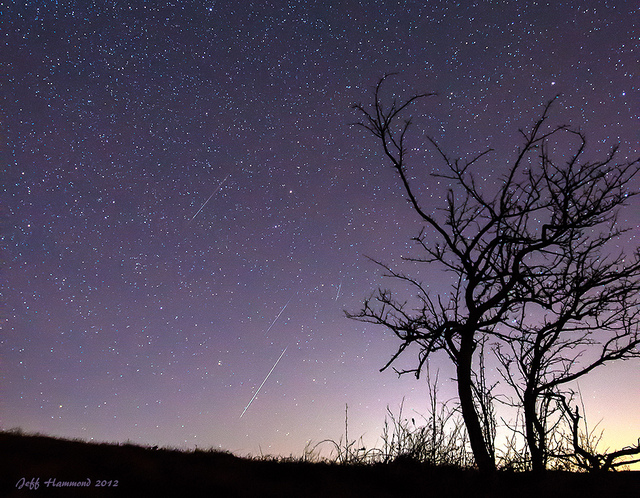
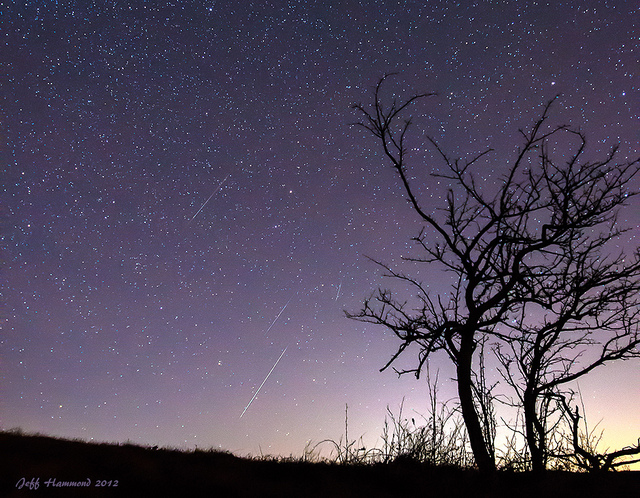
 A Perseid shower years ago (Photo by Jeff Hammond/Flickr Creative Commons)
Tonight is the first of two nights that you can see an especially vibrant meteor show put on by the Perseids.
Every year at this time we pass through the debris field of the comet Swift-Tuttle (named after two astronomers that happen to be buried in Falls Church). As tiny bits of debris enter the Earth’s atmosphere, they flame out in bright streaks. They’re called Perseids since they seem to be emanating from the constellation Perseus.
This year, thanks to Jupiter’s gravity, we’re plowing right through the center of that field instead of grazing its edges. The last time it was this intense was 2009. Bill Cooke, who works out of NASA’s Meteoroid Environments Office, said you could see double the rate of meteors, perhaps up to 200 meteors per hour.
Of course, you’ll only see that many if you’re far away from the bright city lights of D.C. that can drown out the celestial show. You’ll want to get far away from the red-hot center of light pollution, which you can see on this map. As we said last year, the best places are typically state parks and beaches. Shenandoah or Chincoteague, for instance, are good options. The Washington Post rates each of the different areas to watch meteors outside the city.
NASA says that the best time to see the shower is between midnight and the dawn of August 12. Lie on your back and look straight up. It could take about 45 minutes for your eyes to fully adjust to the dark.
If you can’t get out of town or it ends up being too cloudy, you can visit NASA’s site for a live Ustream both tonight and tomorrow starting at 10 p.m.