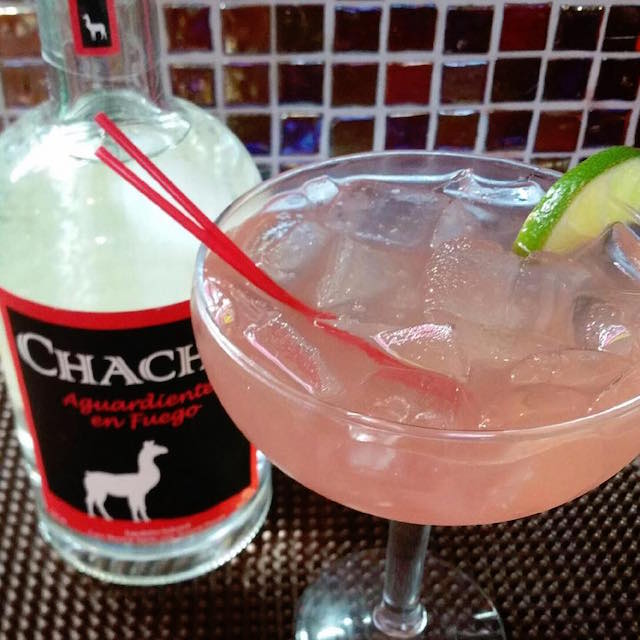
 Chacho watermelon margarita at Banana Cafe in Eastern Market (Photo courtesy of Chacho/Facebook)
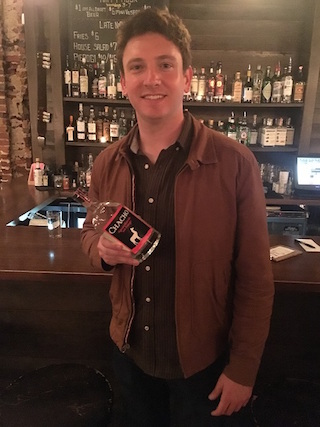 Dan Ziegler (Photo by Josh Novikoff/DCist)
On a trip to Colombia, Washingtonian Dan Ziegler developed a taste for the national spirit aguardiente. The fermented and distilled alcoholic beverage comes from one of several raw plant materials. Sugarcane is the most common across South America: a variation on the liquor is cachaça in Brazil. In Colombia, the juice is flavored with anise just as ouzo is in Greece, sambuca in Italy, and arak in the Middle East. Ziegler’s innovation was to spike the liquor with a spicy jalapeño flavor instead of the licorice-like notes that anise gives clear spirits around the world.
The liquor Ziegler created Chacho is named after the animal he rode while on a bender during that initial visit to Bogotá.
“I just came up with a product I really liked and thought others would enjoy,” Ziegler tells me on a Chacho cocktail tour we took through Eckington and H Street NE. “So I worked like crazy to figure out how to get it in front of people.”
To bring the jalapeño-infused aguardiente to market, Ziegler has taken a different tack than the mounting number of small distilleries blooming in Ivy City. He has aguardiente imported for him from South America to a commercial outfit in Iowa. There the hooch is steeped with pepper to transform into aguardiente en fuego, bottled, then shipped exclusively to the D.C. market. Here Ziegler has been working for years to launch the product, while keeping a day job in finance.
On its own, Chacho has a sweetness from the sugarcane along with a spicy kick from the pepper. In Colombia, aguardiente is imbibed neat, sipped, or shot. But here in the land of craft cocktails, Ziegler has encouraged local bars to feature it on their cocktail menus. At H Street Country Club, the sweet spirit with a kick works well in place of tequila in the El Luchador, a cocktail that features lime juice and cilantro. It comes up twice on Pub & the People’s cocktail menu, fitting well into a pisco punch alongside aperol, lemon, lime, and pineapple. Chacho’s use in their special brunch Bloody Mary, on the other hand, laces the tomato-based concoction with a nice spiciness, though the sweetness from the sugarcane can be off-putting.
You can also try it at the Eastern Market in a watermelon margarita at Banana Cafe. The Tryst serves it in La Maritza, along with tequila, Cocchi Americano, lime and orange juice. And El Rey serves it in a fruity highball called a Playa Roya with ginger ale, cranberry, grapefruit along with tequila reposado.
Chacho is small outfit, and on top of his day job, Ziegler is handling everything from marketing to delivery.
“It can be really tough to balance,” says Ziegler of his moonlighting gig. “Although some people certainly prefer to stick just to the big companies, I’ve found that a lot of people in the industry really respect and appreciate that I’m just out there hustling and trying to do my own thing, so it has definitely helped me out in a lot of ways.”
Chacho can be found at dozens of Washington bars and restaurants and the 750ml bottles with a llama on the label are available at a handful of local liquor stores. It’s coming soon to Chicago.
Editor’s note: a previous version of this story said pisco is also a sugarcane-based liquor, but it is in fact a grape-based spirit.