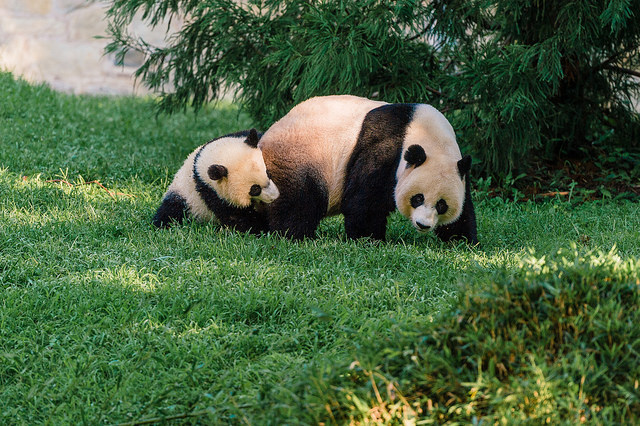
 Courtesy of the Smithsonian National Zoo
There’s good news for a certain group of black and white animals at the Smithsonian National Zoo. After groups have spent decades campaigning for their livelihood, giant pandas are no longer endangered, according to the International Union for Conservation of Nature—the world’s largest environmental network.
The IUCN announced on Sunday that the species is now listed as vulnerable.
In the wild, the giant panda population has risen by 17 percent between 2003 and 2013, according to National Geographic. In 2014, a census report found that 1,850 giant pandas are living the wild in China. That’s an increase from the last census report, which counted 1,600 giant pandas in 2003.
Native to the mountains of China, the Chinese government has been trying to save the species for decades. The pandas’ population has grown due to “effective forest protection and reforestation,” according to the IUCN.
China banned trading panda skins in 1981, and enacted the Wildlife Protection Law in 1988, which banned poaching and gave the pandas’ the highest protected status, CNN reported. The creation of a panda reserve system in 1992 increased available habitats, which are up to 67 reserves in China today. In addition, the country has partnered with international organizations and zoos to conduct research, and spread conservation and breeding efforts.
The first giant pandas arrived in D.C. in 1972, according to the Smithsonian National Zoo. The zoo’s Asia Trail is currently home to Tian Tian, Mei Xiang, Bao Bao, and Bei Bei, three of whom celebrated birthdays last month. Last November, the zoo signed an agreement for pandas to stick around until at least 2020.
But giant pandas aren’t out of the woods yet. Climate change is expected to ruin more than 35 percent of their bamboo habitat in the next 80 years, which will cause a decline and basically eliminate decades of effort, according to the IUCN.
To protect the iconic species, officials must continue to protect the bears’ habitat, as well as address emerging threats, according to the IUCN. Additionally, the Chinese government’s plan to expand existing conservation policy for the species “is a positive step and must be strongly supported to ensure its effective implementation.”