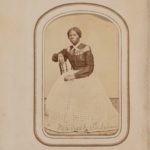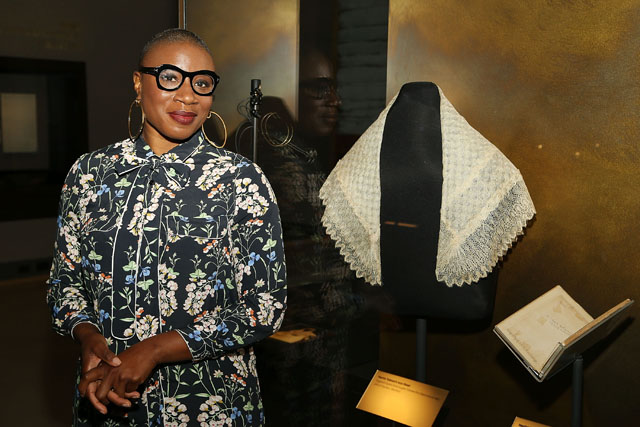
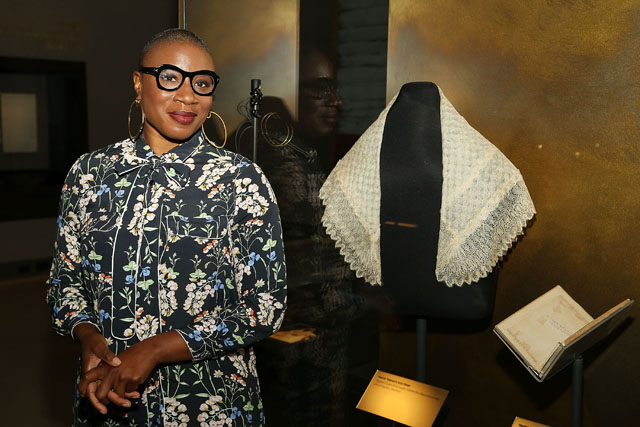
 ‘Underground’ star Aisha Hinds, who portrays Harriett Tubman, visits the Harriett Tubman exhibit during a tour of The Smithsonian National Museum of African American History (Paul Morigi/Getty Images for WGN America)
While we’ve seen more diverse television making waves in the era of “peak TV,” lost in the recent wave of success for African-American television is Underground, which just six months ago broke ratings records for WGN America.
The National Museum of African-American History and Culture hosted a special screening of Underground‘s seventh episode, “Cradle,” on Monday night. It was followed by a panel discussion with some of the show’s cast moderated by Dr. Rex Ellis, the NMAAHC’s Associate Director of Curatorial Affairs. As the museum’s inaugural program, the event was designed to celebrate the show’s success and highlight its connection to the aims of the new institution.
But before the episode screened, something curious happened among passers-by during a photo-op with the series’ stars. The photo-op was set up so anyone visiting the museum could participate, but a staggering number of people had no idea what the show was.
Underground is something of an anomaly in the new wave of black-driven television. Though it functions as social media-minded pop art, it isn’t the audacious soap opera of Empire. Its premise of a band of runaway slaves escaping a plantation is perhaps the headiest on TV right now, but it’s not the critical darling a film like Birth of Nation has become. Because the series depicts weighty subject matter with a pulpy slant, it’s not mainstream enough to be a water cooler topic among casual viewers, but it also lacks the kind of prestige that leads such projects to be championed by critics.
In our review of the show’s premiere earlier this year, we said the show “[had] far more in common with Prison Break than Roots.” It dares to be a thrilling genre exercise that remains true to history without being bogged down by the trappings of prestige drama. This is a show whose first season ends with Harriet Tubman (Aisha Hinds) appearing a la a Marvel film credits stinger, conflating icons of black history with superheroes. But the show doesn’t only excel in sensational adventure storytelling.
“Cradle” is easily the series’ finest hour. It functions as a standalone tale, splitting its time between five different perspectives, each through the eyes of one of the show’s children. The viewer gets a unique POV on plantation life from a young boy’s first day as a field slave, a little girl hiding out in a white woman’s care, a slave catcher’s son, a young runaway trapped between boy and manhood, and the heir to the plantation throne. It furthers existing storylines but works just as well if you’ve never seen the show.
 (Paul Morigi/Getty Images for WGN America)
Director Kate Woods takes the show’s established visual look and comes at it from new angles—for the most part, low angles that place the viewer on the kids’ level. It’s a kaleidoscope on the varied strands of the slave narrative, but one chapter in particular stands out. Young James (Maceo Smedley) has spent his whole life in the big house, playing with Master’s kids and living a kind of carefree life. His mother Ernestine (Amirah Vann) is the owner’s mistress, so out of spite, Master’s wife demands James be moved into the fields. Ernestine and James’ older brother Sam (Johnny Ray Gill) have to prepare him for his first day picking cotton, and the familiar tenor of the pep talk is heartbreaking, sounding as it does like any black mother in 2016 coaching her child on how to best interact with a world still reeling from the effects of slavery.
If, at the end of the day, James’ bag of cotton doesn’t make a set weight, he gets a lashing. The boy is too soft for the fields, so Sam swaps bags with him and takes the lashings for his little brother. That night, while Ernestine tends to Sam’s wounds, James overhears his mother explain how he needs to toughen up and see the world how it really is. The next day, James quietly declines to swap bags with Sam and makes weight. But when James is alone, we see that he has weighted his bag with dirt and debris to pad his haul.
It’s an incendiary little tale that exemplifies the best of what Underground has to offer. While shows like Atlanta are remarkable for the precision and honesty with which they depict the modern condition of being black in America, Underground forces viewers to look further back.
During a post-screening panel, Hinds spoke of the black audience’s dissatisfaction with the proliferation of slave stories in popular media, but she pointed out something important: “All narratives are slave narratives.”
“We don’t have the luxury to say we don’t want to watch another slave narrative,” Hinds said. “When you live in a country that’s built on the foundation of slavery, every narrative is informed by the slave narrative. When you’re watching Empire, you’re watching a slave narrative. When you’re watching Black-Ish, you’re watching a slave narrative. When you’re watching Monday Night Football, you’re watching a slave narrative.”
The second season of Underground is filming now for an early 2017 debut. Perhaps, as the landscape evolves, audiences will be more willing by then to see the importance of looking back to the past to better understand our present.
WGN’s Underground is streaming on Amazon and Hulu.