Rachel Kurzius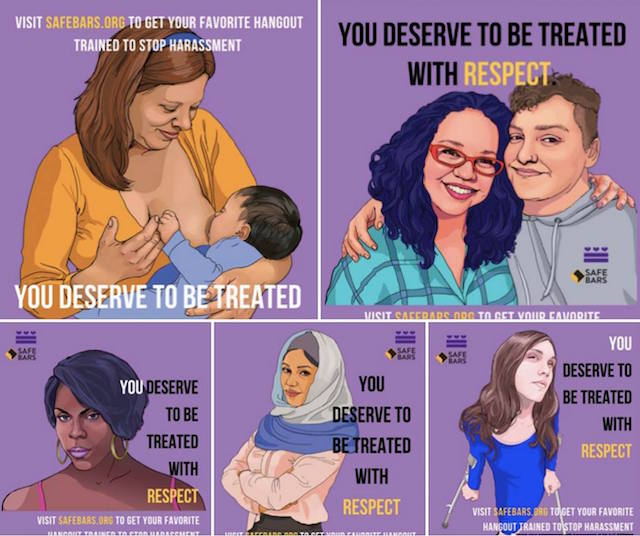
New posters are going up around the city reminding people they deserve to be treated with the respect and providing resources for survivors of abuse, courtesy of SafeBars and the D.C. Coalition Against Domestic Violence.
The posters, designed by Baltimore-based muralist Maura Dwyer, depict a diverse set of people. “We wanted to highlight the faces of some of our city’s marginalized identities,” says Jessica Raven, co-founder of SafeBars and executive director of Collective Action for Safe Spaces.
The images speak to incidents that have taken place in D.C. in the past year. A reported incident of a library officer kicking a woman out of Shaw Library for wearing a hjiab, a breastfeeding patron at Tenleytown Library said she was “warned” by a library assistant that teen boys would be entering the facility, and misgendering at Banneker Pool led to bystander intervention training for D.C. Parks and Recreation staffers.
Volunteers are plastering the 2,500 posters—500 of each of the five designs—throughout bars, coffee shops, storefronts and other locales to mark October as Domestic Violence Awareness Month. The theme for this year’s campaign is “Spread Love D.C.,” with the idea of generating conversations about what makes for a healthy relationship.
The posters, which like the Domestic Violence Awareness Month, have a purple theme, encourage people to bring more spots into the SafeBars fold and share their stories of harassment with CASS, as well as provide contact information for DCCADV, the National Street Harassment hotline, and D.C.’s crime victims hotline.
SafeBars, a collaboration between Defend Yourself and CASS, trains bar staffers to identify and intervene in instances of sexual harassment. The idea is to deescalate situations before things go too far. Already, more than 15 establishments have undergone the training, earning a decal for their window to tip off potential patrons.
Raven has brought the program to Philadelphia and is exporting it to Colorado next month. She expects SafeBars to comfortably meet their goal of training 20 spots by the end of the year, though the program is still trying to get establishments in quadrants outside of Northwest to participate.
SafeBars trainings make the connection that seemingly benign behavior can escalate to something more dangerous or violent. Take as an example the kidnapping in Petworth this Wednesday—a woman was waiting near the bus stop by the corner of New Hampshire Ave. and Georgia Ave. NW when two men started chatting with her.
“After initially engaging the victim in conversation, the males told the victim to come with them and threatened to harm her if she did not comply,” Metro’s release says. The men forced her into a car and drove to her apartment, where they stole valuables and cash. Luckily, the men fled and she was not physically harmed.
So when folks wonder why someone, a woman in particular, might not respond in kind to their perfectly friendly conversation, it’s often because they’re constantly aware of incidents like this, and how any interaction might lead to them.
In addition to these posters going up around the city, Metro will also be posting a new wave of anti-harassment ads starting October 7, Raven says.