Cotton & Reed (1330 5th Street NE) is more than the newest addition to the city’s distillery scene. “Rumtrepreneurs” Reed Walker and Jordan Cotton are leading the rum revolution to bring local craft rum back to Washington. The bar, distillery, and event space is set to open on November 12 across the street from Union Market.
“Why rum instead of whiskey or gin?” co-founder Walker asks. “First of all, we love rum and wanted to change the perception that rum has.”
The other reason, he explains, was to make rum that goes great in a drink. Their approach to distilling is to make their product distinct from other rums on the market, with small batches and unique spice blends. This is done according to a painstaking process involving selecting sugars and yeasts to make the wash, and the small batch distillation.
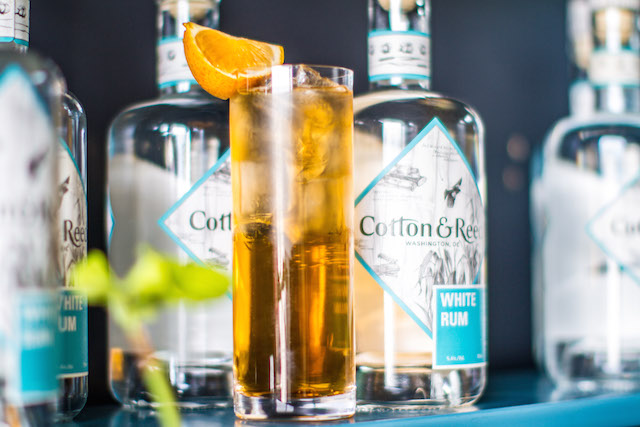
“We wanted it to be assertive, not hidden in Diet Coke,” says Walker. Their $30-dollar white rum isn’t “white label,” it’s the good stuff: lip-smacking when sipped neat with an unmistakable sugar cane presence in a cocktail.
Their other product blurs the line between rum and gin. “Our spiced rum is dry spiced, not with added sugar or caramel,” says Walker.
The $35 bottle is pale yellow in color, a far cry from the dark spiced rums of the Caribbean.
“Typical spiced rum has four botanicals, ours has 17. The main [ingredients] are not cultivated in the Caribbean—we didn’t’ want to limit ourselves to those flavors.”
The list of botanicals on the $35-dollar bottle reads off amburana, angelica, cumin, fenugreek, gentian, ginger, lemon verbena, licorice, peppercorn, orris (iris root) —aromatics that you usually find in pricey gins. The rum finishes with bitterness from the gentian just like an amaro or Angostura bitters. It would make an excellent rum Martini.
Walker and Cotton have positioned their distillery to take advantage of thea growing interest in rum and rum cocktails that has been long in coming. They’ve tapped Lukas B. Smith, a mix master at Dram & Grain and former beverage manager at Daikaya, to head their cocktails program.
A handful of cocktails give us a preview of what’s to come. The Red Beard is white rum, Campari, lemon and ginger juices, and a little chili spice. Batched and served carbonated from a keg for $10, it’s a refreshing and spicy juice drink with bitterness and ginger, but the sugar cane of the white rum comes through all of that noise pleasantly and with balance.
House made sodas make for original $11 soda cocktails as well. Black cola flavored with dehydrated lime and gentian for bitterness classes up a rum & Coke. Their Orangewellian orange soda is used in the Liquid Nostalgia cocktail with the white rum and Bonal gentian spirit. Other specialty cocktails like daiquiris and rum Old Fashioneds are priced between $12 and $14.
There hasn’t been local rum in the city limits since the temperance league marched on Pennsylvania Avenue and pronounced their opponents “rummies.” Rum’s image has only been further tarnished by the hot and bland rail spirits buried in the fruit smoothie-like strawberry daiquiris of the 1980’s. Now with the classic cocktails revival always looking for the next big liquor, it’s rum’s turn in the limelight. As the first legal rum distillery in the District in 96 years, Cotton & Reed has put an enormous effort in getting everything about the distillery just right.
“This is a huge art project from start to finish,” says Walker, spreading his arms wide in the industrial bar space.
With a garage door for a storefront and odds and ends of 1930’s vintage hardware on the shelves, the bar looks like it took over an old chop shop. Much of the décor is a collage of salvaged materials. The blue bar shelves, for example, came from the Buchannan Middle School library, and the old elevator’s operating equipment remains exposed on the wall beside the shaft that the rum still now occupies.
“There’s nothing here that suggests the ocean or pirates,” Walker says, referring to the stereotypical images often associated with rum. “Jordan and I worked as consultants for NASA and we wanted to do something that combined art and science,” he says.
You can see it in the bar top, a hexagonal pattern of wood tiles with realistic-looking etchings of plants, birds, and insects that thrive in the Louisiana sugarcane ecosystem from which Cotton & Reed sources their sugar. A similar flora and fauna pattern occurs on the bottles’ grayscale labels. Even the distillery’s name, a mashup of the co-founders’ names, suggests there’s a bit of the scientific naturalist as well as an air of the agricultural in their rum and its marketing.
Cotton & Reed will have their fist batch of rums ready for sale when the distillery opens this month, but their production is pretty small by industry standards.
“We can produce to meet the demand of D.C. but we will have to expand for Maryland and Virginia,” Cotton says.
The good news is that Cotton & Reed rum will be available outside the distillery in December, so we won’t have long to wait to pick up a bottle at a liquor store or try it at a local bar.