Rachel Kurzius
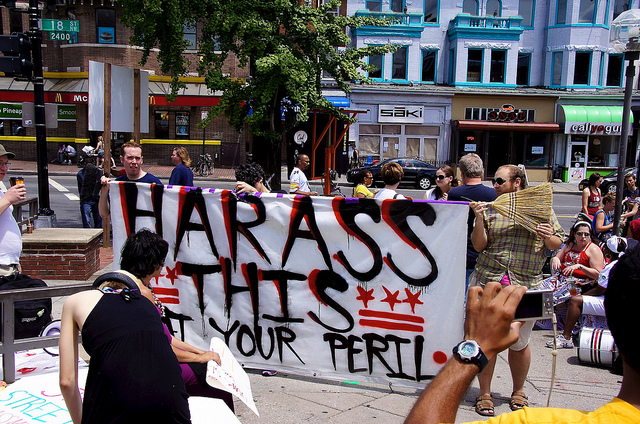 Photo by Ted Eytan
Ward 1 Councilmember Brianne Nadeau was walking down 16th Street NW in broad daylight when a government employee on duty and in uniform started catcalling her.
“I tried to use all the tactics I knew to diffuse it, to make it clear that the attention was unwanted, and it just got worse and worse,” Nadeau says.
She immediately reported the worker to the agency’s director (she declined to say which agency), who “had appropriate response, but it just goes to show that unless we have a concerted effort that involves training, then we’re not going to solve the problem.”
That experience is not Nadeau’s only brush with street harassment, and she’s not alone. A national survey found 65 percent of women and 25 percent of men reported experiencing at least one type of street harassment in their lifetimes. Numbers are markedly higher for those from already marginalized backgrounds, like people of color and members of the LGBT community.
In a D.C. Council round table on the subject last year, residents talked about how harassment made them feel annoyed, angry, embarrassed, or afraid, and was sometimes the precursor to physical assault.
Nadeau remembered the testimony of one young woman, who said that in order to survive in public spaces, she learned how to make herself smaller. “That is not the message we want for our young girls, for our LGBT community,” Nadeau says.
On Tuesday, Nadeau introduced legislation at the D.C. Council that uses education, grant funding, and training to prevent street harassment.
The bill tackles street harassment—defined as “unwanted, disrespectful, or threatening comments, gestures, or other actions forced on a stranger in a public place”—in a couple of ways. Nadeau has been working with advocacy group Collective Action for Safe Spaces on the bill’s language.
It establishes an advisory committee of 15 people that would provide guidance for implementing a series of initiatives relating to street harassment prevention. One of those would be advising the D.C. Office of Human Rights on the best way to educate D.C. employees about identifying and preventing harassment, ultimately training all workers who interface with the public on the topic.
“We’ve got to start at home on a lot of these issues,” says Nadeau. “If we can train our entire workforce, then we have 33,000 trained allies and bystanders who can help prevent harassment.”
The Street Harassment Prevention Act of 2017 would also give the advisory committee grant-making authority, so it can fund ways to address the issue in high risk public places, like public transportation, ridesharing services, bars and restaurants, educational settings, and public spaces like sidewalks. They haven’t determined how much funding would be available for the grants.
Some of the money could go to trainings or to public art, similar to the D.C. Commission on the Arts and Humanities’ $40,000 grant dedicated to anti-street harassment public art.
The bill also requires the mayor’s office to launch a public awareness campaign.
What the bill does not do is create criminal penalties for potential harassers. “One of the big issues with street harassment is that people who undergo harassment are often the most vulnerable people—women, people of color, LGBT folks,” Nadeau says. “We don’t want to solve this problem by criminalizing people who make up those populations. Our city is moving away from over-criminalization on all kinds of issues because it doesn’t work.”
The legislation is coming in the context of greater awareness and action on the issue. D.C. now has a thriving SafeBars program, run by CASS and Defend Yourself, which trains bar and nightlife staffers in bystander intervention techniques.
Metro is on its third wave of anti-harassment ads, and the agency surveyed riders on their experiences with harassment in the system.
Mayor Muriel Bowser’s Vision Zero plan includes establishing a task force to “develop policies and practices that thwart street harassment” as part of its plan to eliminate fatalities and serious injuries to people using D.C. transportation systems.
The majority of the council is on board, including six co-sponsors—Ward 2’s Jack Evans, Ward 6’s Charles Allen, Ward 8’s Trayon White, and At Large Councilmembers Elissa Silverman, David Grosso, and Robert White.
Nadeau says that the street harassment bill demonstrates the importance of having female elected officials. “One of the things that happens when we elect women to office is that we talk about these issues that weren’t discussed previously and can address them using government resources,” she says. “Nobody’s doing this across the country, and D.C. should be leading on this issue.”
She has gotten some pushback from people who think catcalling and the like are just an unavoidable part of living in a city. While doing a radio interview, “a woman called in and told me to move to the suburbs if I don’t like street harassment,” Nadeau says. “I don’t think that’s the right answer. We want our public spaces to feel safe.”
Street Harassment Prevention Act of 2017 by Office of Councilmember Brianne K. Nadeau on Scribd
Updated to reflect that Ward 2 Councilmember Jack Evans is one of the co-sponsors of the legislation.