 Rachel Sadon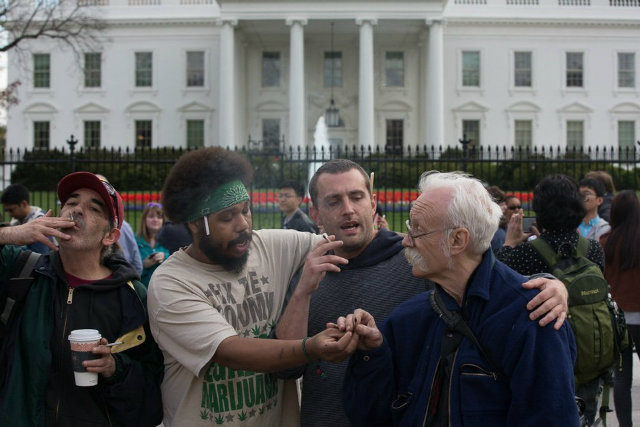
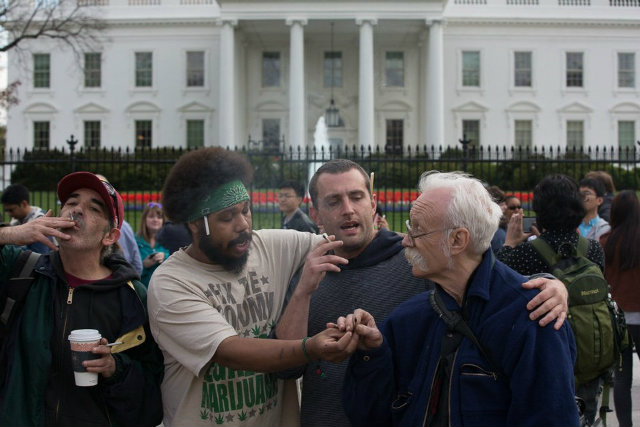 During a smoke-in at the White House last year, only two people of hundreds were cited for marijuana consumption. (Photo by Benjamin Strahs)
As comments made by Press Secretary Sean Spicer yesterday sent a ripple of panic through the marijuana community across the country, a group of D.C. activists are ready with a response, and healthy amounts of homegrown marijuana. They plan to smoke en masse outside the U.S. Capitol on April 24.
“We’re tired of waiting. We’re not going to drag this out for eight years. We’re going straight to civil disobedience,” says DCMJ co-founder Adam Eidinger.
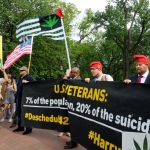
It isn’t the first time. Last year, the group organized a mass smoke-in outside the White House billed as a “rescheduling” of 4/20 to 4/2 to protest marijuana’s classification as a schedule one substance. Although the crowd of hundreds was prepared for the possibility of mass arrests, just two people were cited for public consumption of marijuana under District law (the protesters didn’t stray on to federal land).
This year, DCMJ is ratcheting up the stakes, moving “Reschedule 4/20” to the east side of the U.S. Capitol, where the likelihood for mass arrests is high, and also calling on constituents to smoke inside congressional offices as a rebuke of federal marijuana policy.
While marijuana is classified as a drug as dangerous as heroin from the federal government’s perspective, more than half the states have laws legalizing medical or recreational cannabis use. Nearly 70 percent of D.C. voters came out in favor of Initiative 71 in 2014, which legalized use of the drug. California, Massachusetts, Maine, and Nevada recently joined Alaska, Oregon, Colorado, and Washington in passing recreational marijuana measures.
At a press briefing yesterday, Spicer said the new administration will not be as tolerant as the previous one. Though he didn’t specify any exact actions, he said there will be “greater enforcement” of federal laws regarding marijuana.
The idea isn’t a popular one with the electorate. About 71 percent of Americans oppose such a crackdown on states that have legalized cannabis, according to a Quinnipiac poll released yesterday, and 59 percent favor recreational legalization. Medical marijuana has reached nearly universal approval, with 93 percent in support (up 4 percentage points from a poll taken last summer).
It’s not clear the extent to which Spicer was blowing smoke versus foreshadowing concrete policy changes, but it is certain that the Department of Justice will be a less pot-friendly place under Attorney General Jeff Sessons.
While Sessions didn’t give a clear sense of how he plans to handle marijuana legalization during his confirmation hearings, he has been a stalwart opponent. “Good people don’t smoke marijuana,” Sessions said at an April hearing on narcotics. “We need grown-ups in charge in Washington saying marijuana is not the kind of thing that ought to be legalized, it ought to be minimized, that it is in fact a very real danger.”
That is, in fact, exactly what Spicer said yesterday, dubiously linking marijuana to the country’s opioid crisis, despite some evidence that legalized marijuana might actually reduce opioid abuse.
The attorney general of Washington state, Bob Ferguson, has pledged to fight federal interference, telling the Seattle Times that his office has been preparing for the likelihood of some kind of crackdown. (It is the same office that successfully argued against the the Trump administration’s travel ban in the Ninth Circuit.) In a letter to Sessions sent earlier this month, Ferguson urged the new attorney general to keep in place the Obama-era “Cole Memorandum,” which says that the DOJ would keep state marijuana laws a low priority if they met certain conditions (the likes of not selling to minors).
D.C. leaders also say that they are keeping a close eye on the White House’s moves and are prepared to take action if need be.
“Initiative 71 is the law of the land in the District,” said Rob Marus, a spokesman for D.C. Attorney General Karl Racine. “The attorney general will always defend the District’s laws.”
While the Bowser administration didn’t respond to a question about exactly how the administration might be preparing for a possible crackdown, they pledged to remain vigilant. “Our goal is to always be vigilant and work aggressively against any federal actions that undermine our local laws. Should there be movement on this issue, we would continue our ongoing advocacy to preserve and protect our right to govern ourselves,” said Kevin Harris, a spokesman for Mayor Muriel Bowser, in an emailed statement.
The District is uniquely vulnerable to federal interference in most ways, but the way that Initiative 71 has been enacted may actually render the city less likely to be targeted under the Trump administration.
The ballot initiative allows for adults to grow and consume marijuana and give—but not sell—up to one ounce away. Smoking in public is an arrestable offense, with a $25 fine. D.C. legislators were prepared to come up with a scheme to tax and regulate the drug’s sale before the law went into effect, but Congress stepped in and stamped that plan out. Language in a 2014 congressional spending bill, and those in subsequent years, bars the city from spending funds on implementing cannabis laws, effectively tying the hands of D.C.’s elected leaders and leaving the city in legalization limbo.
That also means that we lack (non-medical) dispensaries to raid.
So for Washingtonians, Eidinger says, the worst (and fairly unlikely) case scenario is that the feds go after home growers. “They can blow a lot of smoke about cracking down but D.C. is going to be one of he hardest places to do it because we have a federally approved marijuana law—it had to be approved by Congress,” he notes. “They had a chance to reject the law [by overturning] it and they didn’t.”
Another possibility is that they go after people who are operating in a gray area, offering “gifts” of bud along with otherwise overpriced juice, art, and clothing. But the law prohibits remuneration of any kind, and many believe such services aren’t legal—Eidinger included.
No less than six marijuana delivery services contacted him in a panic in recent days. “These are activist entrepreneurs and I’ve been telling them all the same thing: what you were doing has never been legal. What did you think would happen?” he says. “Every single one calls me hoping I’m going to say something nice. Dude you should stop or be prepared to go to jail … though I consider these people patriots for trying.”
The Reschedule 420 protest next month was already in the works before Spicer’s comments, but Eidinger says the “tone is going to be much more militant.” One of the administration’s only public comments on marijuana law since taking power has given them additional fervor. “We have direction. We have focus. We know that they’re not going to respect states and D.C.”
While Spicer’s statement “makes it tempting to organize a flash mob outside the White House,” Eidinger says, the real problem lies in Congress, which hasn’t moved to reschedule marijuana. And so that is where they will be on April 24, lit joints in hand.