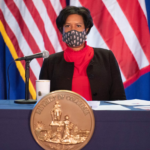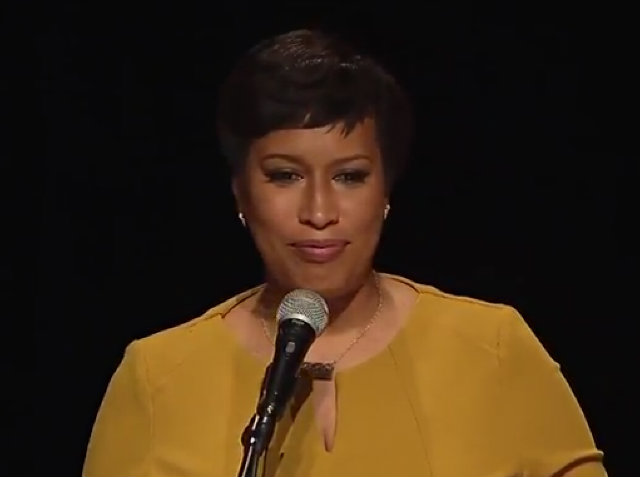
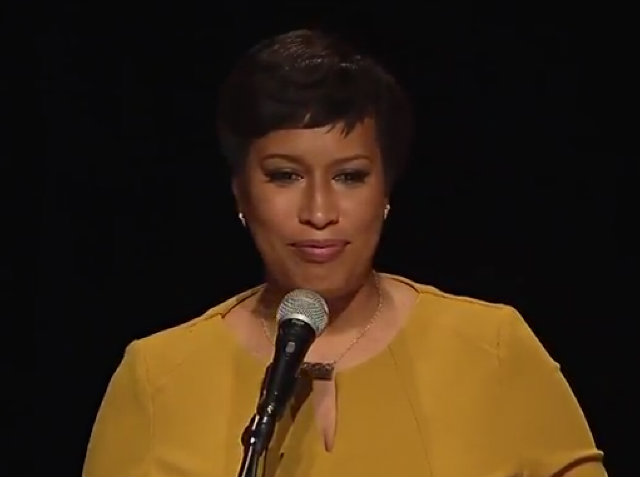
 At Thursday’s 2017 State of the District, Mayor Muriel Bowser asked President Trump and Congress to help D.C. with Metro, the Memorial Bridge, and revitalizing federal park land.
Thinking about Donald Trump has become a national pastime in the last three months year and a half, and Mayor Muriel Bowser has had no choice but to join in.
Her main focus isn’t on his tweets, though, but rather on how his administration could impact D.C.—for good and for ill. During a key portion of her annual State of the District address last night at the University of the District of Columbia, Bowser called upon the president and the Republican-controlled Congress to stand down on some of their early actions with local impacts, and to stand up with assistance on other issues—transportation, infrastructure and parks.
“They tell me President Trump likes to do big things,” Bowser said. “So let’s share some big ideas with him.” (A transcript of the prepared remarks includes the phrase “big league ideas”; perhaps Bowser decided at the last minute that the joke was stale.)
Bowser’s main asks of the White House and Capitol Hill include transforming Robert F. Kennedy Stadium into a vibrant area of mixed uses (“not just a stadium”); expanding investments in Metro beyond holding hearings; allowing the District to take over and revitalize the federally owned Franklin, Hains Point, Rock Creek, and Langston parks; and kicking in financial support to mend the District’s rotting transportation infrastructure. On that last point, Bowser strayed from prepared remarks to deliver an ominous image: “Memorial Bridge, without immediate help, could literally fall into the Potomac.”
Already, the Trump administration has indicated that it hopes to reduce funding for public schools, community development, and the arts, while the new Congress has begun attempts to curtail the District’s right to legislate independent of federal priorities. Bowser rebuffed those plans, rallying the audience to shout “Hands Off D.C.” to people like “our friends on the Hill from Utah.”
While keeping a watchful eye on 1600 Penn, Bowser and her team have plenty to tackle on their own. The speech offered the biggest window yet into her fiscal year 2018 budget, set for release next Tuesday. Public charter school facilities will see a funding increase of 2.2 percent, renewing annually for the next four years. And for the first time, $10 million will be set aside for preservation of affordable housing, on top of an annual $100 million allocation for the Housing Production Trust Fund, which Bowser has offered since 2015.
That announcement didn’t stop five protesters carrying posters from heading for the stage within the first minute of Bowser’s speech. As with a similar display from Black Lives Matter activists during the D.C. Council’s swearing-in ceremony in January, police escorted them away, and the mayor didn’t flinch.
Those signs weren’t the only ones on display last night. Two Lafayette Elementary teachers and a Washington Teachers Union office employee posted outside UDC last night told DCist they’ll be closely monitoring Bowser’s promise to reach a new agreement with the union, which has been calling with increasing urgency for D.C. Public Schools teachers’ first salary increase in more than five years.
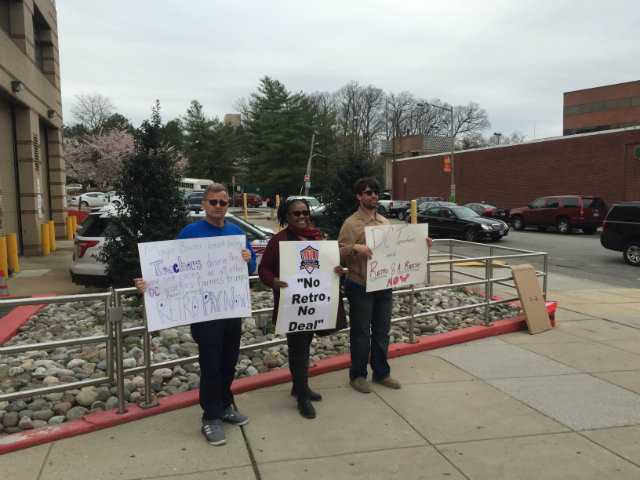 Two Lafayette Elementary teachers and one representative from the Washington Teachers Union office called for the mayor to reach an agreement that raises their salaries. (Photo by Mark Lieberman)
“I am proud to recognize their good work on big stages like this, and in classrooms throughout the year,” Bowser said during her address. “And I will be even prouder to be the mayor who, after 6 years of trying, can hammer out a new deal that continues to make them the best paid teachers in the region, and the the most valued by their management and fellow Washingtonians.”
Meanwhile, a new pledge from Bowser drew excited cheers, and perhaps a little healthy skepticism: All of the city’s residential roads currently designated as poor—nearly a third of all citywide residential roads — will be fixed within five years, she said. Coordination for such a massive effort will be modeled after Alleypalooza, an initiative with a silly name that has nonetheless yielded positive returns. Though roads remain a touchy issue, Bowser maintains a sense of humor about their lackluster condition.
“I’m convinced that being born and raised here gave me a higher tolerance for bad alleys,” Bowser said to hearty laughter.
Less grin-worthy are two recent stories that Bowser took time to address. She opened her speech reiterating the steps she’s already taken to tackle the issue of missing black and Latina teenagers that, while less dramatic than initial reports indicated, is top of mind for many residents and outside observers.
“We will continue to do everything we can to give you the support you need, and we will continue to ensure that equal attention and priority is given to every child,” Bowser said, directing her comments at families whose loved ones were “not at home tonight.”
The other headline making the rounds concerns the negligence of developer Sanford Capitol at numerous residential buildings, mostly in wards 7 and 8. Bowser said news reports of these issues “horrified her,” and laid out three uncompromising options for Sanford going forward: “They have a choice: Fix the violations, face nearly half a million dollars in fines or see us in court.”
Despite those ongoing issues, Bowser emphasized throughout the speech that D.C. is in excellent financial shape and moving steadily away from the city’s more fallow stretches in the 90s and aughts. More than $3.4 billion has already been committed to school modernizations, with another $1.5 billion still to go; unemployment is down nearly 4 percent in Ward 8 since Bowser’s inauguration; and the population continues to swell.
But an influx of residents brings new challenges: a dearth of child care options, more crowded buses; a higher volume of 911 calls. This year’s budget will include funding to address all three of those issues: incentives for 1,300 new child care facilities citywide; limited-stop bus service on 14th Street; and a new Nurse Triage Center that helps connect callers to ambulances or non-urgent care more quickly.
Two key issues in last year’s speech took on a different tenor this year. The streetcar was the subject of several jabs from the mayor in 2016; this year, she cheered its rising ridership numbers and announced that within a few weeks, more than a million people will have taken a ride. Meanwhile, the prospect of a Hillary Clinton presidency in 2016 offered a glimmer of hope for the statehood movement, but Republican control of the federal executive and legislative branches suggests a rougher path forward.
You’d hardly know it from the mayor, though. She beamed as she described the home of her constituents as “the greatest city in the world, and soon to be the 51st state.” The speech ended on a similarly upbeat note, as Andra Day’s “Rise Up” assured the crowd, “We’ll take the world to its feet, and move mountains.”