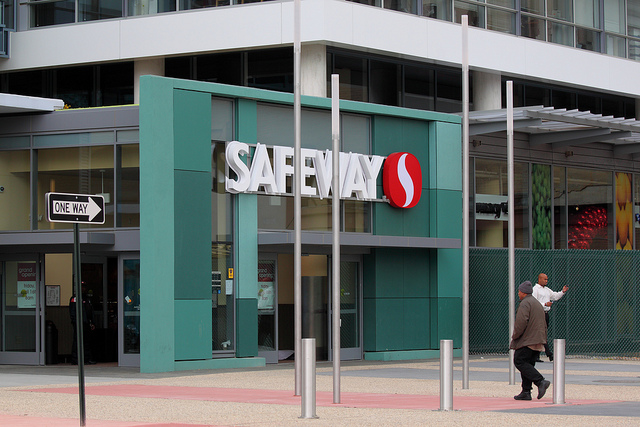
 Safeway in Ward 6 near Waterfront Metro station (Photo by Mr. TinDC)
As residents in the H Street Corridor shop at a recently-opened Whole Foods, people in Capitol Hill and NoMa prepare for Trader Joe’s, and Cleveland Park celebrates a forthcoming Wegmans, the 149,750 District residents who live east of the Anacostia River share a total of three grocery stores, according to a new report.
D.C. Hunger Solutions found that, in 2016, Ward 7 had two full-service grocery stores and Ward 8 had just one.
Collectively, Wards 7 and 8 are down four supermarkets since the organization released its last report on grocery store disparities in 2010.
In 2016, there were 49 grocery stores in D.C. and the average number per ward was six. The highest count was in Ward 6—which has about 82,000 residents in neighborhoods like H Street and NoMa—with 10 full-service supermarkets and three more on the way.
Unsurprisingly, Wards 7 and 8 account for the vast majority of D.C.’s residents (one out of seven) who are what the USDA considers “food insecure,” meaning that at some point during a year, they’re unable to provide “adequate food” for one or more people in their households because they don’t have the resources.
The D.C. Policy Institute released a report in March with similar findings, stating that while 11 percent of D.C. is considered a food desert, more than three-quarters is in Wards 7 and 8.
Because there’s a lack of nearby grocery stores, residents in Wards 7 and 8, which have the lowest income levels in the city, have to pay increased transit costs to get to supermarkets, the report notes. And people who get government assistance like food stamps often shop in Maryland and Virginia, where costs are lower, which takes away from D.C.’s economy. Others rely on nearby corner stores, which tend to carry less healthy food options—likely a factor in the high rates of diabetes and obesity.
D.C. Hunger Solutions recommends in the report that the D.C. Council partner with organizations to make sure that resources like grocery delivery programs, farmer’s markets, emergency food banks in the wards and organize a task force to figure out why full-service grocery stores aren’t being developed.
Warren Williams, a developer who chairs Ward 7 Councilmember Vincent Gray’s economic advisory council, told The Washington Post that east-of-the-river neighborhoods struggle to secure grocery stores and retail options because the areas don’t have large concentrations of office buildings and many residents leave the wards to work in other parts of the city. “The decisions are driven by the numbers,” he said. “Groceries will go where they think they can make a profit.”
Still, Gray said in a speech to constituents in April that he has plans for new developments in Ward 7. And he recently proposed legislation that would incentivize the construction of grocery stores in certain neighborhoods.
Meanwhile, Ward 8 Councilmember Trayon White told The Post that he had “productive discussions” with representatives from the grocery store chain Lidl. He also secured secured $300,000 in next year’s budget to help grow alternative food options in his ward.
Closing the Grocery Store Gap in the Nation’s Capital by Christina Sturdivant on Scribd