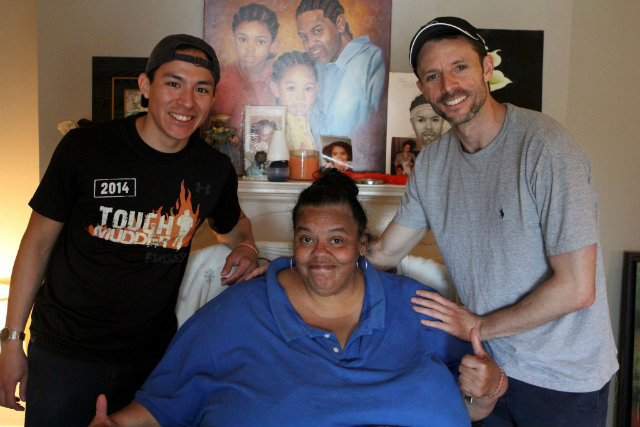
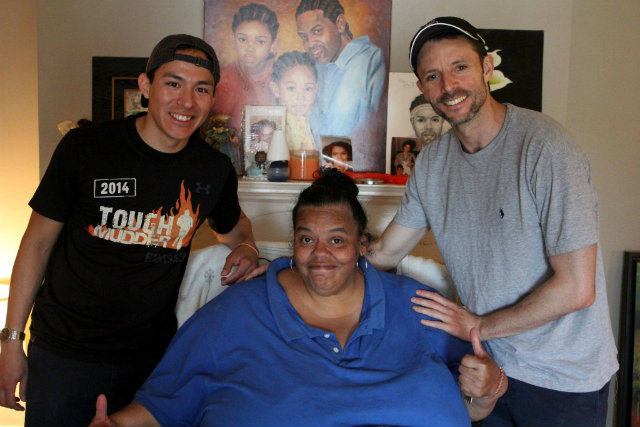
 A new non-profit, LightHouse, is focused on getting furniture and household goods to formerly homeless families. Before launching on Wednesday, they had already done three deliveries, including one to Ms. Moody. (Photo via Facebook)
By DCist contributor Becky Little
Furnishing her new apartment, Shantie Morgan says, is what helped her family transition from “homeless back to home.”
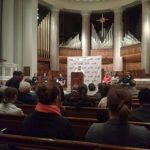
Morgan told a crowd of more than 200 people her story at the launch party of LightHouse DC on Wednesday night. The new nonprofit recently assisted the mother of seven with acquiring the household furniture her family needed to actually live in their new place after their experience of being homeless.
Morgan is one of the D.C. residents who have benefited from a “housing first” approach to the homeless crisis. This model seeks to give people a place to live first, and provides them with counseling and other services once they’ve moved in. But she’s also one of those residents who, once she moved in, was stuck in an awkward in-between phase of not having enough money to furnish her new apartment.
That’s where LightHouse stepped in for her, and hopes to step in for other families. Brian Hart, Jingwen Sun, and Daniel Moskowitz co-founded the new nonprofit to provide low-income and formerly homeless residents with beds to sleep in, tables to eat at, and other necessities.
“For a number of low-income people who have secured housing, they don’t have the furniture or household goods they need in order to take advantage of ‘wrap-around services,’” Hart said. Wrap-around services include things like tutoring and counseling that are hard to take advantage of when a family isn’t yet settled into a new space.
Right now, LightHouse is trying to acquire most of its donations from hotels and local businesses. Unlike some furniture banks that provide low-income families with household goods, LightHouse will actually deliver these items to a family’s home, saving recipients the cost and time of arranging the logistics to pick up the furniture themselves. And although the nonprofit didn’t officially launch until Wednesday, it’s already started delivering goods to families like Morgan’s.
Hart said they’ve done three moves so far, including one recently where a mother and son had a subsidized unit in Adams Morgan. “They were sleeping on the floor, and it was basically empty,” he says. “We got them beds, tables, chairs, some artwork, a mirror—there’s a range of household goods that we provided to really try and create a home environment for them.” A local moving company offered their services for free to help get it all inside.
“It doesn’t even look like the same apartment,” Lucki Moody said after seeing the changes that LightHouse wrought. Ms. Moody also attended the launch party, where she told attendees that LightHouse had helped her “at a time when I was truly going through a storm.” Towards the end of the evening, she sang “You Light Up My Life” for the crowd at the launch party.
The nonprofit’s mission has been well-received by local government officials. On Wednesday, Attorney General Karl Racine and nine D.C. councilmembers served as honorary hosts of the launch party. One of them was At-Large Councilmember Robert White, who is also a founding board member of LightHouse.
“Having four walls and a roof does not make a home,” White said. “What really makes a home is having a bed to sleep on, a table to eat at, and a couch to sit in and talk to family. And that’s not what our housing agencies or housing nonprofits do. They just put a roof over someone’s head. So LightHouse helps them take the next step of turning a house into a home.”
To be sure, putting a roof over someone’s head is the critical first step. But both White and Hart think that there are gaps in the continuum of care that government and non-government organizations provide to D.C.’s homeless and low-income residents; and they’re hoping that LightHouse can help fill some of them in.
The subject of poverty and what causes it has been in the news lately, but not in a productive way; Housing and Urban Development Secretary Ben Carson recently declared that poverty is “a state of mind.” At the launch party for LightHouse, none of the speakers mentioned Carson by name. Yet some seemed to be responding directly to the secretary’s words.
“Don’t you believe in the hype for a minute,” Racine told the crowd, referring to the idea that poor people in D.C. don’t work hard and don’t deserve help. “They’re working their asses off.”
Morgan, for example, started the charity Evelyn’s Closet while she was homeless. And she’s clearly passed that work ethic on to her children—one of her seven sons is about to graduate as valedictorian from Washington Metropolitan High School.
White, too, emphasized that poverty isn’t a result of not working hard. “They’re struggling because they’ve been dealt a bum hand,” he said.
Hart hopes that, by helping families like Morgan’s and conducting impact studies with them afterwards, LightHouse “can be part of the larger discussion of major goals in terms of ending chronic homelessness … and giving every person a chance to enjoy a good life.”