Rachel Kurzius
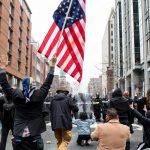
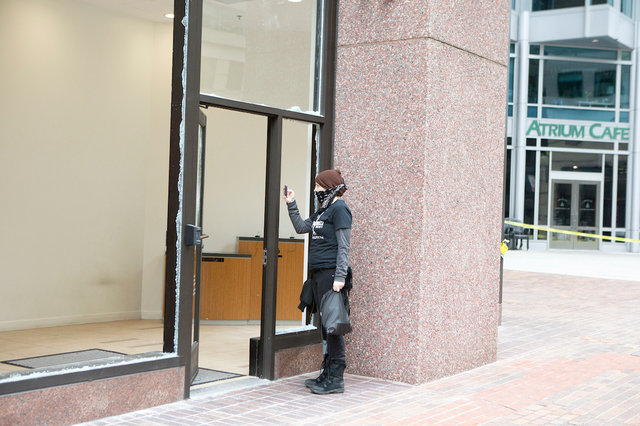 Downtown on Inauguration Day. (Photo by Alex Edelman)
There are nearly 200 people facing decades in prison for the chaos and destruction on Inauguration Day, and whether those charges are dismissed before trial may depend on how a judge interprets the term “willfully.”
Is the entire group of protesters responsible for the windows smashed by a few of them? Would such an interpretation of the law have a chilling effect on First Amendment rights?
Dozens of lawyers packed into a courtroom at D.C. Superior Court on Thursday to argue these issues. It took nearly a half hour for all of the attorneys to introduce themselves, as they lined up down the aisle of the room, which was so packed that U.S. Marshals asked spectators to head to an auxiliary room streaming the proceedings. Then, when there were no seats left in that room, the court had to establish another overflow room.
The defense attorneys had two major motions: to dismiss the charges against their clients, and to make public the instructions that the government gave the grand jury that approved the indictment.
While Judge Lynn Leibovitz said she would not rule on those motions that day, there was one substantive update to the case. Assistant U.S. Attorney Jennifer Kerkhoff agreed to drop one of the charges after acknowledging that the count, misdemeanor assault on a police officer, was an inoperative statute.
But the government is still pursuing a slew of other felony charges against the 197 individuals like inciting or urging to riot, rioting, and conspiracy to riot. The first trials are slated to begin on November 20, and earlier in the day, Leibovitz heard arguments about establishing an online portal to share evidence taken from arrestees’ phones.
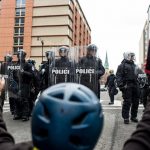
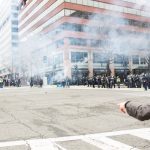
On January 20 and in the days following the inauguration, the Metropolitan Police Department arrested 234 people over their alleged role in what the U.S. Attorney’s Office for D.C. has called a “violent riot,” which caused more than $100,000 in damages to buildings, property, and vehicles, and minor injuries to six police officers.
More than 200 people were charged en masse with felony rioting, and saw a slew of new felony charges added in late April with a superseding indictment.
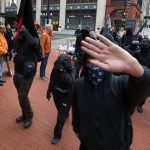
The indictment outlines a minute-by-minute account of the demonstration, as pieced together by prosecutors, and was approved by a different grand jury than the first one. Demonstrators met in Logan Circle, wore dark clothes and masks, moved 16 blocks together in about 30 minutes, and either smashed windows or cheered when others did.
At the end of May, lawyers for 21 of the defendants called for prosecutors to dismiss the felony charges against their clients, saying the indictment “seeks to hold the moving defendants criminally responsible for participating in a large group protest and simply failing to walk away when a small number of other individuals in the group allegedly broke the law.” Since then, many more defendants have joined the motion.
While 16 of the people charged have pleaded to misdemeanors and were ordered to pay fines, one person so far has pleaded guilty to felony charges. Dane Powell, 31, was sentenced in early July to four months in prison for felony rioting and felony assault on a police officer.
During the sentencing hearing for Powell, Assistant U.S. Attorney Jennifer Kerkhoff said that the case against him was “not about wearing black, not about wearing a mask.” But in court on Thursday, defense lawyers argued that the government’s case against their clients was precisely that.
“The government comes in and says my client is liable for a felony—all they’ve established is that he’s arrested, not even what he did during the march,” defense attorney Veronice Holt argued. “You can’t just say, ‘As many people as the government can catch need to stand trial.'”
Attorney Joshua Shriffrin argued that the only actions common to all of the defendants amounted to protected speech, because they were engaged in a political protest.
But Judge Leibowitz said that other cases regarding riots in D.C., like the 1968 riots following the assassination of Martin Luther King, Jr., had political frustration at their core.
“I’m not supposed to be deciding what’s in [protesters’] hearts and minds when they get off the bus,” said Leibowitz. “I’m evaluating their conduct.”
So the question remains: what, exactly, comprises “inciting” a riot? Is being part of a group shouting “‘Fuck it up,’ ‘Fuck Capitalism,’ and ‘Whose streets? Our streets’ prior to, during, and after acts of violence and destruction,” as the indictment alleges, enough? Or does the government need to prove the role of each of the defendants in the ensuing chaos?
That’s where the instructions the government gave to the grand jury come into play. Defense attorneys want to know whether the grand jury considered the evidence against each individual.
Kristin Robinson said that her two defendants did not arrive at the protest until 10:45 a.m., after four of the five violent acts outlined in the indictment had already occurred. She said that their indictments are evidence that they weren’t considered individually, she argued.
“No reasonable grand jury would have indicted my clients on a window broken 20 minutes before they arrived,” she said.
But Kerkhoff said that the clients in question “went to find the Black Bloc, found them, adjusted their masks, and joined them … If you want to get into the facts, there are specific facts. They should come out at trial.”
But Leibowitz seemed interested in hearing the instructions to the grand jury. She asked Kerkhoff if she’d prefer giving the judge a tape of the instructions or sharing them with everyone. Kerkhoff said she’d need to speak to a supervisor, and would include her answer in a legal filing.
For her part, Kerkhoff maintained that every member of the group was responsible for its actions. “A person can be convicted of rioting without breaking a window,” she said. “It is the group who is the danger, the group who is providing the elements.”
Defense attorneys worried this interpretation violates the First Amendment, creating a chilling effect that would make people fear protesting because they would be held responsible for the actions of others.
Before heading inside to watch the proceedings, more than 50 supporters of the defendants gathered outside the courthouse on Thursday morning holding signs with messages like “Drop the charges.”
“I am taking the matter under advisement,” Leibovitz said as she ended the day in court.
Previously:
Inauguration Day Protester Sentenced To Four Months Behind Bars
ACLU Is Suing D.C. Police For Excessive Force, Unlawful Arrests On Inauguration Day
D.C. Budget Includes $150,000 For Review Of Police During Inauguration
Even More Felony Charges For Inauguration Day Protesters
Prosecutors Are Mining Data From The Cellphones Of Inauguration Day Arrestees
Police Complaints Board Wants Independent Investigation Of Inauguration Day Conduct
Journalists, Legal Observers Among Those With ‘Unprecedented’ Felony Charges For Inauguration Day Protests