 Rachel Sadon
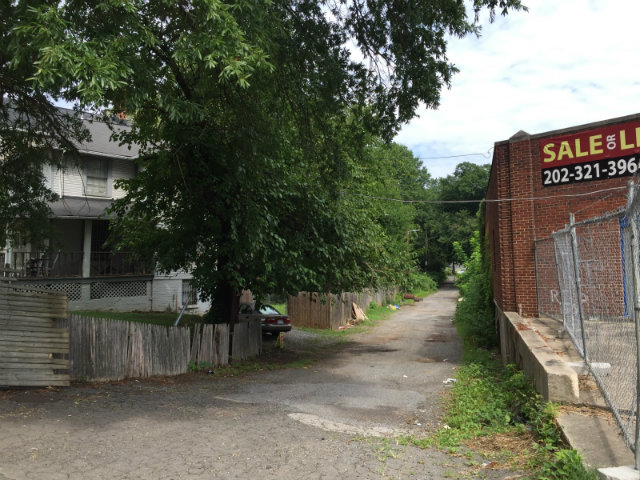 The D.C. government plans to put a fleet yard for the Department of Parks and Recreation at 2424 Evart Street NE, which is separated from neighbors by a small road. (Photo courtesy of Jeremy Wilcox)
An ANC commissioner in Langdon Park is suing the city after officials failed to notify residents of several forthcoming industrial projects that would add more trucks and heavy vehicles to a neighborhood they say is already overburdened with them.
Ward 5, and Langdon Park specifically, is home to much of the city’s remaining industrial land, including warehouses, marijuana cultivation centers, parking lots, junkyards, and two trash transfer stations interspersed among blocks of primarily single-family homes. The city quietly planned to add a fleet yard and offices for the Department of Parks and Recreation, a training center and parking for the D.C. Department of Corrections, and a facility D.C. Fire and Emergency Medical Services Department to the mix.
“The city is potentially bringing three municipal use properties to this neighborhood ” says ANC Commissioner Kevin Mullone. “What benefit do those facilities bring to the community? None.”
The city admits that it erred by not alerting neighbors to the plans as required by law, and officials have called it an oversight. But while Mayor Muriel Bowser has pulled the lease for the FEMs facility after Ward 5 Councilmember Kenyan McDuffie introduced a disapproval resolution (he told WJLA he was unaware of the other leases at the time they were transmitted to the council chairman).
The administration has said it plans to move forward on the DPR site at 2424 Evarts Street NE and the DOC facility at 2130 Queens Chapel Road NE.
A spokesperson for the Department of General Services, which oversees D.C. government facilities, says officials have apologized twice and they hope to work with residents to make the facilities a part of the community.
“It’s nothing that anybody wants, and they’d have known that from the beginning if they had talked to anyone to begin with,” says Shaina Ward, a lawyer whose backyard faces the DPR site. “It’s noise. It’s traffic. It’s safety. It’s congestion. It’s saturation. All of those reasons would go into a community discussion if that was something they had ever done”
She filed a lawsuit on behalf of Mullone in Superior Court on Friday against the mayor, the director of DGS, DGS, and the owner of one of the sites. “The execution of these leases in one small neighborhood, prior to any ANC notification or community engagement at all, shows a pattern and practice of abuse by these government agencies, and a blatant disregard for basic civic engagement,” the suit reads. It seeks both an emergency and a permanent injunction barring the leases’ execution.
“Honestly, I never thought I would be in this situation where I would be needing to use my law degree for this purpose, as an affected resident of D.C.,” says Ward, who typically does trial work for civil litigation. “It’s a mess, it really is …. I wish that we didn’t have to [file the suit] and they would just follow the law like they were supposed to and take our neighborhood concerns seriously.”
 A view of 2424 Evart NE from Jeremy Wilcox’s backyard. (Courtesy of Jeremy Wilcox)
Under D.C. law, the local Advisory Neighborhood Commission is to be notified with a 30 days notice when the government acquires a property (either through a sale or lease) or changes the use of a property on behalf of the city. All commissioners and the ward’s councilmember must receive the notice.
That didn’t happen before the mayor sent the leases over to the D.C. Council, which passively approved them after a 10-day period, as was first reported by the Washington Post.
“They really can’t purchase or lease a space in an impacted community without notifying the ANC, and that’s the heart of the issue,” says Mullone, who discovered two of the leases through an online search after a neighbor spotted construction activity. “It takes away the rights, opinions, and concerns of the residents.”
The city is also supposed to give the ANC’s views “great weight” in moving forward on plans, and to provide an environmental impact assessment on changes likely to have a significant effect on the environment. The residents’ lawsuit argues the fleet and storage vehicles are likely to emit “dangerous and toxic carbon-emitting fumes” and should be subject to the latter requirement.
Jeremy Wilcox was the first to call attention to the work being done at 2424 Evart Street NE, which sits just across his backyard, separated by a small street that he describes as more like an alley.
Wilcox says they have yet to see plans for the facility, but he can envision how adding dozens more heavy vehicles to the neighborhood, plus things like spotlights or generators, will affect their quality of life.
“This little corner of Langdon Park is already inundated with traffic,” Wilcox says. “Ward 5 is a dumping ground for this sort of stuff.” He no longer parks on the street in front of his house after his car was hit twice by what he suspects were large vehicles, and at least one of his neighbors fears driving at night because of their presence.
Adding insult to injury, he says, is the fact that the city is planning to sell off a lot it already owns at 13th and S streets NW to rent out the 2424 Evart Street property. “No one has told me that the S Street location isn’t working. It’s simply ‘commercially desirable,'” he says, quoting from the mayor’s letter to the D.C. Council. “Why is the city selling property that it owns to lease property elsewhere?”
The city plans to pay $1.4 million a year for 10 years for a property that was sold just nine months ago for $4.85 million to an LLC managed by the Menkiti Group. According to the mayor’s notice to the council, the developer’s financing for that purchase was contingent on the city’s lease agreement.
For the Queens Chapel site, the city plans to pay about $1.1 million a year for 15 years. An LLC registered to Douglas Development bought the former chicken and seafood processing plant for $5.9 million in 2015.
Currently, that site is often used as overflow parking for patrons of the neighborhood’s clubs. “It’s damn near 7,000 people out there when all three are in full swing,” Mullone says. “They’re not going to have anywhere to park,” aside from the already inundated residential streets.
Says Ward, “the D.C. agencies don’t seem to care about Ward 5, and particularly the Langdon Park neighborhood … [the leases were] done completely under the cover of night.”
The city says there was no intent to hide the projects from neighbors.
“It was just overlooked,” says DGS public information officer Joia Jefferson Nuri about why residents weren’t notified. “We acknowledge it was just an error and have apologized twice.”
Going forward, the agency is tweaking its process for notifying residents about neighborhood projects, pledging to publish them on a website in addition to the required notice by mail. “We have improved our check and balances to ensure the community and the council are notified as we approach lease agreements,” Nuri says.
But as for the two projects, the city has planned to forge ahead despite the outcry. The lease agreements are slated to go into effect in early 2018.
“What we’re hoping is to find a way to become a part of the community,” Nuri told DCist before the suit was filed.
Residents, though, say their complaints about heavy vehicular traffic, parking concerns from several large nightlife venues, and blighted buildings have already gone unheeded for years.
“[The mayor] would not get away with this in the Palisades, in 16th Street Heights, anywhere in Northwest,” Mullone says.
The mayor’s office did not return an immediate request for comment about the lawsuit.
“We are reviewing the documents that were sent to DGS today,” Nuri says, adding that DGS has been working on setting up a meeting between the agency, residents, and Ward 5 Councilmember Kenyan McDuffie.
 The city is seeking to put a Department of Corrections facility on the site of a former food processing facility in Langdon Park. The building is currently vacant while the lot is often used as overflow parking for nearby clubs. (Photo via Google Streetview)
There are direct echoes of the situation in Langdon Park, right down to complaints of being treated as “dumping ground”, in a fight that was waged in Ivy City five years ago.
Residents there were already concerned about air quality given the disproportionate number of parking lots that had been strewn about the neighborhood, with school buses, snow plows, and parking enforcement vehicles frequently driving through or idling in lots. So when then-Mayor Vincent Gray announced plans for overflow bus parking for the huge influx of D.C.-NYC motorcoaches, they fought back, uniting under the banner of “Let Ivy City Breathe.”
The activist group Empower DC filed a lawsuit on behalf of two residents and the area’s Advisory Neighborhood Commission, arguing that the city had acted improperly in planning the depot without notifying them.
A judge sided with the neighbors and issued an injunction blocking the government’s plans, finding that officials had failed to give the required notice to the ANC or conduct an environmental impact assessment. The city eventually satisfied the legal requirements, and the judge lifted the order in 2014.
A year later, though, Bowser told residents that the site was no longer being considered for bus parking.
Skeptical residents credited the decision with the gleaming new developments that had been built in the meantime. Over the past few years, Ivy City has seen the openings of a MOM’s Organic Market, several distilleries, BicycleSPACE, luxury rental units and retail at the restored Hecht warehouse, and a slew of new restaurants (and the city’s craft food hall and a Michelin-starred restaurant sit just one neighborhood over).
“Nothing happened until there was interest [in the neighborhood] from predominantly white developers and business owners,” Parisa Norouzi, the executive director of the group that filed the lawsuit, told the Washington Post after finally winning assurances that the land wouldn’t be used as a bus depot.
“We’re taking about people who did not even know that Ivy City existed two or three years ago.” A Post story that ran a few months later literally called it “the next cool D.C. neighborhood you have never heard of.”
After going through a public process, the administration announced at the end of 2016 that the 108,000-square-foot site around the Crummell School will be redeveloped into more than 300 rental apartments and townhouses, plus an urban garden, a working farm, retail and commercial spaces, and an open community space (plans for the school building itself have not yet been finalized).
“Many Ivy City residents have waited decades—and some, a lifetime—for the renovation of the Crummell School site as a community hub,” Peta-Gay Lewis, Ivy City’s Advisory Neighborhood Commissioner, told DCist after the proposal was chosen.
Some Langdon Park residents say they wish to see something similar for the sites in question. Whereas some neighborhoods kick up an automatic fuss about new condo developments, that’s exactly what Ward and others say the neighborhood could use.
“It’s a lot that needs to be developed—it’s blight. But the good thing that it has going right now is that we don’t have 90 trucks using it,” Ward says. They’d welcome “condos, apartment buildings, a community center—anything that would bring positive features. I don’t want 80-90 vehicles plus 30 employees who don’t care about our neighborhood.”
And so they’re going to court.
“I’m not relishing the fact of fighting the city. It makes me sick,” Wilcox says. “What we want is a comfortable place to live. I want quiet, safe streets. We feel powerless. I feel more powerless than anything else.”