 Rachel Sadon
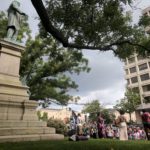
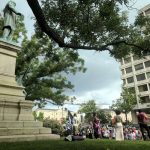
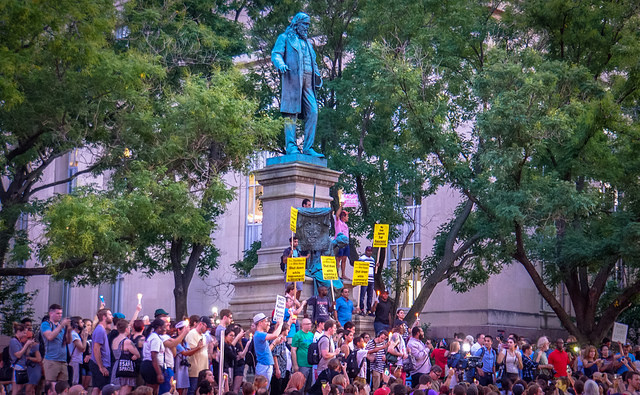 Protesters surrounded a statue of Confederate General Pike on Sunday night in the wake of violence in Charlottesville. (Photo by Ted Eytan)
The mayor, more than half of the D.C. Council, and the D.C. attorney general have joined activists in calling for the removal of a statue of a Confederate general from federal land in Judiciary Square.
“Albert Pike was a strong proponent of slavery and fought to try to preserve that in this country. Regardless of what he did in other parts of his life, it’s inappropriate to honor him,” says At-large Councilmember David Grosso, who sent a letter today to the acting director of the National Park Service calling for a statue of Pike at 3rd and D streets NW to be taken down.
Mayor Muriel Bowser agrees that the statue should be removed and replaced.
“Across the South, cities are removing outdoor statues of Confederate leaders. Here in the nation’s capital, there is one on National Park Service land. We believe the National Park Service should remove the Pike statue and seek public input on which historical figure should replace it,” said LaToya Foster, Bowser’s press secretary, in an emailed statement.
Fellow At-large councilmembers Elissa Silverman, Anita Bonds, and Robert White, Ward 1’s Brianne Nadeau, Ward 5’s Kenyan McDuffie, Ward 6’s Charles Allen, and Attorney General Karl Racine co-signed the letter sent by Grosso.
“We in the District of Columbia hold dear the values of equality, diversity, and inclusion, which are in direct conflict with the values embodied by the statue,” it reads. “In a time when these values are under constant attack by white supremacists, neo-Nazis, and far-right terrorists, the presence of a statue honoring Albert Pike only serves to perpetuate and incite hate, violence, and oppression.”
Activists drew attention to the Pike statue this weekend in the wake of the white nationalist gathering and terrorist attack in Charlottesville. At vigils on Sunday and Monday nights, hundreds of people marched from the White House to Judiciary Square to protest its continued presence in D.C.
“[Pike] is a guy who loved slavery so much that he quit two political parties. He wrote pamphlets about it, and then when the civil war started, he raised three regiments of troops,” Eugene Puryear of the Stop Police Terror Project told a crowd of protesters on Sunday. “The Richard Spencers of the world, they want to invoke fear in people, they want people to fear their fascist movement. This [vigil] is a sign that people are not going to let that genie out of that bottle, that people are going to fight back.”
Grosso says that he learned about the Pike’s Confederate ties through activists, because the statue doesn’t have any visible reference to them. Pike was honored for his work with the Freemasons, who paid for the sculpture, rather than his failed tenure as a general.
Pike convinced and led a number of Native American tribes into battle on behalf of the Southern cause, losing badly at Pea Ridge. Facing charges of misappropriating funds and allowing his troops to scalp Union soldiers, he fled the Confederate Army and mailed in his resignation. Eventually, Pike was arrested and charged with treason. Later, he was tried for the same crime by the United States—making Pike an accused traitor in the eyes of both governments. The Confederates essentially let it go, and Andrew Johnson gave him a pardon.
After the war, Pike spent time in Tennessee, where some allege he fell in with the Klu Klux Klan and helped form their rituals, though hard evidence does not exist for the claim. Whether or not he was a bona fide KKK member, Pike was certainly once a member of the nativist Know-Nothing American Party and an avowed racist.
In addition to practicing law and writing poetry, Pike became a very active member of the Freemasons. He authored the Morals and Dogma of the Ancient and Accepted Scottish Rite of Freemasonry in 1871, and remains a revered figure among Freemasons.
There’s a Masonic lodge in Little Rock named for Pike that sits on the National Register of Historic Places and an intersection in Knoxville is named for him. There’s also an Albert Pike Museum housed in D.C.’s House of the Temple, where Pike is interred.
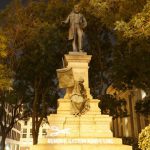
The Freemasons—who generally neglect to mention racism and treason in literature that extols Pike as a “jurist, orator, philosopher, scholar, soldier, and poet [whose renown] extends throughout the world”—sponsored and paid for the 11-foot bronze statue, which sits on a pedestal at 3rd and D streets NW. But it took an act of Congress in 1898 to approve its placement on land administered by the National Park Service.
This isn’t the first time, though, that the statue’s presence in the nation’s capital has been protested. In 1992, followers of Lyndon LaRouche draped white sheets over the statue on a weekly basis to call attention to Pike’s alleged KKK membership.
Then At-large D.C. Councilmember Bill Lightfoot introduced a bill calling for the statue’s removal. Legislators in more than a dozen cities joined the call, but not much else happened.
“It kind of faded away,” Lightfoot tells DCist. “Back in 1992, the city had many, many problems. Back then we were still dealing with the crack cocaine epidemic, we were the murder capital of the country … so we were dealing with more pressing immediate concerns.”
But as in the rest of the country, the D.C. region in recent years has been grappling with how to handle statues, memorials, and building names that honor Confederates.
Rockville, Md. transferred ownership and moved a Confederate statue out of a public square earlier this summer, though it didn’t publicize the event beforehand for fear of protests. The Fairfax County School Board voted last month to rename a high school that honored a Confederate general after a two-year community debate. And the National Cathedral quietly removed the Confederate flag from stained glass panels last summer, as it debates how to handle the memorial to Robert E. Lee and Stonewall Jackson.
“I think what we’ve seen overall not only since Charlottesville but since the Charleston shooting is a new and much broader understanding of how hurtful and toxic the legacy of Confederate monuments are,” Puryear says, noting that many were established in the late 1800s and early 1900s. “These are not monuments for remembrance. They are statements, almost gloating statements, of the repression of black participation and the rise of segregation and the re-rise of white terrorism against the black community.”
Other efforts to remove memorials to Confederates are ongoing. Baltimore Mayor Catherine Pugh pledged on Monday that the city will take down Confederate-era monuments, and requested estimates for the cost to remove four statues. The city council, meanwhile, said that didn’t go far enough, and voted unanimously to destroy rather than move them.
Maryland Governor Larry Hogan, a Republican, today called for the removal of a statue from the Amnapolis statehouse that honors the U.S. Supreme Court justice who wrote the Dred Scott decision.
At least one D.C. institution is also already undergoing efforts to reconcile its slaveholding past.
“Georgetown showed some leadership on this in a meaningful way when they changed the name of buildings and apologized. Every city and every part of this country needs to do that,” Grosso says, referring to the university’s efforts to honor the 272 slaves who the university sold in 1838 and offer apologies to their descendants. “[We need to] to make it so that all people can be treated equally in our country. Taking down these statues of symbols of segregation and slavery is a step toward doing that. We have a long way to go to heal. This is just one thing we can do.”
While the memorial to Pike appears to be the only public outdoor statue in D.C. that honors a Confederate soldier, there are a slew of them inside the Capitol’s National Statuary Hall Collection.
It’s not exactly clear what steps must be taken to get the Pike monument taken down; there are many guidelines for erecting a new statue on federal land but few on removing them. Grosso also plans to introduce a resolution calling for the removal once the D.C. Council is back in session, but ultimately the decision must be made by federal authorities. He says his office is still working to figure out the exact procedures by which the statue may be removed, and it may require an act of Congress.
“Just the fact that I have to ask the feds to remove this is frustrating, but this is the nature of being in the nation’s capital,” Grosso says. About 30 percent of District land—ranging from the National Mall to tiny neighborhood pocket parks—is controlled by the federal government.
Del. Eleanor Holmes Norton, who frequently weighs in on matters regarding federal land in D.C., did not return a request for comment. A spokesperson for the National Park Service said it had not yet received the letter, but will review it once they do.
“Certain things are the right thing to do regardless of the era. There are certain historical figures that should be remembered accurately, for proposing hateful ideas, and they should not be honored at any time,” Lightfoot says, 25 years after he first proposed removing the statue. “I’m just glad to know that somebody has remembered and is doing something about it.”
Grosso NPS letter by Rachel Sadon on Scribd