 Rachel Sadon
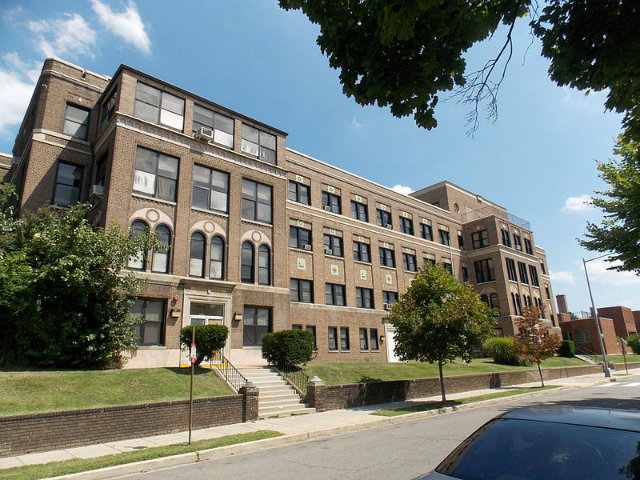 Photo by Farragutful (via Wikipedia)
Amid a citywide affordable housing crisis, a one-time home for Jewish seniors has sat vacant at Petworth’s southern border for nearly a decade. That is finally about to change.
After a failed proposal to turn it into a homeless shelter, a full public process that ended in a scuttled plan for 90 percent affordable housing, and yet another full public process, the city says it has picked a plan to turn the old Hebrew Home and the Paul Robeson School into housing.
“With the support of the community, we now have a path forward for this long-vacant property and a plan to create much-needed affordable housing for District seniors and families,” said Mayor Muriel Bowser in announcing that her administration has chosen a proposal from Victory Housing and Brinshore Development.
The project at 1125 Spring Road NW will have 187 units, 80 percent of which will be affordable housing. Of that total, 88 units will be available to seniors who earn less than 60 percent of area median income, with the remainder available to individuals and families at various percentages of area median income, or AMI. The developers are Illinois-based Brinshore and Victory Housing, the nonprofit development arm of the Archdiocese of Washington.
The two area ANCs ranked it as their top choice from a field of seven proposals because of the amount of parking and affordable housing
The buildings sit at the border between Columbia Heights and Petworth, two neighborhoods that have seen rapid gentrification since the construction of the Green Line in the early 2000s.
Built in 1925, the old Hebrew Home served as a retirement home for seniors, many of them poor immigrants, who were part of a sizable Jewish community in the area. Thirty years later, a bigger facility was opened in Rockville, Md., and the District government bought the land. It served as a health center for the homeless until closing in 2009.
The next year, facing a significant rise in homelessness, the Department of Human Services proposed making it a shelter. Neighbors resisted the plan and then-Ward 4 Councilmember Muriel Bowser backed them, arguing the area had enough group homes and shelters.
A few years later, the administration of then-Mayor Vincent Gray began a public process to come up with a use for the site, conducting a survey and hosting a series of meetings. It culminated in a plan for 90 percent affordable housing, which was unanimously approved by a local ANC.
After Bowser came into office, though, her administration undertook a review of all city projects and eventually determined that the plan couldn’t be enacted as proposed.
The process dragged out to the point that even the mayor acknowledged in 2015 that it had taken too long.
Last year, the administration again undertook a public process, repeating a survey and a series of community meetings. Some residents organized to show up en masse wearing stickers in support of affordable housing.
“I’m one of the people that the city has made space for,” Katie Ashmore, who moved to D.C. in 2011, told DCist. “I don’t want to see our neighbors pushed out.”
Affordable housing advocates say they are pleased with the decision to choose the Victory/Brinshore project.
“We are thrilled that Victory Housing will be developing the Hebrew Home/Robeson School site. In particular it’s terrific that Mayor Bowser followed the lead of neighbors, community leaders, ANC officials, and local organizations, who all supported Victory’s proposal,” says Jews United for Justice community organizer Sarah Novick.
There’s a particular resonance for some members of the Jewish community, who see the historic significance of the building as deeply entwined with social justice.
“I feel really differently about it than if it was a decommissioned public school or a parking lot. I would want them to build affordable housing, but I wouldn’t feel the same sense of responsibility and obligation,” says Rebecca Ennen, JUFJ’s deputy director for development and communications and a Petworth resident. “From a policy perspective city-owned land is this incredible opportunity to not be driven by only profit consideration and to make sure that we’re putting resources into making sure that poor and working class people can live in the city.”
Victory Housing & Brinshore Development proposal by Rachel Sadon on Scribd
Previously:
After Public Process, Activists Want Answers About The Future of Columbia Heights’ Hebrew Home
This post had been updated with comment from Ennen.