 Rachel Sadon
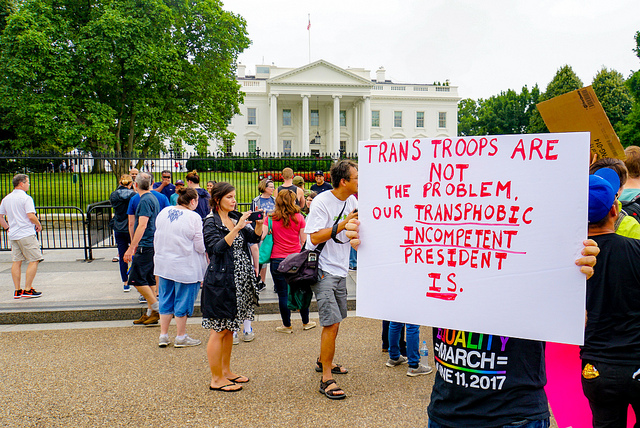 (Photo by Ted Eytan)
Two groups have filed lawsuits after President Donald Trump announced last month that the U.S. military would not allow transgender people to serve and then followed through on Friday with a directive that formally re-instituted the ban.
Lambda Legal and OutServe-SLDN immediately filed suit last week on behalf of three individuals, one of whom is currently serving in the military and two who seek to join, and two human rights organizations.
“Thousands of current service members are transgender, and many have been serving openly, courageously, and successfully in the U.S. military for more than a year—not to mention the previous decades when many were forced to serve in silence,” said Lambda Legal Senior Attorney Peter Renn. “Once again attacking a vulnerable population based on bias, political opportunism, and demonstrably untrue ‘alternative facts,’ President Trump is denying brave men and women the opportunity to serve our country without any legitimate justification whatsoever.”
The RAND Corporation found in a 2016 study there are about 2,500 transgender people out of 1.3 million active duty service members, and 1,500 out of 825,000 in the reserves (with upper end of estimates are 7,000 and 4,000 respectively). LGBTQ groups put the estimate even higher, at around 15,000.
The American Civil Liberties Union and the ACLU of Maryland also filed a lawsuit Monday on behalf of six currently enlisted service members.
“Every justification that the president has offered in support of the ban has already been thoroughly reviewed and debunked by the Department of Defense itself when it adopted a policy permitting military service by transgender individuals last year,” writes ACLU staff attorney Chase Strangio.
The administration of President Barack Obama made the decision last year to end the ban on transgender people serving openly in the military after a lengthy period of study.
“We’re talking about talented and trained Americans who are serving our country with honor and distinction,” said then-Defense Secretary Ashton Carter. While noting the decision involved taking “into account the unique nature of military readiness,” Carter cited recommendations from a RAND Corporation study that found minimal financial costs and no significant impact on readiness.
In announcing the ban in a series of tweets in July, Trump argued that allowing transgender military service members would involve “tremendous medical costs and disruption” without citing any evidence for the claim.
Pentagon leaders did not immediately implement the ban, saying they would wait for formal guidance from the White House. That directive was finally handed down on Friday, a month after the initial announcement.
“We hoped that the ill-advised ban would languish on the president’s Twitter feed, but unfortunately, he turned the tweets into a directive banning open transgender service,” said Strangio.
The guidance prohibits transgender individuals from enlisting and prevents funds from being spent on gender reassignment surgeries, while leaving the fate of currently serving service members up in the air. Trump has tasked Secretary of Defense Jim Mattis with coming up with a plan by February 2018 for addressing already enlisted transgender individuals.
Both lawsuits argue the ban violates the Fifth Amendment, which guarantees equal protection and substantive due process.
“We understand what it means to put our lives on the line and we’re ready to die for this country,” said Denise Brogan-Kator, a retired transgendered Navy service member at a protest in the wake of the initial announcement. “For [Donald Trump] to disrespect those service-members is the worst possible slap. It is a gut punch.”
Previously:
Transgender Service Members Share Their Stories At White House: ‘Our Patriotism Shouldn’t Have An Asterisk Next To It’
Trump Administration Will Bar Transgender Individuals From Serving In The Military
Pentagon Repeals Ban on Transgender People Serving Openly In The Military