 Rachel Sadon
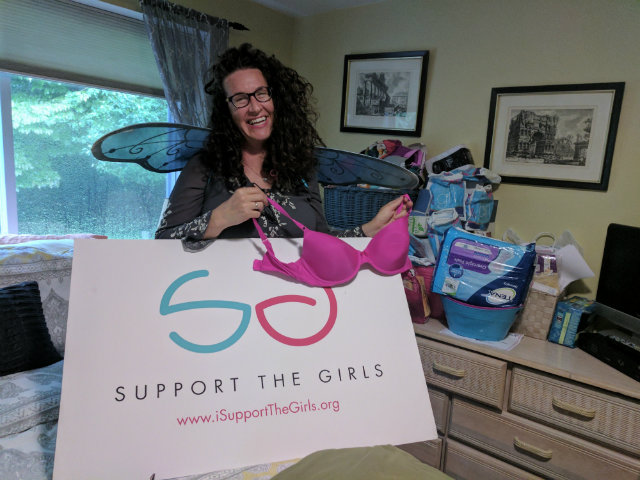 Dana Marlowe shows off the Support the Girls logo and a set of fairy wings that someone gave her. (Photo by Rachel Sadon)
Dana Marlowe never set out to become “the bra fairy,” and she definitely didn’t bestow the title on herself. After donating plain bras, lacy bras, training bras, sports bras, mastectomy bras, bralettes, bras of every size and color under the rainbow, though, she has rather earned it.
A one-time donation spiraled far beyond her original vision, leading Marlowe to found the non-profit Support The Girls. Between bras, tampons, and maxipads, the organization has collected and donated around 1 million products in less than two years.
“Bras are dignity. So many women that I have spoken with are using old leather belts to hold up their breasts. People have told me that ‘I have two, they’re 8 and 9 years old and I can’t afford a new bra because I need to eat.’ Or ‘I can’t go buy tampons because I need a hot meal or to feed my kid,'” Marlowe says. “So they’re going to use cardboard or take a maxipad and make it into individual tampons or use a ripped up t-shirt, or use paper towels and duct tape and do what they have to do. So this is about dignity.”
Long before the bras and menstrual hygiene products came into her life and basement in Silver Spring, Marlowe was already a successful social entrepreneur, running an IT consulting company that focuses on making technology accessible for people with disabilities. She hadn’t given any particular thought to the needs of women who are experiencing homelessness until two years ago, when a series of unlikely events, coupled with unflagging effort, turned her into the bra fairy—on top of her regular job.
“I didn’t dream this up. I didn’t have a marketing plan, or a business plan. I didn’t do a competitive analysis. I stumbled on it,” she says. “But I do have an entrepreneurial background and I knew I was on to something.”
 Marlowe loads boxes that she received in a 10-day span last month into her minivan. (Photo by Rachel Sadon)
That something started when Marlowe, approaching 40, decided to focus on her health. After a year of dieting and exercising, she’d dropped 35 pounds by the summer of 2015. Little in her wardrobe still fit, including bras.
At a Soma lingerie boutique in Bethesda where she went to buy better fitting replacements, Marlowe wondered if there was a way to repurpose all the gently used bras she still had sitting at home.
“I asked the sales associate ‘Can you refurbish bras like a computer?’ She laughed and said, ‘Are you an IT contractor?’ I was like ‘Yeah how’d you know?'” Marlowe recalls with a laugh. “But still, you know what I’m saying. I have perfectly good bras at home. Is there anything I can do with them—because bras are so expensive they cost so much money for, like, the lack of material.”
Bras are surprisingly challenging to make from a technical standpoint and they are nearly always handmade. A “day-to-day” bra at Victoria’s Secret runs around $40.
Even less expensive garments are a luxury that most homeless women can’t afford, along with things like tampons and maxipads. “If you don’t have these things, you think about it all the time,” says Alicia Horton, the executive director of Thrive DC, a non-profit that provides services to the homeless and vulnerable individuals.
The sales associate at Soma “told me four really important words that I had not really considered before. She told me ‘homeless women need bras,'” Marlowe recalls.
The lingerie store, it turns out, did donation drives, but only twice a year and one had just ended. Waiting six months was far too slow for Marlowe’s taste.
After doing some research, and finding a DCist story about efforts at Thrive DC to give bras and maxipads to homeless women, she gave the non-profit a call and asked if they could use 16 gently used bras.
Thrive said yes, and told Marlowe that they also needed tampons and maxipads. “That’s when it hit me, what it must be like to be a woman experiencing homelessness and have your period,” she says.
When Marlowe relayed that newfound knowledge, a friend realized she’d also never considered those particular needs—and asked Marlowe to take in her own 30 bras along with an extra donation off maxipads.
And so 16 bras had become 46, and Marlowe realized that others might also have a lingerie drawer stuffed with bras they no longer needed. She put out a post on Facebook and offered to take other friends’ bras in, too.
It would be the first of several times that one small gesture spun into an unexpected outpouring of support.
 There are thousands of bras, tampons, and maxipads in Marlowe’s home. (Photo by Rachel Sadon)
Marlowe got so many comments and shares of her single post that it was challenging to keep track of them. So she decided to create a Facebook group. “Support the Girls,” she dubbed it.
From there, friends, family members, strangers, synagogues, a dentist office, yoga studios, and others all took up collections, and Marlowe spent the next few months running around picking them up.
Her two children even got in on the action, coming home from summer camp with donations. “My kids became bra mules. In their little backpacks, the moms of their friends would put them in their backpack, and they were coming home with pads and tampons and bras,” Marlowe says. Meanwhile, people kept asking her to put off the final run to Thrive.
“They were like wait, don’t donate yet, my drive hasn’t finished—as if this was a thing,” she says. “It wasn’t. It was a passion project that exploded.”
Finally, Marlowe scheduled a donation date: it was time to get the 1,051 bras and 7,100 menstrual hygiene products out of her basement. A Washington Post reporter tagged along, and wrote a story about the effort.
“I thought it was a one and done,” Marlowe says. “I was wrong. Really, really wrong.”
After the Post story ran, her phone became unusable. Marlowe’s inbox, her phone number, her social media accounts were flooded—people wanted to learn more, they wanted to submit donations, they wanted to interview her.
She faced another choice: get the word out that this was meant to be a one-time venture that had spiraled beyond her original vision, the equivalent of a digital “do not disturb” sign—or take it to another level.
Marlowe roused her husband from early morning sleep and asked his help in building a website.
“I bought isupporthegirls.org,” she told him. “It’s on something called WordPress. I sent you a link on how to work in WordPress.”
 At a recent conference, women took up a collection that ended up totaling 6,000 bras, shown waiting to be sorted in Marlowe’s basement family room last month. (Photo by Rachel Sadon)
Most people who are already working 50-60 hour weeks don’t normally take on a side job starting a non-profit. But Marlowe saw a need that wasn’t being addressed, and had a background in social entrepreneurship well-suited to solving it.
What quickly became clear from her flooded email inbox was not just that people were interested in donating but that there was an equally tremendous need.
“I could have been done, but what nobody else saw but me was how many people had products. But I was also receiving constant emails and messages—’Hi, I’m a woman in need,’ ‘Hi, I’m a shelter in New York,’ ‘ Hi, I’m a shelter in California. Nobody’s sending bras,” Marlowe says.
“I’m like, did they not just read that I just got rid of everything? Was that not clear in the Washington Post weekend Metro section? And I was like wait a second, what if I can marry all these people who want to donate with all these people who need? And I just said I’m going to figure this out.”
There’s a Jewish teaching: “You are not obligated to complete the work, but neither are you free to desist from it.”
“This was me not desisting,” Marlowe says.
Four months after she first had an epiphany in a bra store, Marlowe got to work in earnest, starting with a PO Box. Up until that point, the dentist, the yoga studio, and everyone else—essentially friends of friends of friends—were just sending them straight to her house.
A year later, the post office workers not only know Marlowe by name, but several have her phone number saved. One time, she went on vacation for a few weeks and it took four trips in a minivan to retrieve all the boxes.
 Marlowe does pick-ups every week or two of dozens of boxes at a time. The post office workers know her by name. (Photo by Rachel Sadon)
With the help of volunteers around the world, Marlowe set up an affiliate network, letting people around the country replicate exactly what she had done, and is still doing, in the D.C. area: collect bras and donate them locally. Support the Girls affiliate groups are located in dozens of U.S. cities and five countries, with more than 75 volunteers working on the project.
The numbers in such a short time are staggering: 135,000 bras and 850,000 menstrual hygiene products in less than a year.
Most of those go to directly to the local communities where they were donated, places like homeless shelters, domestic violence shelters, refugee resettlement homes, foster care agencies, LGBTQ agencies, and homes for pregnant teens. Support the Girls also does disaster relief, and they are currently working to get thousands of bras, tampons, and pads to displaced women in Texas.
Marlowe been recognized around the country for her efforts, which have helped open up long overdue conversations about the specific needs of women facing homelessness.
“Menstruation is still taboo, and I’m out there taking about it in front of thousands of people, and I’m a very relatable, normal person,” Marlowe says. “‘I’m not a medical professional, I’m not a social worker. I’ve never talked in front of people before about periods, and now I go on stage and I hold up tampons and bras.”
Legislators have been influenced by such frankness and grassroots activism, introducing laws in several states to exempt menstrual products from sales tax and working to get free products in schools, homeless shelters, and jails. The D.C. Council voted last year to end a tax on feminine hygiene products and diapers for kids and adults, though it has not yet been implemented.
After all that, Marlowe has accepted the “bra fairy” nickname, if a bit begrudgingly, along with a set of fairy wings that someone gave her.
“I think I’m just somebody who is just willing to do something. And I think that’s really important for people to hear, is that anybody can do something to give back to others,” she says. “It doesn’t have to be your bailiwick. It doesn’t have to be your subject matter area of expertise. It doesn’t have to be what you studied. … I never thought I was going to be talking about bras and tampons as much as I do.”
For more information, check out Support The Girls
Previously:
For Homeless Women In D.C., Maxipads And Bras Can Be Rare Luxuries