 Rachel Sadon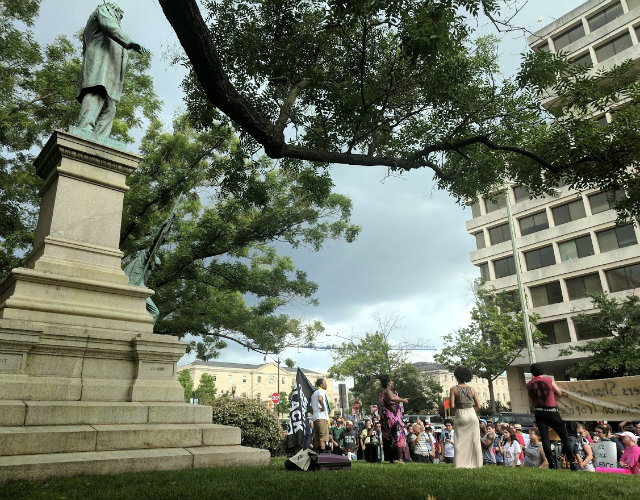
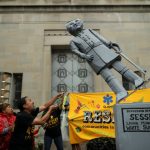
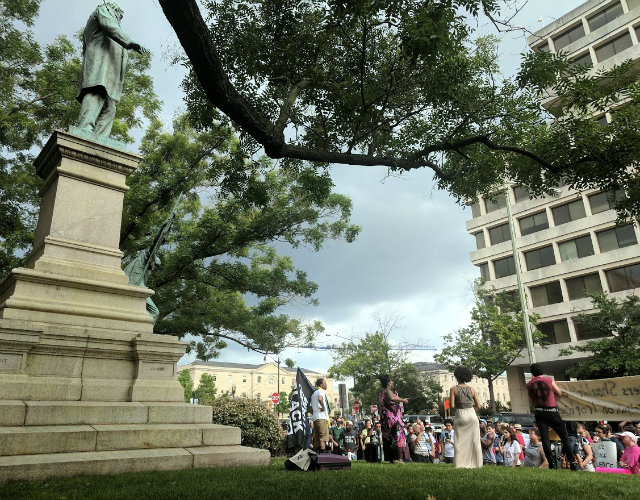 People rallied against the Albert Pike statue at one of a series of protests last month. (Photo by Rachel Sadon)
One of the first things on the D.C. Council’s agenda after returning from summer break was sending a message to the National Park Service that the city doesn’t want the statue of a former Confederate general that currently sits in Judiciary Square. The District’s leadership is in agreement. The Freemasons, who erected the monument, stand ready to remove it. But as with so many other things in the District, Congress stands in the way.
“I do not think we should be honoring with a statue a former Confederate general that is literally three blocks from the U.S. Capitol,” says Ward 2 Councilmember Jack Evans, who represents the area where it is situated. Evans and Ward 3 Councilmember Mary Cheh introduced a resolution at the D.C. Council on Tuesday calling for NPS to honor the city’s request.
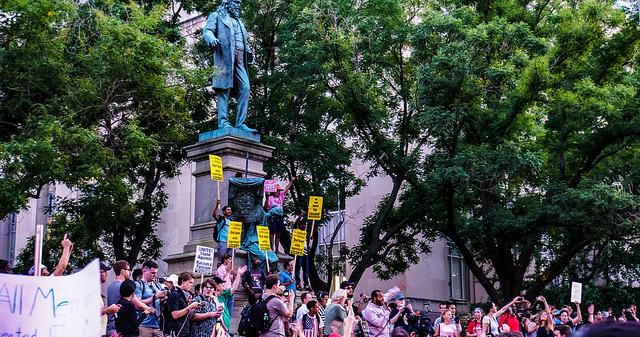
In the wake of Charlottesville, the statue has been the site of several protests, but there’s little D.C.’s elected leaders can do to get it removed—not that they haven’t tried. It sits on a federal site, and is maintained by the National Park Service.
No statue has been removed from NPS-controlled land for decades, possibly ever, according to a spokesman. The National Park Service says it would only do so—regardless of whether or nor Congress authorized it, or how it conflicts with modern day values—is if directed by legislation.
They have told District officials that it would take an act of Congress to take the Pike statue down—and if D.C. leaders try to circumvent that process and remove it themselves, they’ll be arrested.
 (Photo by Ted Eytan)
In the world of the Freemasons, Albert Pike is a revered figure for this contributions to the fraternal organization. They continue to honor him for writing a seminal text of the organization and for his work as a “jurist, orator, philosopher, scholar, soldier, and poet [whose renown] extends throughout the world.”
The Freemasons tend to leave out Pike’s brief, spectacular failure as a Confederate general when memorializing him. After losing badly in battle, Pike deserted his troops and was charged with treason by the Confederates; the United States government later charged him for the same crime.
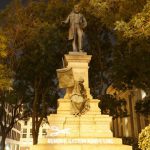
The 11-foot bronze statue, which now sits on a pedestal at 3rd and D streets NW, was sponsored and paid for by the Freemasons, and it doesn’t reference his war activities. Congress approved its placement on land administered by NPS in 1898 and it was unveiled two years later.
There was some debate about it in the early 1990s when followers of Lyndon LaRouche draped white sheets over the statue on a weekly basis to call attention to Pike’s alleged KKK membership (that’s never been proven, but Pike was a known advocate of slavery and segregation). Then At-large D.C. Councilmember Bill Lightfoot introduced a bill calling for the statue’s removal, but it didn’t go much further and the controversy faded from view.
In the wake of a larger national discussion about memorials that honor Confederates, activists have brought up the issue again.
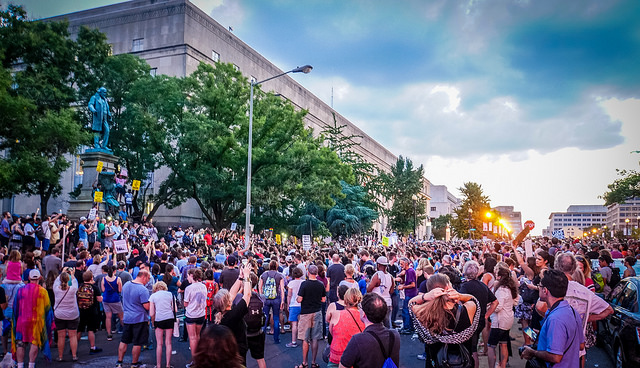
Several rallies in the immediate wake of Charlottesville involved marching to the Pike statue to draw attention to the man it honors. “[Pike] is a guy who loved slavery so much that he quit two political parties. He wrote pamphlets about it, and then when the civil war started, he raised three regiments of troops,” Eugene Puryear of the Stop Police Terror Project told a crowd of protesters.
At-large Councilmember David Grosso quickly called for its removal and sent a letter to NPS that was signed by more than half the D.C. Council and the D.C. attorney general. Mayor Muriel Bowser said that she agreed that it ought to be taken down.
Carlos McKnight, a 19 year-old college student, organized a rally at the site to publicize the issue.
“It doesn’t matter that he’s not being honored as a Confederate general. He still has a long history of supporting racist causes,” he told DCist. “I really commend city leaders on taking a stance on the statue, on removing it. I think that sends a strong message to the Trump administration that D.C. is trying to stand up against racism and white supremacy.”
In another demonstration, artist Robin Bell pointed his projector at the statue and beamed a pair of scissors and a dotted line that read “remove racism above the line.”
 (Photo by Ted Eytan)
Remembering what had happened in the early 1990s, Evans says that he had quietly brought up the issue of the statue with the Freemasons about a year ago, before it came into the public eye again. At the time, according to Evans, its leadership said they didn’t want to take it back.
Publicly, the Freemasons haven’t said much about the issue, but it turns out that they are now willing to support efforts to remove the statue from public land and re-take possession.
“A core tenet of Freemasonry is that we strive to bring people of all races and creeds together in harmony and the fact that this statue should become a divisive factor in the community clearly indicates that the original purpose for which it was erected is no longer being served,” writes Sovereign Grand Commander Ronald Seale in a letter to Evans. “Accordingly, the Supreme Council of Scottish Rite Freemasonry, Southern Jurisdiction, USA will support an action by the District of Columbia to remove the statue forthwith so that it shall not serve as a source of contention or strife for the residents of our community.”
Thinking that the issue seemed to be solved, Evans went about trying to think through the logistics and the cost of moving Pike.
“[The Freemasons] said ‘we can provide a flatbed truck.’ And I know someone who has a crane. I had a crane lined up to pick it up and put it on the flatbed truck and haul it out of town,” said Evans, noting that it would have been entirely free to the city and federal governments to arrange.
First, though, he reached out to one of the regional directors of the National Park Service. “Can we just come and pick it up and take it out?” Evans asked.
The reply came back by text.
“It’s such a government response. You have to appreciate this response,” he told DCist, pulling up the exact wording: “Our attorneys have determined that the statue can not be removed unless Congress passes a law directing us to do so.”
NPS officials say they have no record of a monument or statue being removed from the federal parks system in past few decades, and historians are digging through the archives to see if there are even any earlier instances in the agency’s history. As they work to respond to D.C.’s unusual request, spokesman Mike Litterst tells DCist that it is NPS policy not to remove a statue for any reason.
Many commemorative works maintained by the National Park Service including monuments and markers were specifically authorized by Congress. In other cases, a monument may have preceded the establishment of a park, and thus could be considered a protected park resource and value. In either of these situations, legislation could be required to remove the monument, and the NPS may need to comply with Section 106 of the National Historic Preservation Act and the National Environmental Policy Act before removing a statue/memorial.
Even if a monument wasn’t specifically authorized by Congress, NPS policy says they can’t be taken down without federal legislation because they are considered “historic features.”
Still other monuments, while lacking legislative authorization, may have existed in parks long enough to qualify as historic features. A key aspect of their historical interest is that they reflect the knowledge, attitudes, and tastes of the people who designed and placed them. Unless directed by legislation, it is the policy of the National Park Service that these works and their inscriptions will not be altered, relocated, obscured, or removed, even when they are deemed inaccurate or incompatible with prevailing present-day values.
Evans is ruing his decision to consult NPS in the first place. If he had just gone in and taken it, “do you think they would have made me put the general back?” he asks.
At this point, though, NPS told Evans that he and/or his crane operator would be arrested for trespassing and destruction of property should they undertake such a ploy. “One of my ideas was to get all 13 councilmembers to go down and then they could arrest all 13 of us,” Evans says jokingly.
Strictly speaking, this isn’t a home rule issue. The same sort of problem could play out on federal land in any state. But D.C. is unique in two ways: about 30 percent of District land—small triangles and pocket parks all the way up to Rock Creek Park—is controlled by the federal government, and the District doesn’t have voting representatives to advocate for such issues.
Instead of heading to the office of a D.C. senator, Evans has worked to arrange a conversation with Senator Cory Booker (D-NJ), who has already introduced a bill to remove the statues that honor Confederate generals in the Capitol’s National Statuary Hall Collection.
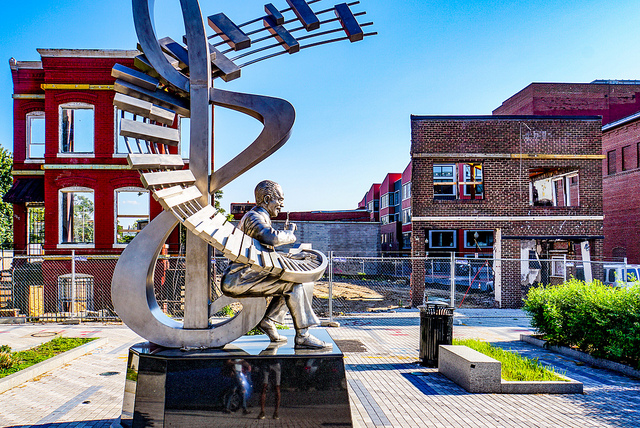 The Duke Ellington statue at Florida Avenue and T Street NW. (Photo by Ted Eytan)
As D.C. leaders continue trying to get the Pike statue taken down, there’s also a parallel push to erect new statues—ones that better reflect the District’s diversity.
In a city crammed with memorials, there are only a few dozen that feature women or African Americans. Ward 5 Councilmember Kenyan McDuffie has proposed shifting the ratio a bit by erecting eight statues, one in each ward, of native Washingtonians who are women, people of color, or both.
Currently, he has said, there’s only one existing statue that fits the bill: Duke Ellington.
“The District is the birthplace of a lot of heroes and sheroes who I believe have had an indelible impact on local and national historical events,” McDuffie says. “Yet when you look around the city, you don’t see historical figures memorialized in statues that necessarily reflect the diversity of the city.”
As he raises two daughters in D.C., he wants to see that change. A statue is “something that is tangible, that people can go to, both young and old, but in particular young people can see a reflection of themselves in a city as diverse as the District of Columbia, whereas today they can’t”
Some of the people who McDuffie would personally want to see honored include Euphemia Lofton Haynes, the first African American woman to earn a PdD in mathematics; the physician and surgeon Charles Drew; Senator Edward Brooks; and the jazz singer Shirley Horn.
But the only person the legislation names specifically is Charles Hamilton Houston, the lawyer who played a prominent role in dismantling Jim Crow laws (McDuffie notes that Judiciary Square, where the Pike statue currently sits, would be a particularly appropriate location to honor Houston). The others would be determined through a community engagement process.
In response to some criticism that the bill is too narrow—honorees must be native Washingtonians—McDuffie says it is important to see the bill as a “floor not a ceiling” with respect to how many statues can be erected. It simply sets a minimum of eight.
A hearing for the Charles Hamilton Houston and Other Diverse Washingtonians Commemorative Works Amendment Act of 2017 is scheduled for October 5. Nearly the entire D.C. Council joined McDuffie in introducing or co-introducing the legislation.
“This came up as a bill independently of the national conversation [about removing Confederate statues]. But I think it fits neatly into the national conversation and, quite frankly, is a welcome contrast,” McDuffie says. “We’re talking in the District about erecting statues to people who have contributed to the District of Columbia and the United States, internationally, who I think for a long time in our history have been overlooked when it comes to erecting statues, and that’s women and minorities.”
Previously:
Mayor, D.C. Councilmembers Want Statue Of Confederate General On Federal Land Removed