Rachel Kurzius
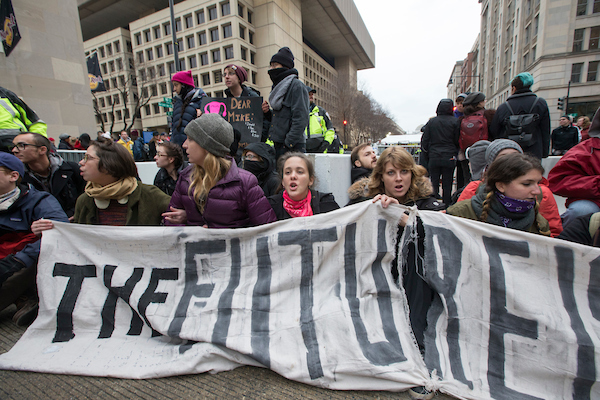 Anti-Inauguration protesters block a security checkpoint on January 20. (Photo by Alex Edelman)
In D.C. Superior Court on Friday, a government prosecutor argued that Facebook “likes” could be probative, meaning they could be used as a piece of proof.
Later in the hearing, Assistant U.S. Attorney John Borchert gave an example of a post that could be evidence of criminal activity—”How to dress in black bloc for a protest”—before slightly walking back the claim.
“A like in itself is not, by itself, evidence of criminal activity,” Borchert said. He declined to clarify further after the hearing.
The discussion came up as people involved with the planning of protests on Inauguration Day in D.C. were in court to fight a search warrant that would require Facebook to give prosecutors 90 days-worth of their account information, including “likes.”
Lawyers representing Facebook, the holders of the Facebook accounts in question, and three “Does”—unnamed people who were Facebook friends of those accounts—made their cases to Chief Judge Robert Morin.
For months, Facebook fought a gag order from the U.S. Attorney’s Office in D.C. that prevented the company from telling Legba Carrefour and Lacey MacAuley that they were the subjects of a search warrant, along with a “DisruptJ20” Facebook group page (now called “Resist This”) moderated by Emmelia Talarico.
But when government prosecutors stopped defending the gag order, Facebook could notify the three users involved with planning Inauguration Day activities that the government sought their data. The ACLU of D.C. has taken up their case and filed a motion in late September for the courts to either quash or narrow those warrants, which it says are overly broad.
The search warrants are part of the investigation into felony rioting on Inauguration Day, and include posts, photographs, friend lists, and direct messages. Boechert said that the government is only “looking for evidence of one particular criminal activity.”
The U.S. Attorney’s Office in D.C. is currently prosecuting nearly 200 people with felony charges over the destruction in downtown D.C. on January 20, and the defendants face about 75 years in prison. The first trials are scheduled to begin in November and are scheduled through 2018.
However, Carrefour, MacAuley, and Talarico were not among the the 234 people arrested by D.C. police during or in the aftermath of Inauguration Day nor do they face charges.
Prosecutors have deemed the events a “violent riot” that caused more than $100,000 in damages to buildings, property, and vehicles, and minor injuries for six police officers.
But while images of destruction dominate the public’s perception of Inauguration Day protests, the group in question, Disrupt J20, also facilitated blockades at security checkpoints and a peaceful parade and gathering space at McPherson Square called the “Festival of Resistance.”
Looming large over the Friday hearing was the case of Dreamhost, an online service provider that fought government prosecutors over their demands for user data of more than 1.3 million visitors to the DisruptJ20.org website, along with addresses, phone numbers, bank accounts, and other personal information for thousands of subscribers.
Morin granted a scaled-back version of the government’s request under court supervision and, earlier this week, ruled on behalf of Dreamhost that the server should redact users’ names and other identifying information at first. If there’s criminal activity detected, then the company would have to provide further details.
While the case heard on Friday is ostensibly one between Facebook and the government, ACLU attorney Scott Michelman argued that account holders MacAuley and Carrefour “cannot rely on custodians of information” to protect their data, and need to intervene on their own behalf, because personal and First Amendment-protected information would be swept up in the government’s warrant.
Michelman characterized the warrant as “let’s get the whole account and see what we can find … It’s the broad disclosure of everything that raises political dangers.”
He and Paul Alan Levy, the Public Citizen attorney representing the Does, both argued that providing the information could have a chilling effect on online political activity, particularly on Facebook, where many organizers post details about forthcoming demonstrations and events.
Levy said that prosecutors across the country are watching this case to see what kind of precedent it sets.
MacAuley says that, since she learned about the search warrant, she still logs on to Facebook to post personal content but “people have unfriended me because they’re afraid of being investigated” and sees the search as “an investigation of all D.C. activism.”
Borchert said the government wasn’t interested in the overall list of 6,000 people who “liked” J20’s group page or the overall friend lists of MacCauley and Carrefour, but instead in posts that could provide proof of criminal activity. He also agreed to limiting photo requests to a shorter date range: January 20 through February 9.
For Facebook, represented by John Roche of Perkins Coie, the main question was what kind of technological capacity the company had to search through data and provide the parts that are relevant to the investigation to the government. (Cat photos, Boerchert said, would be an example of irrelevant posts.)
That was one of a few suggestions for a “minimization project” to narrow the search warrant, which also included having a “special master” who goes through the data first to segregate it by relevancy (which Morin did not seem keen on), or having a “taint team” of government investigators who are walled off from the investigation working on going through the data.
Borchert, the assistant U.S. attorney, said that “searches are best done when the government does the search,” noting that a team of walled-off prosecutors still means the government has the information, just that their search is more cumbersome.
He described the way the government would search Carrefour and MacAuley’s data: “a physical, front-to-back, scroll through, find what you need and move on.”
To Michelman, that was precisely the problem, characterizing a “front-to-back” search as a fishing expedition. That’s why we’re here today.”
Borchert wanted Morin for a motion to compel Facebook to grant the public account information immediately.
“Why do you need a warrant?” asked Morin. “If it’s public, it’s public.”
There was some confusion about what parts of the accounts were public already, versus private. Morin requested that Facebook provide information about its capacity to search by subject matter, and that the ACLU provide information about what account information is already available publicly.
“I’m struggling with the practicalities” of limiting the search, said Morin. “I’ll get the order out as soon as I can.”
Previously:
Prosecutors Are Demanding Facebook’s Data On Inauguration Protesters. The ACLU Is Trying To Stop Them
Judge Denies Motions To Dismiss Rioting Charges Against Inauguration Day Protesters
Anti-Trump Protest Website Host Needs To Give Government User Data, Judge Rules
DOJ Demands Info On More Than A Million Visitors To Anti-Trump Website
How Many People Should Be Held Responsible For Smashed Windows On Inauguration Day?
Inauguration Day Protester Sentenced To Four Months Behind Bars
ACLU Is Suing D.C. Police For Excessive Force, Unlawful Arrests On Inauguration Day
Citing ‘Fatal Defects’ In Government Case, Lawyers Move To Dismiss Charges Against Inauguration Protesters
D.C. Budget Includes $150,000 For Review Of Police During Inauguration
Even More Felony Charges For Inauguration Day Protesters
Prosecutors Are Mining Data From The Cellphones Of Inauguration Day Arrestees
Police Complaints Board Wants Independent Investigation Of Inauguration Day Conduct
Journalists, Legal Observers Among Those With ‘Unprecedented’ Felony Charges For Inauguration Day Protests
Activists Plan To Block A Dozen Inaugural Security Checkpoints
‘We Can Do A Lot With Few People’: DisruptJ20 Plans To Wreak Havoc On Inauguration