Rachel Kurzius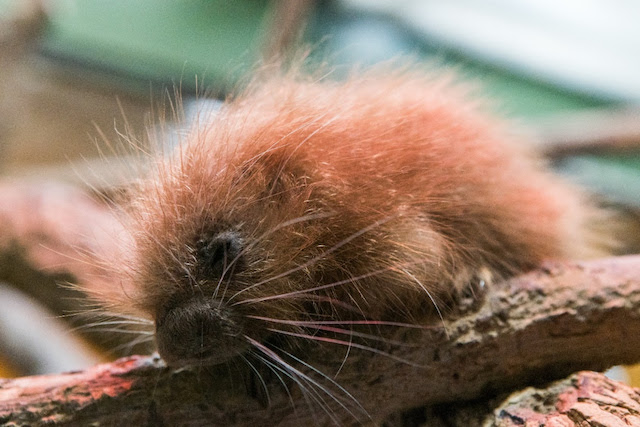
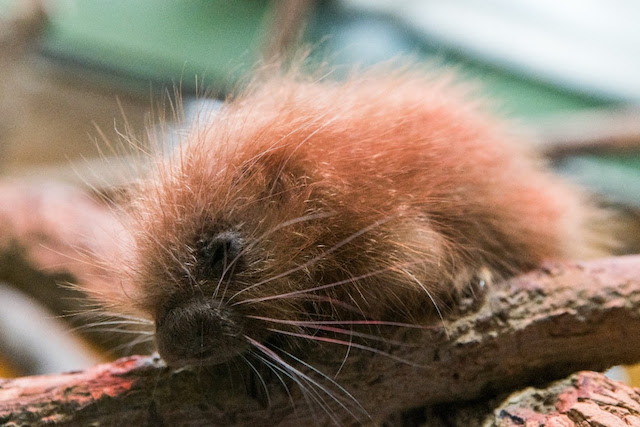 A prehensile-tailed porcupine, born Oct. 19, in its habitat at the Smithsonian’s National Zoo’s Small Mammal House. (Photo by Roshan Patel / Smithsonian’s National Zoo)
For the fourth time since December 2015, the Smithsonian’s National Zoo prehensile-tailed porcupines Bess and Clark brought life into the world.
The latest porcupette—yes, porcupette is a word, even if my phone still tries to autocorrect it—was born on October 19 weighing 314 grams. “So far it’s gained a good amount of weight,” says Kenton Kerns, assistant curator at the zoo’s Small Mammal House. As of Wednesday morning, it clocked in at 400 grams.
Beginning that first night, mother and child were able to nurse without issues.
Thankfully for Bess, porcupettes are born with soft quills, which then harden in the span of minutes. It’ll be fully quilled in a month or two.
While keepers won’t know the porcupette’s gender until the completion of a DNA analysis of its quill, it is already on view with Bess and Clark at the Small Mammal House.
The youngster’s siblings are no longer in D.C. First-born Charlotte now lives at Lowry Park Zoo in Tampa, Chloe was transferred to the Little Rock Zoo, and Rico is now residing at the Maryland Zoo in Baltimore.
The Association of Zoos and Aquariums’ Species Survival Plan decides where the porcupines will go, along with all of the other animals in the zoo’s care.
The latest porcupette “is an important ambassador and important genetic stock for entire population,” says Kerns. The prehensile-tailed porcupine, one of 18 “New World” porcupine species, is native to South America.
All of the three previous kids of Bess and Clark had different personalities. Charlotte enjoyed human contact, Chloe was a bit more independent and not eager to be held, and Rico was “less enthused with being handled” when he still lived in the same exhibit as his parents, per Kerns, though “was more readily accepting of his keepers” when he struck out on his own.
So what do we know about the burgeoning behavior of the latest porcupette? “It’s sleepy, though it seems active at night, which is perfect” Kerns says, which makes sense for a nocturnal animal. He adds that while some new porcupines are more vocal, “this one is more calm and easygoing.”
Keepers train the porcupines to go willingly into a crate so they can take the animals to different exhibits, locations, and the hospital for its annual check-up. They even coached Bess to submit to an ultrasound by using a rewards system of nuts and bananas, getting so far as putting ultrasound gel on her belly. Unfortunately, though, her quills were too thick for the ultrasound to get a good view.
Bess is shouldering the rearing responsibilities as the new porcupette lives with her and Clark. “Based on observations, [Clark is] there, he’s around, but he’s not doing any type of paternal care,” says Kerns.
Bess and Clark are monogamous, mainly by default, though they exhibit some reproductive behavior common among prehensile-tailed porcupines in the wild.
“The males will mark their territory—by that I mean the female—by urinating on them,” says Kerns. “At the zoo, we have seen that happen here right before breeding.”
So will the two of them breed again? That all depends on the Species Survival Plan, which updates its recommendations annually. “We balance the health of the animals along with the needs of the population,” says Keans. They don’t want to “flood the market” with Bess and Clark’s genes, plus they’ve got to weigh whether more births will be riskier for Bess as she ages. She’s 11 right now, and Clark is eight.
So how does Kerns feel knowing that the new porcupette could get shipped off soon? “You get attached to these animals and you work with them everyday, so it’s hard to say goodbye,” he says. “But it’s more rewarding because we’re definitely part of something bigger—we’re here to take care of animals, but we’re here to save them.”
Previously:
Bao Who? Look At This Adorable New Porcupette Instead
National Zoo Welcomes New Porcupette As D.C. Remembers ‘Porcupette’ Is A Word
Meet Charlotte, The National Zoo’s Baby Porcupine