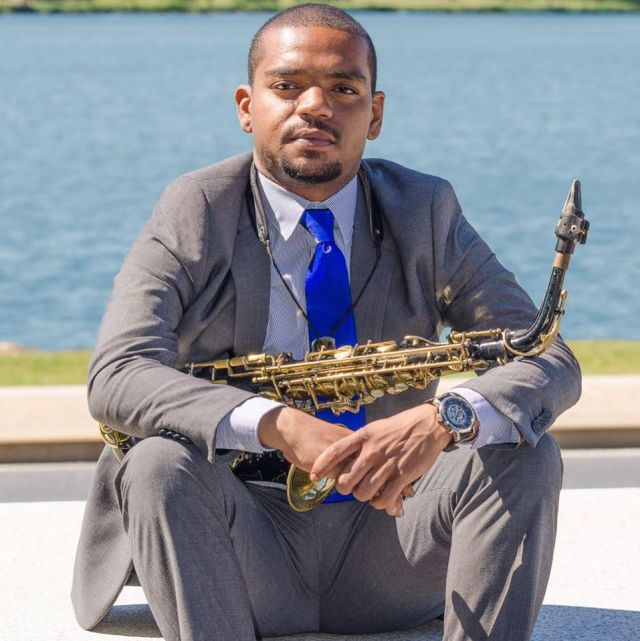
 Herb Scott, musician and jazz advocate, performs on Friday at the Atlas (Photo via Facebook).
By DCist Contributor Joshua Leach
When most people think of jazz, people like Louis Armstrong or Tommy Dorsey might
spring to mind. Crystal sets playing Glenn Miller’s “In the Mood” or Benny Goodman’s “Sing, Sing, Sing” would likely pop into their heads. For most, House Concurrent Resolution 57 from the 100th Congress would be the absolute last thing they would think of, if they even knew about it at all.
That’s not the case for area saxophonist Herb Scott.
“The very first jazz performance I saw live was the Smithsonian Jazz Masterworks Orchestra. That orchestra was created because of [H.Con.Res.57],” said Scott in a recent interview with DCist.
The bill that funded the orchestra made jazz “a national American treasure,” and that concert inspired Scott to pursue music. The D.C. native studied at multiple schools in the area before getting his degree at Michigan State. According to Scott, it was his time at Michigan State that opened his eyes to the political nature of music, and of jazz in particular.
“One of my professors told me that if I want to raise the pay for jazz musicians, the middle class had to care,” Scott said.
He returned to the District amid the Great Recession and struggled to make a living doing what he loved. That didn’t stop him from performing in most of the area’s top jazz rooms, including the Atlas, where he performs on Friday. However, it’s Capitol Hill’s Mr. Henry’s that has become a musical home for Scott through the weekly jam session he runs on Wednesday nights.
“It’s my favorite night of the week,” says Cathy Nagy, who has bartended the jazz jam since it’s inception in 2015. “It’s unlike any other night, you just never know on Jazz Jam night who’s going to roll through here.”
The Jazz Jam is open to anyone, though musicians and listeners should first familiarize themselves with jam session etiquette. Most surprisingly, D.C. Council members often frequent the club as a result of the tireless advocacy work Scott engages in along with other prominent area musicians such as vocalist Aaron Myers.
“A number of venues were closing and we didn’t know why,” Scott said. “Through over one hundred different meetings [with council members], we concluded there were a number of issues the jazz scene has to address.”
The most prominent and obvious issue is that of artists getting paid for performing and the ability of venues to compensate musicians. Scott and his colleagues went so far as to draft legislation for council members’s consideration.
“The key components of the legislation were a registry for artists to self-register [and] a sales-tax rebate that would allow owners of music venues to be able to provide more money to musicians,” Scott explained.
The registration element was important because it would generate more accurate data on the number of artists in the city who depend on performance income to meet their day-to-day needs. Scott hoped that this could significantly change the amount of funding for the D.C. Commission on the Arts and Humanities, which could in turn be used for artist grants.
The legislation died in committee. Undeterred, Myers and Scott formed the Capitol Hill Jazz Foundation, a group that would “act as the economic activist for the D.C. jazz community.”
Scott is also taking his cause to Congress. He has been working to re-establish a jazz caucus within the House of Representatives, which would bring awareness to issues facing jazz musicians and would give Scott allies on the Hill. Scott cites John Conyers (D-MI), Steny Hoyer (D-MD), and Doug Collins (R-GA) as members who have shown interest in his efforts.
Scott has secured more than $20,000 in funding for his foundation and staged a successful jazz festival during the first weekend of October, featuring Grammy-winning bassist and area native Ben Williams, as well as headliner Frank McComb. The foundation and festival received official recognition from D.C.’s congressional representative, Eleanor Holmes Norton.
“In five years, we want to say we were able to give money to the UDC jazz program, and because of that, they have [more] resources, they have guest artists; [that] we provided a $50,000 grant to a club to improve their sound system and increase the pay of their musicians; [that] we provided homeless musicians with funding for housing,” Scott said.
The Herb Scott Quintet performs at the Atlas on Friday, November 3, at 8 p.m. $25-$32.