Rachel Kurzius
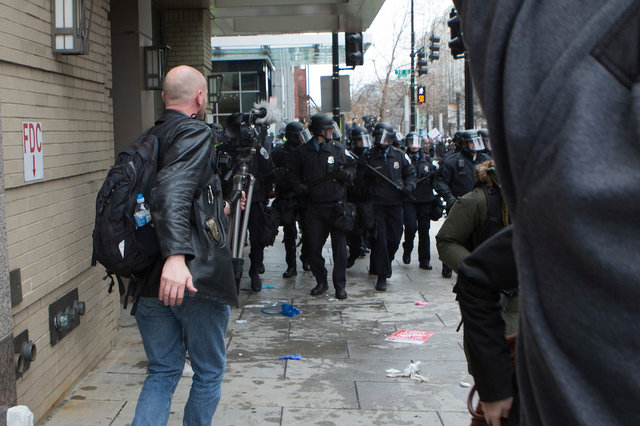 A journalist documents police action on Inauguration Day. (Photo by Alex Edelman)
The U.S. Attorney’s Office of D.C. announced on Wednesday that it was dropping charges against eight defendants who were set to face trial for their alleged role what prosecutors call a “violent riot” in downtown D.C. on Inauguration Day.
It’s the latest in a slew of dismissals from the U.S. Attorney’s Office, which at one point had charged 230 people with felony rioting, among other counts. But in the two jury trials held so far, prosecutors have failed to secure any convictions. Plus, a judge has sanctioned the U.S. attorneys heading up the case for withholding evidence from the defense.
So how did we get here? And what comes next? Let’s break it down.
Why were hundreds of people arrested on Inauguration Day?
A group that called itself DisruptJ20 (short for January 20th, the date of the Inauguration) planned a series of demonstrations for the day. “We want to undermine the legitimacy of the incoming administration by ruining the inauguration,” organizer Legba Carrefour told DCist at the time. Those plans included blocking security checkpoints, a permitted march called the Festival of Resitance, tents and information at McPherson Square, and an unpermitted Anti-Capitalist, Anti-Fascist Bloc march meeting at Logan Circle at 10 a.m.
During the course of that Anti-Capitalist, Anti-Fascist march from Logan Circle toward Franklin Square, some participants smashed windows and spray-painted graffiti on local businesses. The U.S. Attorney’s Office called it a “violent riot” that caused approximately $100,000 in property damage and resulted in minor injuries for six police officers.
About a half hour after the protest began, D.C. police deployed pepper spray and sting balls as they began the process of mass arresting hundreds of marchers. Officers surrounded a large group of demonstrators—which included journalists, medics, and legal observers—at 12th and L NW.
Is that the normal practice for MPD?
D.C. police hadn’t engaged in any mass arrests since the District was sued over the practice during Pershing Park demonstrations in 2002. Those mass arrests were deemed unconstitutional and cost the city millions of dollars in lawsuits.
A little more than a month after the Inauguration Day arrests, the Office of Police Complaints called for an independent investigation into MPD’s Inauguration Day conduct. That investigation is still underway.
There are also civil lawsuits against the city and MPD, including one from the American Civil Liberties Union of D.C., which alleges excessive force and unlawful arrests. (Keith DeVille, the commanding officer on Inauguration Day, said during the first trial that “criminal convictions would perhaps limit our civil liability in the matter.”)
So what kind of criminal convictions are we talking about here?
Last April, a superceding indictment added even more charges for the defendants, who at that point faced 70 years behind bars. Many, though not all, of the journalists who had been charged had seen their charges dropped.
Prosecutors wanted to begin trials nearly a year later, in spring 2018, but judges insisted that the pace be quickened. And so, the first trial began with six defendants right before Thanksgiving 2017.
What was the evidence in the first trial?
Assistant U.S. Attorney Jennifer Kerkhoff acknowledged that there was no evidence that the six defendants—Oliver Harris, Jennifer Armento, Britne Lawson, Michelle Macchio, Alexei Wood, and Christina Simmons—destroyed any property. Instead, she argued, by taking part in the demonstration while wearing all black, they aided and abetted the people who did smash windows.
As Assistant US Attorney Rizwan Qureshi put it, the group was the “getaway car” that allowed the troublemakers to avoid getting caught.
Prosecutors brought out business owners impacted by the property destruction, shared texts and other messages gleaned from mining arrestees’ phones, and also entered undercover videos from DisruptJ20 planning meetings taken by James O’Keefe’s Project Veritas group into evidence.
Wait, *that* James O’Keefe?
That’s right. O’Keefe’s Project Veritas records undercover videos aimed at exposing bias and malfeasance in mainstream media outlets, often through deception. In not-so-ideal timing for the prosecution, The Washington Post had exposed one Project Veritas sting in which a woman falsely told reporters that she had been impregnated by Roy Moore, the Republican Senate candidate in Alabama facing credible reports of trying to date teenage girls while in his 30s.
Remember these videos. There’s more drama to come.
So how did the first trial end?
After a month-long trial, the jury acquitted the six defendants of all the charges against them.
“The jury as a whole believes it is a legal act to attend a protest at which vandalism occurs,” said Juror 16 after the trial.
By then, 188 other people still faced felony charges.
How did the U.S. Attorney’s Office of D.C. respond to the acquittals?
A few weeks later, the USAO dropped charges against 129 of the remaining defendants, meaning 59 still faced decades in prison.
The court filing said that the government wanted to focus on the defendants who “engaged in identifiable acts of destruction, violence, or other assaultive conduct,” participated in the planning of it, or who knowing helped people riot through a “knowing and intentional use of the black-bloc tactic.”
Those 129 people had their charges dropped without prejudice, meaning the USAO could recharge them at a later date.
What happened in the second trial?
The second trial began in mid-May. The big difference between the first trial and this one is that the USAO said that it had evidence that three of the four defendants engaged in property destruction, in addition to aiding and abetting. (The defense disagreed, as one might expect.)
Why were people making a big deal about one guy’s t-shirt?
One police officer who testified in the second trial, MPD Officer William Chatman, put on a t-shirt over his uniform as he left the courtroom. The shirt said, “Police brutality … or doing what their parents should have?” below a picture of a nightstick and a pair of handcuffs.
So you promised more drama with those O’Keefe videos. What happened?
As the second trial was proceeding, there were more issues underway during a series of motions from lawyers for trials scheduled later this year.
Defense attorneys alleged that the prosecution hid 69 other O’Keefe recordings from them, including some that would have weakened the government’s case.
While the prosecution claimed it was a mistake, Superior Court Judge Robert Morin wasn’t buying it. He called it a “serious violation.”
As a sanction, Morin ruled at the end of May that the prosecution could no longer use a legal argument called the Pinkerton theory. That means that each person involved in a conspiracy is legally responsible for all the overt actions undertaken by others. So, if you were part of a conspiracy to smash windows, you don’t have to actually throw something through the glass to be held responsible for the property damage.
Morin also dismissed with prejudice charges against 10 defendents.
The prosecution said the O’Keefe videos had become a distraction, and would no longer use them.
Did that ruling affect the second trial?
Nope. The USAO had already showed the O’Keefe videos in the second trial.
Siobhan O’Leary, an investigative journalist who has been attending the court proceedings, characterized the second trial as “very messy.”
In addition to claims that Chapman’s shirt had amounted to jury tampering, jurors told the judge that one juror had seen “Google jury nullification” scrawled in a bathroom stall.
Jury nullification is the theory that a jury can declare a defendant “not guilty” if they believe the charging law is unjust. The juror did indeed say she Googled it, though the jury went on to deliberation.
So what’d the jury say about the second group of defendants?
It didn’t take more than a day for the jury to acquit Casey Weber, who was found not guilty on all six charges he faced. The prosecution never claimed to have evidence of him damaging property.
It was a different story for the other three co-defendants. Seth Cadman was acquitted of all charges except one. The jury deadlocked on engaging in a riot, and the judge declared a mistrial on that charge.
Judge Kimberly Knowles also declared a mistrial in the case of Michael Basillas, accused of vandalism, when the jury could not reach a verdict.
The jury deemed Anthony Felice not guilty on all charges except for rioting, which was deadlocked. Again, a mistrial for that charge.
So how many people still face charges?
Prosecutors could retry Cadman, Felice, and Basillas on their deadlocked charges. In addition to that, there are 36 other defendants who have yet to face trial.
The U.S. Attorney’s Office declined to comment on the cases, the sanctions, or anything else about the ongoing prosecutions.
Elizabeth Lagesse is one of the defendants who learned on Wednesday that her charges were dropped. She describes her main feeling as one of frustration.
Prosecutors “held all of the cards the entire time,” says Lagesse, who is also a plaintiff in the ACLU case and has been attending the other trials. “Days before we were finally going to be able to go into court and put this evidence before a judge for the first time and go before a jury for the first time, they call it quits.”
Has the government secured any guilty pleas?
A number of defendants pled guilty to misdemeanors, and one person, Dane Powell, was sentenced to four months behind bars. He pleaded guilty to felony charges for breaking windows and throwing a heavy object at law enforcement. He was released months ago.