Matt Blitz
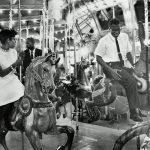
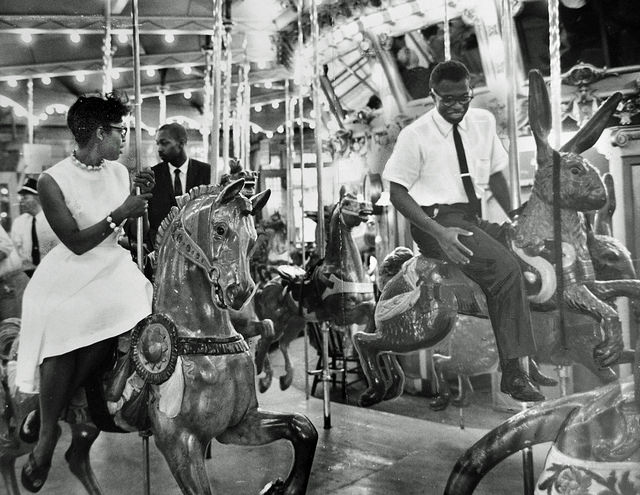 Gwendolyn Greene, Cecil Washington, and Marvous Saunders sit on the carousel at Glen Echo Amusement Park on June 30, 1960 before getting arrested. (Photo by Ranny Routt. Courtesy of the D.C. Public Library Washington Star Collection © Washington Post)
As Glen Echo Park’s red neon lights glowed and cheerful organ music filled the air, a group of college students took their seats on the park’s iconic carousel. In another era, this simple action would attract little attention. But this was June 30, 1960 and many of these students were black.
For some, the amusement park in suburban Maryland was the D.C.-area’s premiere place for summer time fun. For African Americans, it was off-limits.
Frank Collins, a private security guard who was deputized as a deputy sheriff by the state, approached within moments. The students handed over their purchased tickets, but that wasn’t what the officer wanted.
“I remember a sheriff coming up to me and saying ‘I’m going to ask you three times to leave. If you don’t, I’m going to arrest you,’” 83-year-old retired dentist Bill Griffin tells DCist. “He just wanted us out.”
Griffin didn’t budge from the merry-go-round, nor did four other young black college students.
It was the defining act of an extended protest at the private, segregated Glen Echo Park, which is located about ten miles from the Capitol (it is now owned by the National Park Service).
“I had never gone to jail before,” says 80-year-old dermatologist Dr. Marvous Saunders. “We were scholarly people who were in college.”
In 1960, segregation was a part of daily life in the D.C.-area. There were white-only water fountains, black-only schools, white-only lunch counters, and black-only bathrooms.
“I grew up in an entirely black [neighborhood]. We had our little city,” recalls Saunders, who grew up on 11th Street in Northwest and attended medical school at Howard University.
Dion Diamond had a similar experience in Petersburg, Virginia. “I grew up in a totally segregated environment. I just didn’t have exposure to white folks.”
But it didn’t mean that they didn’t see inequality or feel the impact. It was everywhere, from swimming pools to apartment complexes.
“The high school facilities that were provided for people of color… and the courses one could study. It just wasn’t the same,” says Diamond, who moved to D.C. to attend Howard.
Griffin, who grew up in Peekskill, New York, but moved to D.C. in 1953 for both undergrad and dental school at Howard, says he “saw things going on [in D.C.] that I didn’t appreciate. So, I thought to myself ‘hey, I need to do something.’”
While attending Howard, Saunders, Diamond, and Griffin all joined the Nonviolent Action Group, a student-run protest group aimed at ending segregation. Inspired by the February 1960 sit-in at the whites-only lunch counter in Greensboro, North Carolina, the group looked to conduct a similar wave of sit-ins across the D.C. region. Their first stop: lunch counters in Arlington, Virginia.
On June 9, 1960, six students from NAG sat down at the counter at Cherrydale Drug Fair and refused to move. A photograph captures a college-age Dion Diamond withstanding verbal abuse and a pointed finger from a much younger white kid. “There’s was this… 12-year-old kid who was telling me ‘why are you here, why don’t you go where you belong,’” says Diamond.“I looked at him… just trying to figure out how a kid this young could be [treating] me like this.”
Behind him in the photo is Joan Mulholland (then, Joan Trumpauer), a Duke University student. She was also a member of NAG and one of the few white women to to participate in the Arlington sit-ins. What she remembers most is the eventual appearance of the American Nazi Party, a small hate-filled group based in Arlington and led by George Lincoln Rockwell.
“The Nazis. Brown shirts. Swastika armbands,” Mulholland tells DCist. “It all made me concerned what could happen.”
But violence never erupted, and the protests worked. Within two weeks, lunch counters across Arlington were desegregated.
“We were so enthralled with our quick victory, that we [looked] to what we could do next,” Diamond recalls.
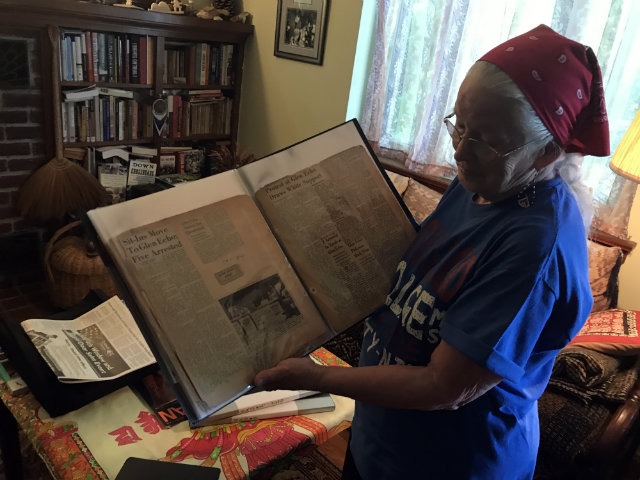 Joan Mulholland shows a scrapbook filled with newspaper clippings and one of the tickets that the protesters tried to use. (Photo by Matt Blitz)
Maryland’s Glen Echo Park, a summer haven for white families, was chosen by NAG as the follow-up target for the simple reason that it was popular.
“Everybody in D.C… heard the Glen Echo jingle on the radio all the time,” says Ilana Trachtman, who is working on a documentary about the Glen Echo protests (they are actively fundraising in hopes it will be released for the 60th anniversary in 2020). “Everyone saw the print ads that said, ‘come one, come all.’ But everyone knew that it was a lie.”
As a local white child, Mulholland want all the time with her family. “I had always gone to Glen Echo. It was a big thing every summer… [it was] exciting,” says Mulholland. “If it had been integrated, my mother wouldn’t have wanted to take us.”
It was in the afternoon on June 30th when the NAG protesters showed up at Glen Echo’s gates, armed with signs that read “Glen Echo Should Echo Democracy,” “Discrimination is Not Our Generation,” and “Bigotry is No Fun.” They were met there by a group of white allies.
For years prior, members of the nearby Bannockburn neighborhood had boycotted the park, written to local newspapers, and appealed to the Montgomery County Council all in the hopes of pressuring Glen Echo to desegregate. Built in the mid-1940s, Bannockburn was (and remains) a left-leaning community with a large Jewish population.
Many of the town’s residents came to the area to work in Roosevelt’s New Deal administration but had trouble buying homes in the District of Columbia. Instead, they banded together to buy property in Bannockburn, according to Trachtman. By 1960, when they joined the Glen Echo picket lines alongside members of NAG, Bannockburners (as they call themselves) were a healthy mix of New Deal acolytes, labor-sympathizing leftists, and European Jews who had survived the Holocaust.
“My experiences are that there’s a certain bond between… Jews and blacks,” says Saunders, “because of their experiences with oppression.”
By early evening, it’s estimated that more than 60 people—young NAG members and those from the Bannockburn community—made up a diverse set of protesters who were chanting, singing, holding up signs, and handing out pamphlets. They were peaceful, but that wasn’t the case for everyone who entered the park.
“I was… passing out pamphlets when an elderly man slapped me,” remembers Saunders. “A police officer ran up and asked [the elderly man] ‘did he hit you?’ As expected, I was black and wrong.”
At around 6p.m., about a dozen protesters entered the park and headed to the carousel. They held tickets that were purchased for them by white protesters (Mulholland still has one displayed in a scrapbook).
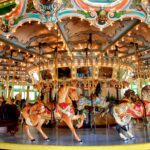
Then, they took their seats on the brightly decorated carousel as peppy organ music wafted in the background. A well-known image shows Saunders leaning over a sculpted rabbit, calmly listening to the park guard.
Saunders was arrested, along with Bill Griffin, Michael Proctor, Cecil T. Washington, Jr., and future Maryland State Senator Gwendolyn Greene (later, Gwendolyn Britt). The five protesters were held in jail for an hour or two, before being bailed out by the local NAACP legal team. The next day, they were back at the park’s gates as the crowd and media attention grew.
The Glen Echo protests went on for a long, hot nine weeks. Rockwell and his “stormtroopers” would show up again to intimidate the demonstrators, giving the assembly the specter of looming violence.
It never occured, but there was certainly a disquieting symbolism with some in the Bannockburn community having survived the Holocaust. “It was really creepy to have the Nazis [counter-protesting] and the people with the numbers on their arm picketing… just yards apart,” says Mulholland.
Diamond, who was arrested about a month after the original group, credits the media for keeping things mostly calm. “I was very thankful for the fact that the newspaper reporters were there. If not for them, I would have been frightened…as long as the reporters and photographers were, I felt… safe.”
The attention also helped to galvanize public support and amplify the group’s message. In an exchange captured by a radio reporter, the only known existing audio from the protest, a deputy sheriff asked the group’s leader, Laurence Henry, about his race. His answer: “I belong to the human race.”
On September 11th, the park closed for the season, and the protesters vowed to return the next year.
During the fall and winter, however, Attorney General Robert F. Kennedy got involved. He threatened to pull the federal government’s lease of the land where the trolley ran and parking lot laid. On March 4th, 1961, the announcement was made: Glen Echo Amusement Park would desegregate.
Four years later, the original five charges of criminal trespass were overturned by the Supreme Court on the grounds that their arrests violated the 14th amendment.
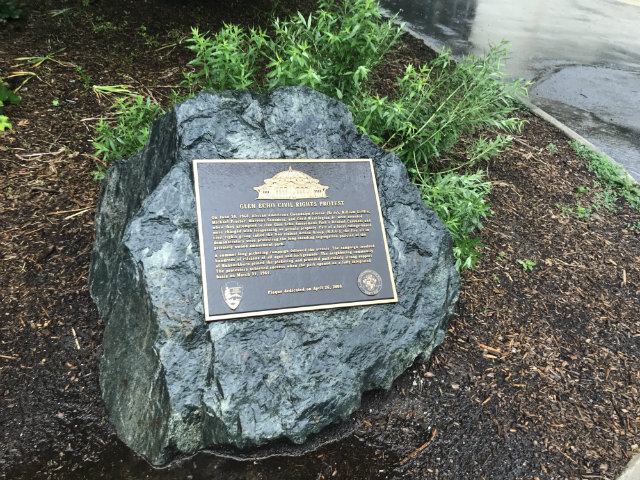 A plaque at Glen Echo commemorates the protests. (Photo by Caroline Tucker)
For some, these protests were the beginning of a lifelong commitment to activism. Both Diamond and Mulholland joined the Freedom Riders. For others, like Griffin and Saunders, this was their only public foray into the Civil Rights movement.
Griffin finished up dental school at Howard, joined the Air Force for two years, and, then opened a private practice in White Plains, New York. He finished his career in 2004 as the dental director for the New York State Department of Corrections. Though Griffin is proud of what he did, he never felt the need to make a big deal about it. In fact, he didn’t tell his kids about his activist past until they were in high school.
Saunders is still a working dermatologist with a private practice in Santa Ana, California. He doesn’t identify as an activist, saying it was simply an “opportunity to do something” about segregation. Saunders is sometimes asked to come back to Glen Echo and speak about June 30th, 1960., but he has always declined. “Hell, [they] didn’t want me then, why should I go back now?” he says.
Nearly sixty years later, Glen Echo Park is now under the National Park Service’s umbrella and a haven for the arts. There are sculpting studios, pottery classes, a children’s theater, art galleries, glass-blowing workshops, and a puppet company. Every weekend, there are dances. The carousel is still there with the Wurlitzer organ playing happy tunes. In the spring and summer, it’s a popular place for weddings.
Next to the carousel is a small plaque that briefly explains the events of June 30th, 1960.
“I think Glen Echo should become a Civil Rights pilgrimage site,” says Trachtman. “We don’t treat it that way in Washington, and I think it’s because we just don’t know the story.”
Says Saunders, “We were just trying to make life a little better for those folks who happened to be black.”