Rachel Kurzius
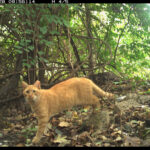
 This photo illustrates a camera trap photo of a domestic cat. (Photo by Michael Cove, courtesy of Smithsonian’s National Zoo and Conservation Biology Institute)
Cats are controversial.
Aside from the question of whether a person prefers dogs, felines have long been blamed for killing wildlife like birds and small mammals. For more than a century, humans have asked whether they can control the mighty, moody cat and use its predatory prowess for pest control. (Hence programs like the Blue Collar Cats, which pairs antisocial cats with local businesses that want help keeping rodents at bay.)
Now, a newly launched project in D.C. has a question that sounds deceivingly simple: just how many cats live here?
The answer, as it turns out, will require three years and $1.5 million to get the D.C. Cat Count. And even then, the effort from the Humane Rescue Alliance, the Humane Society of the United States, the Smithsonian Conservation Biology Institute, and PetSmart Charities serves more as a rough gauge than an exact headcount.
“There’s too many cats in too many places,” says Bill McShea, a wildlife ecologist with Smithsonian’s National Zoo who is in charge of collecting data on outdoor felines. “We’re going to do this as an estimate of cats.”
Right now, the number of felines in the city is “impossible to say,” says Lauren Lipsey, the vice president of community programs at the Humane Rescue Alliance. HRA averages about 2,000-3,000 cat adoptions annually (about two-thirds of their total pet adoptions), with all owners agreeing to keep the cats indoors. The organization also traps, neuters, and returns to the streets about 1,000 more felines.
But they have little sense if their programs are the lion’s share of adoptions in the city, or if their trap-neuter-return program is effective in helping to control the cat population.
The population data will “be really helpful to have us tailor what our programs and services are for the cats of the city,” says Lipsey. “We want to understand the movement and flow of cats.”
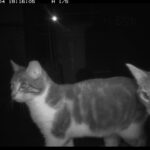
The main tool of the project will be camera traps, which is a common technique in surveying other kinds of wildlife.
McShea says they will be looking to get as many pictures of cats as possible, by setting the 60 infrared cameras up on city blocks, in backyards, by dumpsters, and in parks.
“With cats we have the advantage that most of them are individually marked,” so people can distinguish between them, says McShea. “We have to see cats more than once—that’s the key, and the more I see them, the better. We’ll be getting as many pictures of cats wandering out there as possible”
He says that D.C. Cat Count will also have an app, which they’re hoping to roll out by Christmas, so that residents can submit their own photos of cats roaming.
McShea and his team have already stratified the city into different habitat-types based on housing density, tree density, and economic strata. He says there’s a correlation between lower income neighborhoods and increased feral cat populations, as well as more cats in residential areas more broadly.
Tuesday serves as the official project launch, says Lipsey, meaning that they’ve purchased all the supplies, including the 60 cameras, and have contracts in place with researchers like McShea. The D.C. Cat Count will also be bringing on board two full-time staffers who will work as field crew.
Other elements of the count will include a home survey and an analysis of shelter populations. The effort, slated for completion in June 2021, will rely on community support for placing the cameras, volunteers for neighborhood walks, and responses to surveys.
So is this feline census an indicator that the involved organizations are picking a favorite in the neverending debate between cats and dogs?
“Dogs have a little bit of a different position in our society,” says Lipsey. “If they’re running at large that’s against the law—they need to be caught and brought in.” Cats, on the other hand, are allowed “to be a lot more prevalent. Cats also have larger litters. There are just more cats.”
Reporting contributed by WAMU’s Jacob Fenston.