I remember it like it was yesterday, or more accurately, two weeks ago. Metro once provided a semi-reliable, affordable, and convenient commute to work. Sure, occasionally it would break down, smell, be delayed, or catch on fire. But generally speaking, I could count on the Red Line getting me from my home in Silver Spring to my job in NoMa in about 35 minutes. It was a straight shot, until WMATA shut down the Brookland and Rhode Island Metro stations for 45 days to fix eroding concrete and a host of other issues.
Confronted with a variety of unappealing options for getting to work, I decided to try all of them. The following are ranked in order of my willingness to do them again. The short answer? Hard pass if it involves any kind of bus.
 (Photo by Lauren Landau)
1. MARC
- Cost: $5
- Time: About 40 minutes
- Direction: Silver Spring to NoMa
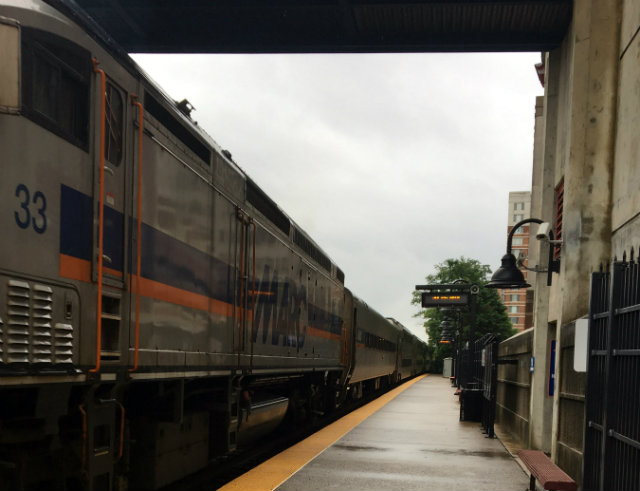
When I started mentally preparing myself for the summer shutdown of 2018, the MARC train quickly became the most recommended and appealing workaround. However, while reasonably affordable, fast, and comfortable, there are only a handful of trains. The wait between them can be close to thirty minutes long, so you’ve got to catch your train. Both times I attempted to hop the MARC train from Silver Spring to Union Station, the train left a few minutes ahead of schedule (luckily, I learned from the first experience and arrived early the second time).
On the bright side, MARC is fast and somewhat luxurious compared to Metro. The seats are big and comfy, and some are even equipped with outlets. When I took MARC, plenty of seats were available and the train was pretty quiet. Aside from the issue of actually getting on the train, there’s the problem of paying for it. Be sure to buy your ticket online or at the ticket vending machine. You can buy it on the train, but you’ll need exact change, plus enough cash to cover a $5 penalty.
 (Photo by Elvert Barnes)
2. BICYCLE
- Cost: $4
- Time: 60 minutes
- Direction: Silver Spring to NoMa
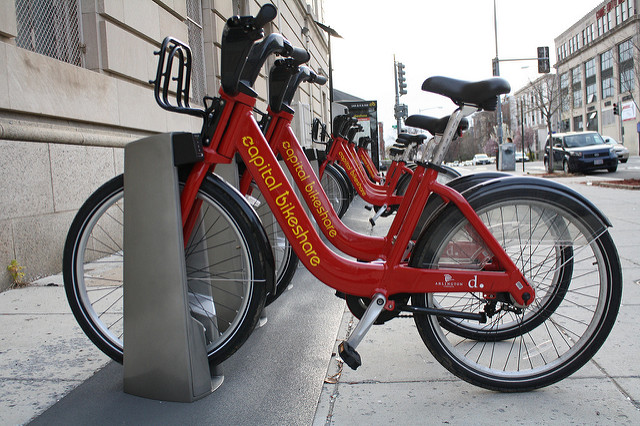
The second-most recommended workaround after MARC was biking to work. My coworkers were particularly enthusiastic about this method, but I was hesitant. Silver Spring to NoMa isn’t exactly a quick spin around the block, and I don’t bike. Before the shutdown, I didn’t even own a helmet. But I decided to try it anyway, and downloaded the Capital Bikeshare app. There was only one bike left at my nearest docking location in Silver Spring, and only one open spot when I returned the bike in NoMa. I got lucky, and could easily see this being more of a hassle.
I used the app to navigate, assuming the directions would take me along the Metropolitan Branch Trail. This assumption was incorrect, and my route consisted of residential and a few main roads instead. But even off the trail, the whole trip was pretty lovely. I got some exercise in, reduced my carbon footprint, and I was on time for work.
 The crowd transferring at Fort Totten. (Photo by Lauren Landau)
3. METRO WORKAROUND
- Cost: $2.35
- Time: 52 minutes
- Direction: NoMa to Silver Spring
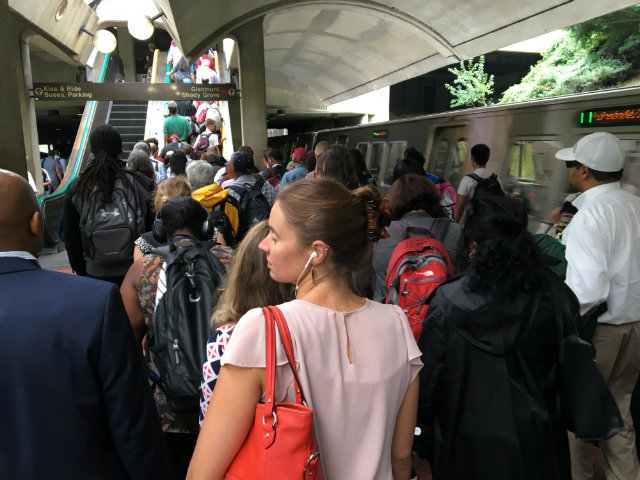
The train is a pain in the ass right now, but it’s not terrible. Instead of getting on the Red Line at NoMa and zipping straight home to Silver Spring in 15 minutes (not including my walk to/from the train station), the commute now requires two transfers and double the time. Maybe people are heeding WMATA’s warnings to explore other options, but the evening I try the Red Line to Green Line to Red Line method, I am one of the few passengers taking the train from NoMa back toward downtown. Heading into the station reminds me of every apocalyptic film ever, with b-roll of a jam-packed highway as everyone heads out of town; I’m that one idiot going in the opposite direction. I have no trouble finding a seat on my way to Chinatown, but the Green Line train to Fort Totten is pretty crowded.
The escalator at Fort Totten has a queue, so I take the stairs. I’m heading up the escalator when a WMATA employee leans over the cement and shouts “Red Line train to Glenmont on the platform!” I race up the escalator and jump on the train. I didn’t need to. No one is turned away, and the train holds for a minute or two before leaving. The only person who seems uncomfortable is the woman who taps my arm to inform me my backpack is in her face. Whoops. I get home only 15-20 minutes later than I usually would. This route is neither fast nor comfortable, but it gets the job done.
 (Photo by Elvert Barnes)
4. CAR2GO
- Cost: $14.94
- Time: 50 minutes
- Direction: Silver Spring to NoMa
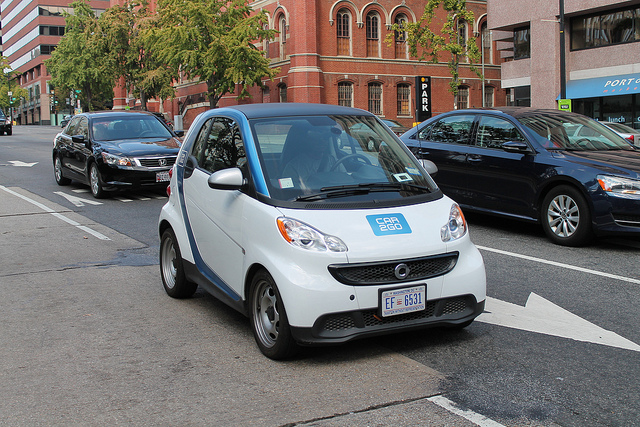
This method was more expensive than I expected, but half the cost of the Uber Pool I took during rush hour. Driving is driving, but I listen to WAMU 88.5 (where I previously worked, and DCist’s parent company) and try not to let the morning traffic stress me out. The biggest inconvenience was walking half a mile to get to the rental. The ride was easy though, and I got to work on time. When I park the car, a woman immediately asks if I’m done with it. The compact vehicle is off on another trip.
 (Photo by Dianne Yee)
5. UBER POOL
- Cost: $28.12 (including tip)
- Time: 60 minutes
- Direction: NoMa to Silver Spring
I take advantage of the pouring rain to experiment with ride hailing as my commute du jour. Uber Pool is nearly $10 cheaper than Lyft Line, but I wait 8 minutes for my ride. Frederick is the world’s friendliest Uber driver. He insists D.C. is the best place to drive, thanks to the polite drivers. I remind him that he said this when someone honks at us. The car I’m sharing with two other riders is huge and super comfortable. One of them is on the phone, but I don’t mind. Frederick’s mother calls, and he says he’ll call her back later, then sings a happy little song about loving his mom. He is delightful, and we chat the whole way home.
The ride costs half what I’d usually spend on an entire work week of Metro fares, and doesn’t save me any time in rainy rush hour traffic. But, I had a lovely trip with wonderful conversation. Unfortunately, this is too expensive to be worth repeating.
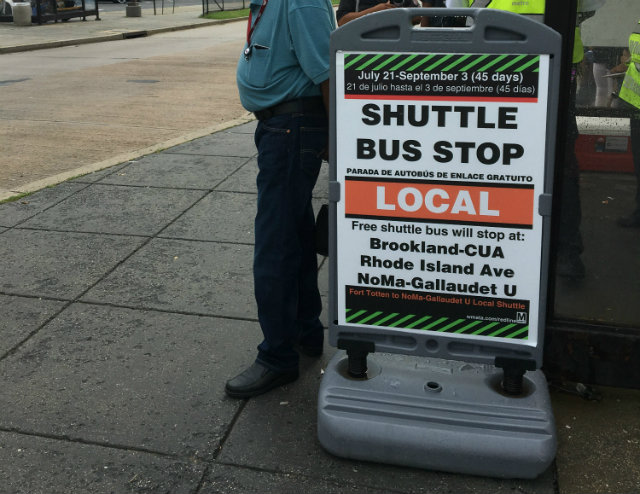 (Photo by Lauren Landau)
6. METRO + SHUTTLE
- Cost: $2.35
- Time: 70 minutes
- Direction: Silver Spring to NoMa
The WMATA trip planner says this will take 36 minutes. That is false. I wait 7 minutes for the train to Fort Totten, where I learn there are no express shuttles to NoMa. The shuttle takes a few minutes to arrive, then quickly fills up. Operators have to turn commuters away, and a nun is told to exit the bus and wait for the next shuttle. I almost feel bad, until I remember that god is everywhere, while my office is four miles away and I’m already late.
We arrive in NoMa, only to be stopped in the middle of the street by construction. This is very annoying, both because we are less than three blocks from the Metro station, and because we are literally pulled up next to my office building. Someone else asks the driver if we can just get off here. She opens the doors, and I leap off the shuttle like an ensemble member in Newsies. I made it, and won’t be taking the shuttle again.
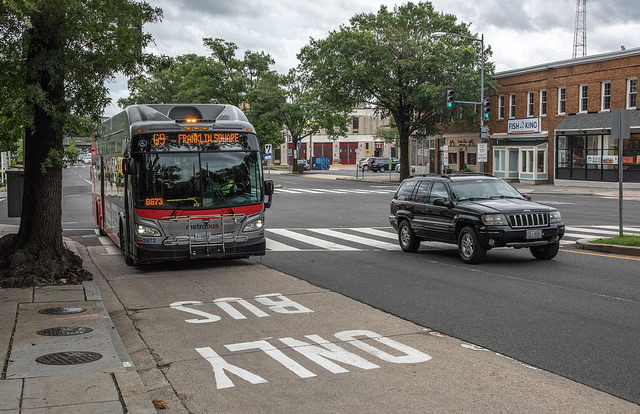
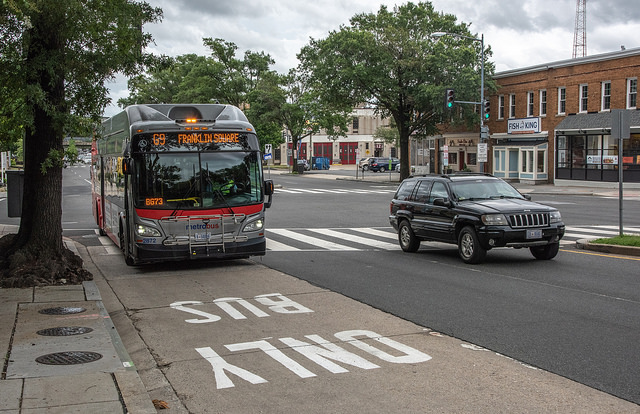 Elsewhere, on Rhode Island Avenue, Metro has put in place a temporary bus lane to make travel faster. (Photo by Kyle Anderson)
7. METROBUS
- Cost: $2
- Time: 100 minutes
- Direction: Silver Spring to NoMa
I have to take two buses to get to work from Silver Spring. I wait more than 10 minutes for the S2 to arrive, and grab a seat when it does. By the time we pass Columbia Heights, the aisle is filling up with standing passengers. I get off at U Street to transfer to the 90 bus, which does not arrive on time—not even close. I wait with a growing crowd, and watch my ETA get later and later on Google Maps. I wonder when I’ll actually get to work. Eventually, our chariot rolls through. We all get seats, but I’m late for work and aggravated. The bus is cheap and reasonably comfortable, but it took 40 minutes longer than the projected hour-long journey. I will not repeat this method.
More:
How Metro Is Planning To Handle A 45-Day Partial Red Line Shutdown This Summer
Why Metro Is Shutting Down Those Two Red Line Stations
Maps: The Hardest And Easiest Places To Find A Car2Go