 Mikaela Lefrak
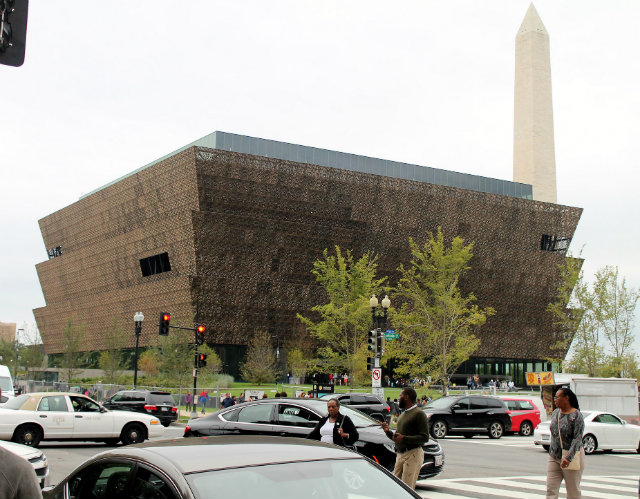 (Photo by Elvert Barnes
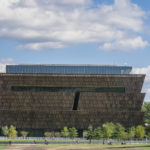
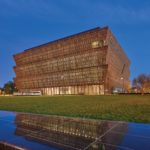
The National Museum of African American History and Culture is again requiring visitors to obtain timed tickets to enter the museum. Officials have no concrete plans to do away with the timed entry program entirely, despite visitor numbers leveling off over the past year and public confusion over experiments with unticketed days.
The institution suspended its ticketing program on weekdays for the month of September as part of a pilot program to test free entry.
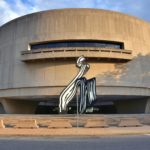
Tickets are easier to come by now than when the museum first opened in September 2016, as are the limited number of same-day entry passes the museum releases each morning. But it’s still not as easy as showing up and walking in, as you would at the Natural History Museum or the Hirshhorn nearby.
The Need For Crowd Control
The museum has required visitors to get free tickets using an online system since it opened two years ago. In the months that followed, high demand led to website crashes and months of waiting for many people who wanted to visit.
Still, the museum welcomed nearly 2.4 million visitors in 2017, its first full year of operation. It was the fourth-most visited Smithsonian institution of the year after the Air and Space Museum (7 million), the Natural History Museum (6 million) and the American History Museum (3.8 million). None of those others limit visitor numbers with a timed entry system.
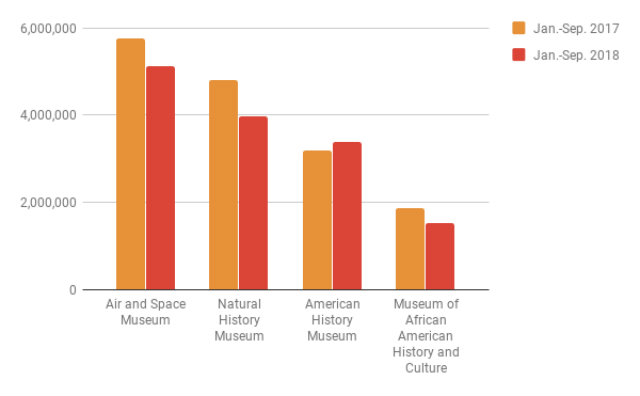 Attendance has fallen at many of the Smithsonian’s most popular museums, but demand remains high for the Museum of African American History and Culture. (Image courtesy of the Smithsonian Institution)
Part of the reason is sheer size. While the African American museum is large—nearly 400,000 square feet spread over seven stories—it’s tiny in comparison to some of its Smithsonian brethren on the National Mall. Two-and-a-half African American museums could fit inside the Air and Space Museum.
“These legacy museums have incredible amounts of square footage,” says Linda St. Thomas, the Smithsonian’s chief spokesperson. “In order to have a good experience, [the African American museum] can’t let in quite as many people.”
The structure and content of the museum’s exhibitions have also compelled its leadership to continue limiting crowd size, St. Thomas says. Visitors often get bottlenecked in the three underground floors that chronicle the transatlantic slave trade, American slavery, and the country’s racist past. There’s a lot to read, for one, and the heaviness of the subject matter can lead visitors to linger.
“The normal dwell time for most museums is an hour 45 minutes to two hours,” said the museum’s associate director of external affairs, Beverly Morgan-Welch, in an interview with NPR in 2016. “Our dwell time can go to six.”
Ticketing Experiments
The museum began experimenting with a more fluid entry system when it introduced “Walk Up Wednesdays” in April and May. Visitors could enter the museum on a first come, first served basis without passes. It expanded the program to all weekdays in September.
But once October hit, that program abruptly ended. Advanced passes for October, November, and December have already been distributed online. While tickets are free, the process can still be a headache for potential visitors who want to make a spur-of-the-minute stop or who aren’t read up on the museum’s entry policies. According to the Washington Post, people who showed up without tickets on Oct. 1 faced long lines and mixed messages from guards and staff.
Recently, the museum announced it will restart its Walk-Up Weekdays program in January and February 2019. St. Thomas says there are no plans to try that program on Saturdays or Sundays. The museum regularly welcomes an average of 8,000 people on weekend days.
The museum is a popular destination for school field trips, church outings and other large groups. However, the museum has had to suspend group reservations so that it can deal with its backlog of reservation requests.
St. Thomas says the high demand and resulting headache over ticketing doesn’t surprise her. “People waited decades for this museum,” she said.
Why Other Museums Use Timed Entry
No other Smithsonian institutions use the timed entry system on a regular basis.
The Smithsonian’s Hirshhorn Museum instituted timed entry for last spring’s blockbuster exhibit “Infinity Mirrors” by Yayoi Kusama. Despite the museum’s efforts at crowd control, long lines regularly formed outside each room of the highly Instagrammable exhibit.
The Holocaust Memorial Museum also uses timed entry during its high season of Mar. 1 to Aug. 31. Visitor numbers can hit around 9,000 per day, according to Dana Carroll, the director of museum services, and the permanent exhibit gets bottlenecked without a ticketing system. The Holocaust Museum is free to enter, but it is not part of the Smithsonian.
The Glenstone Museum in Potomac, Maryland goes even further. Not only does it time its tickets, but it also sharply limits the number released per day. Only 500 people will be able to enter the free museum each day when its new exhibition space opens on Oct. 4.
The policy is an an overt effort to control the atmosphere in which visitors experience the museum’s modern and contemporary art collection. The museum does not rely on visitor numbers for funding or prestige; it is privately backed by billionaire philanthropists Emily and Mitchell Rales.
“You go see the Mona Lisa with 400 of your friends,” said Thomas Phifer, the architect who designed Glenstone’s new space. “But the thing we wanted desperately to find was how to slow that experience down, and how to make it about continuing to refresh your mind.”
St. Thomas can identify with that sentiment. Without timed entry during the African American museum’s peak hours, she said, “it’s not an enjoyable visit.”
This story originally appeared on WAMU.