Natalie Delgadillo
 (Photo courtesy of the Homeless Children’s Playtime Project)
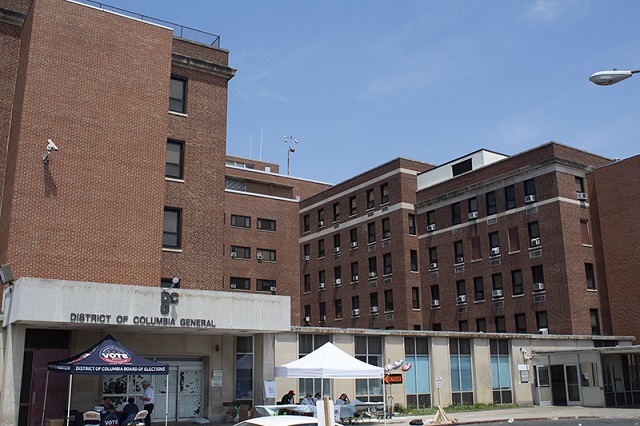
Thirty-four families are still living at D.C. General, the large, dilapidated former hospital-turned-homeless shelter that Mayor Muriel Bowser is working to close by the end of the year.
The city announced to residents this summer that it planned to move everyone out of the shelter by the end of September, but that timeline has been extended slightly. Department of Human Services Director Laura Zeilinger says the city always planned to move families out in the fall, and officials consider themselves to be on target.
At the same time, the Department of General Services confirmed to DCist that deconstruction has resumed on Building 9, an uninhabited building about 250 feet away from the main shelter that the administration of Mayor Muriel Bowser has insisted on demolishing while residents are still on site, even as it’s faced opposition from residents and advocates.
Groups like the Washington Legal Clinic for the Homeless have been concerned that the deconstruction would pose health risks to families living at D.C. General, some of which have babies and young children. Activists showed up at Bowser’s home at the end of July and staged a mock demolition to protest any deconstruction on the D.C. General site while families still lived there.
“It comes down to what amount of risk is D.C. willing to take for the health of homeless children and families and women when there’s no reason, no legitimate reason that I’ve heard, for why this has to happen now,” Amber Harding, a lawyer at WLCH, told DCist in June.
As construction began, some residents at the shelter said they felt disrespected by the city’s decision to start tearing buildings down around them as they continued to live at the shelter.
“Construction has been going on for like four months and it’s getting to the point where this is what we have to look at every day. Does it make me angry? Yes it does,” Ikea Hunter, a 24-year-old mother living at the shelter with her young son, told DCist over the summer.
The D.C. Council also got involved in the controversy, passing emergency legislation in July mandating stricter oversight of deconstruction on the site (the original bill was supposed to halt all deconstruction until families moved out, but that version ended up getting revised before it was even introduced.)
The city says that deconstruction poses no health risk to the families living at the shelter.
“We’ve hired an industrial hygienist to oversee this process. Their job is to make sure this process is done correctly, in line with all D.C. rules and regulations. And that’s the key: if it’s done properly, it is safe,” Brian Butler, a project manager with the Department of General Services, said at a D.C. Council hearing in March.
Advocacy groups have remained unconvinced, especially after the Department of General Services announced in early August that it had found elevated levels of lead in the soil outside of Building 9. The finding prompted eight D.C. councilmembers to call on the mayor to halt all demolition at D.C. General immediately.
Instead, exterior demolition halted while the city remediated the lead in the soil. That remediation ended on September 20. Demolition on the inside of the building finished up on September 24, and crews resumed exterior demolition on the same day. Exterior demolition of the building is now about 45 percent finished, according to DGS.
The 34 families at D.C. General can expect to be moved out of the shelter by the end of the month, according to Zeilinger. She says all of the families have already been matched with appropriate housing, with many just waiting for housing inspections to be completed and leases to be signed.
The family placements are happening right as two brand new family homeless shelters open up in Ward 4 and Ward 7. (Originally, the closing of D.C. General was supposed to coincide with the opening of three new shelters this year, but the Ward 8 shelter continues to be delayed).
A majority of the families moving out will be placed into housing via rapid re-housing, a program that offers families financial help with rent and case management, usually for about a year, Zeilinger says. Since D.C. General stopped accepting new families back in May, only a few have left the shelter to enter other temporary shelters, according to Zeilinger, and the department is trying to avoid that outcome whenever possible.
“Families are being moved directly into housing, and we think that’s really important and that’s what’s good for families,” she says.
Zeilinger also said that the remaining families at D.C. General do not have concerns about demolition at Building 9. “If people had concerns, we would know that. We know these families really well, we work with them every day,” she says.
Previously:
Despite Delays For New Homeless Shelters, Officials Aren’t Pushing Back D.C. General’s Closure
Gleaming Posters For New Development, Construction, Dust: What It’s Like To Live At D.C. General Right Now
Activists Stage Mock Demolition Of D.C. General Outside Mayor Bowser’s House
D.C. Council Won’t Delay Closure Of D.C. General
Update: Now Eight Members Of The D.C. Council Call On Bowser To Halt D.C. General Demolition After Lead Is Found In Soil
First Homeless Shelter To Replace D.C. General Opens In Ward 4