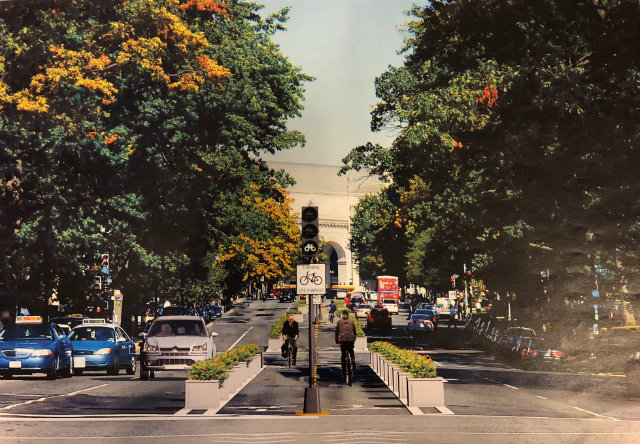
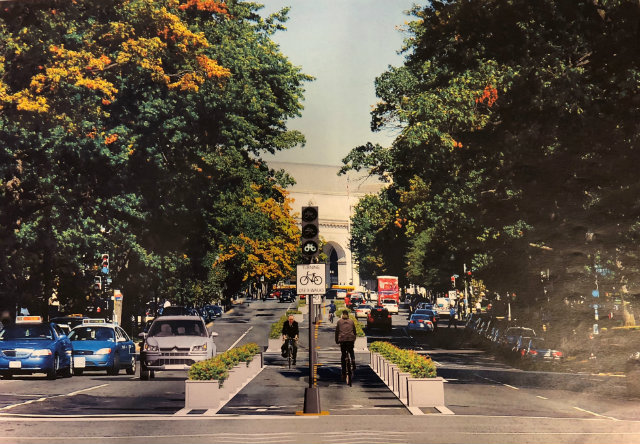
 A rendering shows the proposed bike lanes for Louisiana Avenue, which connect the Metropolitan Branch Trail to several downtown bike lanes. (Rendering courtesy of DDOT)
By DCist contributor Edward Russell
D.C. is nearly ready to build a new connection in its protected bike lane network near the U.S. Capitol. But first, Congress needs to get out of the way.
The planned facility along Louisiana Avenue and Constitution Avenue would connect Columbus Circle in front of Union Station to the Pennsylvania Avenue NW bike lanes about half a mile away. The link would create a connection, long-sought by the city and advocates, between the protected facilities through downtown, including 15th Street NW, and the Metropolitan Branch Trail that will eventually stretch to Silver Spring.
“What a hole this is—to have [the Pennsylvania Avenue] bike lane that comes to a screeching stop in the network we have so carefully built,” said Eleanor Holmes Norton, the District’s non-voting representative to Congress, at a community meeting on Capitol Hill last night.
The DC Department of Transportation, after more than three years of study, wants to build the two-way protected bike lane down the center of Louisiana Avenue, similar to those on Pennsylvania Avenue. The facility would stretch from North Capitol Street down Louisiana to Constitution Avenue, then continue to Pennsylvania. Cyclists will continue to share a lane with vehicles for the block from North Capitol to Columbus Circle.
The lanes could be separated by a raised curb, like on First Street NE, or with planter boxes on Louisiana Avenue. The stretch on Constitution Avenue will likely be flexible posts, as on Pennsylvania Avenue, due to the need to remove them every four years for the inaugural parade.
Sam Zimbabwe, chief project delivery officer at DDOT, said the proposed lanes would likely cost between $1 million and $3 million to build, depending on what type of separation is selected. The project will also include traffic signal modifications, he added.
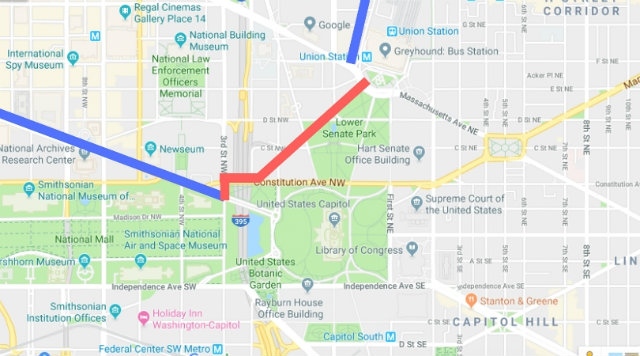 The red line shows the proposed Louisiana bike lane project, which will need Congressional action to get built. (Google maps, illustration by Maria Carrasco)
Under normal circumstances, when DDOT wants to build a new protected bike lane it would study and draw up several alternatives before going to the community to seek input. It would then adjust the alternatives accordingly, present a preferred layout to the public then, barring serious objections, seek funding, design and build the the proposed facility. While straightforward, this process can take years, as residents have seen with the stalled Eastern Downtown protected bike lanes planned for either 6th Street or 9th Street NW since 2015.
But Louisiana Avenue is no normal street. The thoroughfare was not part of the original L’Enfant grid for the District; instead, it was added by cutting through existing blocks when Union Station was built in the first decade of the 20th century. The land is owned by the Architect of the Capitol, placing Congress firmly between DDOT’s best laid plans and a protected bike connection.
“This is really a unique stretch,” said Jim Sebastian, associate director for the planning and sustainability division at DDOT, at the meeting. Once an agreement with the AOC is hammered out, likely granting DDOT an easement for the proposed lanes on Louisiana Avenue, it will require congressional action (in the form of votes by the Senate Rules Committee and the House Office Building Commission, according to Norton’s office) before construction can begin.
The AOC, however, is dragging its heels. Officials from the office, as well as the Senate Sergeant at Arms, declined Norton’s invite to attend the meeting held at the Rayburn House Office Building.
Instead, they sent the congresswoman and DDOT officials a letter saying they “believed” the agency was ready to begin the design phase but added a number of conditions for their support, Norton said, reading the letter aloud at the meeting. These include retaining curbside parking on Louisiana Avenue and meeting the needs of the U.S. Capitol Police.
“[Senators] don’t bike to work,” she said in response. “They’re not losing parking spaces [and] their staff aren’t losing parking spaces.”
Other officials at the meeting, including Ward 6 Councilmember Charles Allen, agreed with Norton, noting that on-street parking is mostly by used area workers and tourists, rather than by Capitol Hill staffers.
“This comes down to about 30 parking spaces. That’s what this is all about in my mind,” said Allen, who adds that he has been discussing the Louisiana Avenue project with the AOC for at least three years.

Without the AOC or sergeant of arms in attendance, the meeting was a bit of a rah-fest for the proposed protected lanes, with residents and advocates alike pushing DDOT to build them quickly.
One point of contention among attendees was over DDOT’s decision to not build the protected bike lane on the block between North Capitol and Columbus Circle. Bryan Rodda, a Ward 6 resident who commutes by bike from H Street NE to Navy Yard, called this block the “most annoying” section of Louisiana Avenue due to the diagonal parking and some drivers’ desire to speed northbound to “catch the light” at Columbus Circle.
This view was echoed by other attendees and a representative of the Advisory Neighborhood Council 6C, which includes the corridor, who pushed for a protected facility all the way to Columbus Circle.
DDOT officials said they will take these comments into consideration as they continue to push the project forward with the AOC.
Building protected bike lanes on Louisiana Avenue would help the goal D.C. Mayor Muriel Bowser set earlier this week to accelerate construction of protected bike facilities in more than a dozen corridors. The push comes after an increase in pedestrian and cyclist deaths on D.C. streets this year.
Louisiana Avenue sees a high number of cyclists for a road that doesn’t have any bike lane facilities, says Sebastian. DDOT counts between 90-100 cyclists on the road or sidewalk during peak hours currently, only slightly lower than the 150-200 cyclists per hour that use the protected lanes on Pennsylvania Avenue currently.
15th Street NW, the busiest protected bike lane in the District, sees upwards of 300 cyclists per hour during peak times, according to Sebastian.
Conversely, Louisiana Avenue sees a relatively low number of vehicles for its 76 foot width, said Zimbabwe. Roughly 18,000 vehicles use the road daily.