Rachel Kurzius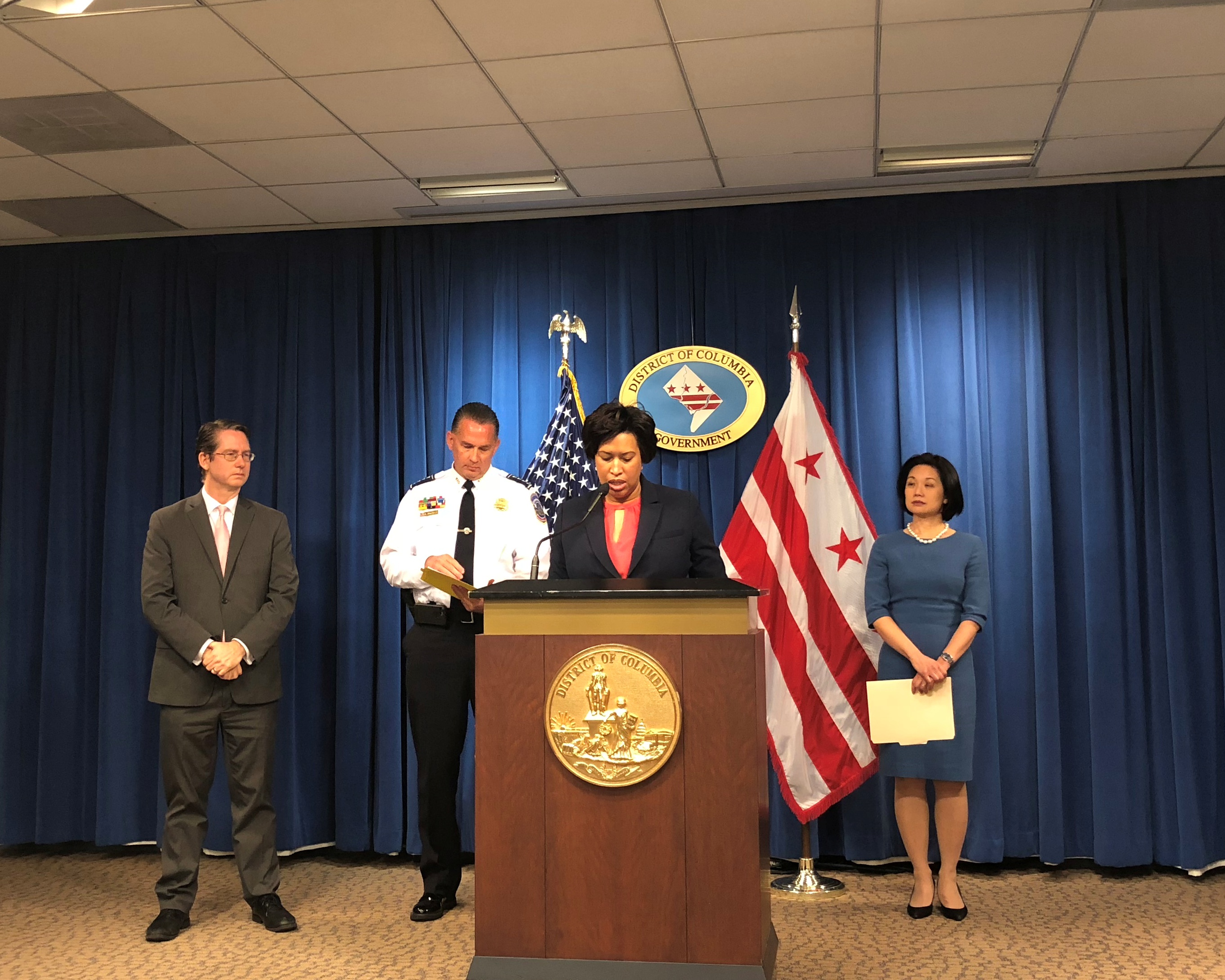
Facing a 40 percent homicide spike in the District last year and a violent 2019 so far, city officials are identifying a chokepoint for policy change: previously convicted felons who continue to possess guns.
Previously, the majority of those people were charged under local “felon-in-possession” laws, with their cases sent to D.C. Superior Court. But under a new policy shift that began this month, felons illegally possessing firearms will be charged under federal laws instead in an attempt to prevent repeat violent offenders.
Mayor Muriel Bowser announced the change at a press conference on Wednesday, flanked by U.S. Attorney for D.C. Jesse Liu, D.C. police chief Peter Newsham, and Deputy Mayor for Public Safety and Justice Kevin Donahue, saying that pursuing federal charges will allow for a more fruitful partnership with federal law enforcement from the outset, and will allow them to better track guns and determine how they arrived in the District. They said the shift came after months of meeting with one another to determine how to deal with ongoing gun violence in the city.
D.C. is the only jurisdiction in the country in which the U.S. Attorney’s Office prosecutes both local and federal crimes. A quarter of the 350 “felon-in-possession” gun cases brought in D.C. in 2018 were charged as federal crimes, according to the Washington Post. The aim is to have all of them charged this way. Liu, who called D.C.’s increase in homicides “completely unacceptable,” said she couldn’t generalize about whether federal charges would result in longer sentences than local ones because that would depend on the specifics of each case.
Liu’s office has been in touch with both court systems and with the public defender’s office in both courts, and will “continue to dialogue” with them. According to the Post, the Federal Public Defender’s Office has fewer than 10 full-time attorneys and three investigators, whereas the D.C. Public Defender Service is significantly larger: 62 attorneys and 24 investigators.
The American Civil Liberties Union of D.C. has characterized the change as “sending cases where the deck is stacked against defendants” and that it amounts to “ceding more control of our criminal legal system to the Feds,” and members of the D.C. Council have echoed those concerns.
At-large Councilmember Robert White said in a statement he “cannot support any proposal that effectively eliminates local control over the criminal laws that apply to hundreds of our residents. If the administration would like to propose harsher criminal sentencing and reduced access to local programs for sealing and expungement, then the proper forum for that debate is before the elected legislative representatives of our residents, not in closed door discussions with federal prosecutors that have no accountability to our residents … by pushing our residents deeper into the federal system, we will simply be intimidating more defendants into accepting false or unfair plea bargains.”
Ward 6 Councilmember Charles Allen, who chairs committee on the judiciary and public safety, said in a statement that he was “very concerned” about the policy change, because residents sentenced in federal court “may not be eligible for programs aimed at helping returning citizens and young adult offenders … We have to be honest with ourselves: we cannot hope for improved public safety outcomes by locking people up for longer without providing rehabilitative services and a path forward for returning citizens. Twenty-two years ago, the District made a terrible bargain to cede all control of our justice system to the federal government, and it has had lasting and destructive consequences that we must undo.”
D.C. Council Chair Phil Mendelson told the Post that the shift would undermine local law, without providing a real reduction in crime, but Bowser pushed back against the notion that this shift was administrative rather than substantial.
She said 45 percent of homicide suspects last year were previously convicted felons, and this new strategy will send a “clear message” that violence will not be tolerated and that justice will be swift. Bowser emphasized that this shift is one of multiple strategies her administration is pursuing to prevent violence, which include both criminal justice and public health solutions.
The mayor attributed the uptick in the murder rate to an increase in lethality among shootings, as she did at the D.C. Council breakfast last week. At that breakfast, Newsham specifically said that the city needed to look at repeat offenders.
“We are seeing more daylight shootings, we are seeing shootings with multiple rounds being fired, we are seeing shootings where the suspects are closer to the victims, they’re getting in very close proximity during daylight hours, and the wounds are more significant,” Newsham said at the time. “That’s one of the things we’ve got to take a look at is the capacity of the weapons that are out there … and the availability of these weapons in our community and more specifically the repeat violent offenders and folks that are involved in this behavior.”
Previously:
In Wake Of Triple Murder, Bowser And D.C. Council Discuss Strategies To Curb Homicides
This story has been updated with comment from councilmembers Charles Allen and Robert White.