Natalie Delgadillo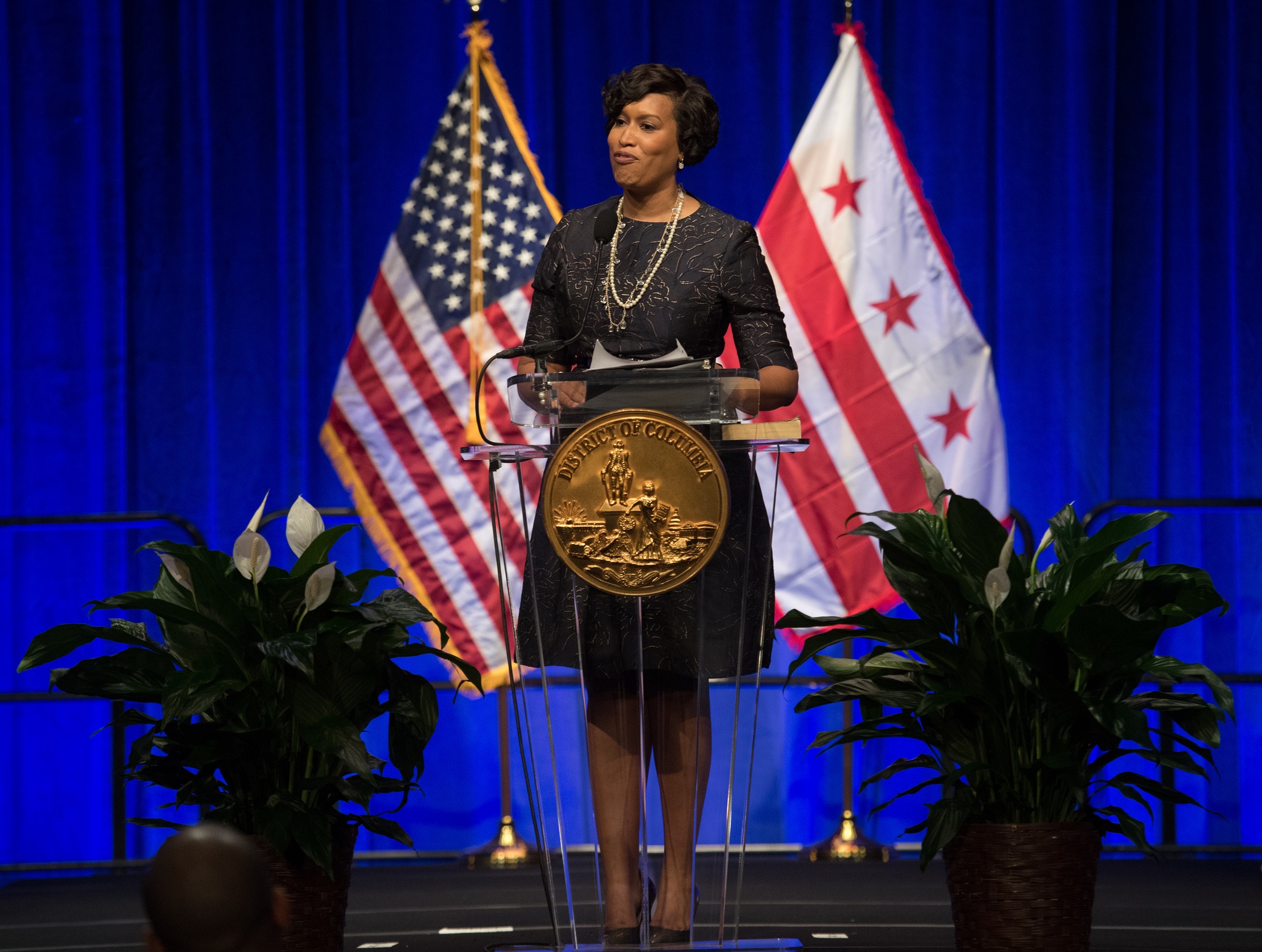
Mayor Muriel Bowser gave the first State of the District speech of her second term on Monday evening, where she announced several new investments in housing and transportation, including more money to the city’s affordable housing fund and a permanently free Circulator.
But even as the mayor unveiled the new investments and touted her accomplishments in reducing family homelessness, activists continuously interrupted her speech with chants of “This is our home,” and “Stop the war on the poor.” Protesters stood in small waves throughout the speech and had to be escorted out by security.
And yet another wave of protesters in a small group on the other side of the room. It seems they've planned to stand up in small groups and interrupt throughout. "This is our home, stop the war on the poor," they chant.
— Natalie Delgadillo (@ndelgadillo07) March 18, 2019
“There needs to be a challenge to this narrative that everyone is doing okay, or that everyone is thriving,” says Aja Taylor, the advocacy director at Bread for the City and one of the protesters who interrupted Bowser’s speech. “We know that what people need is an opportunity to live in safe, healthy, stable housing that they can afford, regardless of their income, regardless of whether they’re a returning citizen or not, regardless of whether they have one kid, two kids, or six kids.”
Taylor and other activists say that Bowser’s investments to affordable housing during her first term were paltry, and they’re hoping to see a drastic spike in money directed towards housing this time around.
In her speech, Bowser did not announce the kinds of numbers advocates would like to see. But she did announce some investments: in her budget, she will increase the city’s yearly contribution to the Housing Production Trust Fund, which is D.C.’s main source of funding to build affordable housing, from $100 million to $130 million. (Housing advocates have called for $200 million a year to this fund.)
She also announced a $20 million Workforce Housing Fund to help build middle class housing for “teachers, police officers, firefighters, janitors, social workers, and everyone else who has a good job but also needs a good, affordable home.”
The mayor will make permanent the Early Learning tax credit, a $1,000-maximum credit she created last year as a one-time financial salve for D.C. families, she announced Monday night. The credit is meant to help offset childcare expenses. Her budget also funds a bill that would remove the tax from diapers, similar to last year’s removal of the tax from menstrual hygiene products.
Still, those announcements did not appear to move the activists who had come to protest her speech. “Seeing every person that I know, that I care about … my mother has just been displaced,” says Lark Catoe of Bread for the City and Empower DC. “I am literally here fighting to keep myself in the city, keep my family in this city. And yeah, I am really pissed off with the mayor and her lies … and her rhetoric about helping the city.”
Bowser also announced investments in transportation. She is making rides on the D.C. Circulator permanently free, after two months of experimenting with it. She also announced a $122 million investment in her budget for the K Street Transitway.
The mayor also voiced her support for a Congressional bill that would transfer RFK Stadium and its campus (which she called a “national park dedicated to asphalt”) over to the District “at fair market value.” She did not, however, go so far as to say she supports bringing Washington’s football team back to the stadium.
“To be clear, there is no deal to bring a professional sports team to that site,” Bowser said in her speech. “Whether a stadium or sports arena is included in the reimagined RFK Campus is a debate for a future date, which we as a city should decide by, and for, ourselves.”
The mayor made several references in her speech to 2020 presidential candidates and D.C.’s role in the campaign, calling on the Council to move the city’s primary up from June 2020 to April. “The Bible says, ‘the first shall be last, and the last shall be first.’ But in presidential primaries, the last, well, they’re just last,” she said.