Ursula von Rydingsvard, a German sculptor known for her colossal cedar works, arrives at the National Museum of Women in the Arts with her first D.C. solo exhibition: “The Contour of Feeling,” featuring 26 sculptures, nine works on paper, and a wall installation.
The exhibition’s title is taken from a poem by Rainer Maria Rilke: “We don’t know the contour of our feeling; only the thing that molds it from without.”
Von Rydingsvard often turns to Polish words for titles, which she leaves untranslated. Zakopane, a wall of painted cedar which she crafted in 1987, stands more than 11 feet tall and 22 feet wide. At the bottom are a row of hollow wooden containers and at the top, diagonal beams. “Probably the piece when I inhaled the most sawdust,” von Rydingsvard said during a media preview of the exhibit.
The artist maintains she never uses a chainsaw; only a circular saw, which makes smaller cuts. For 35 years, she sculpted monumental pieces with little help. Now 76, von Rydingsvard has a whole team sawing and carving at her instruction.
She’s worked in a variety of mediums—from bronze and textiles to animal parts and handmade paper—but always von Rydingsvard returns to cedar. “There’s a softness, a sexiness,” she says. “An ease with which you cut it.”

While the exhibit focuses on her most recent work, von Rydingsvard’s early masterpieces anchor “The Contour of Feeling.”
The daughter of a woodcutter from a long line of Polish peasant farmers, von Rydingsvard spent her early childhood moving from one refugee camp to another at the end of World War II.
Though she moved to America in the 1950s, von Rydingsvard speaks of those early years leaving an indelible mark on her subconscious. “There’s something that feels ripped out of me, that I need,” she says. “You can’t let it go, can’t pretend it’s not there. So you work with it.”
But she defies any purely biographical interpretations of her work, which is, of course, rooted in the abstract. “I don’t care about precision,” she says. “I care about things that make you feel something.”
The artist admits she borrowed from the minimalist approach early in her career — like in Untitled (Nine Cones) (1976) — which consists of nine conical shapes, carved out of cedar. But over the years, as she experimented with the possibilities of the wood, she began carving pieces like Droga (2009), a horizontal sculpture resembling a creature collapsed and bound by gravity.
“I can have this image in my head of what I want. That doesn’t mean that’s what I’m going to get,” von Rydingsvard says. “I have to do what’s impossible to execute.”
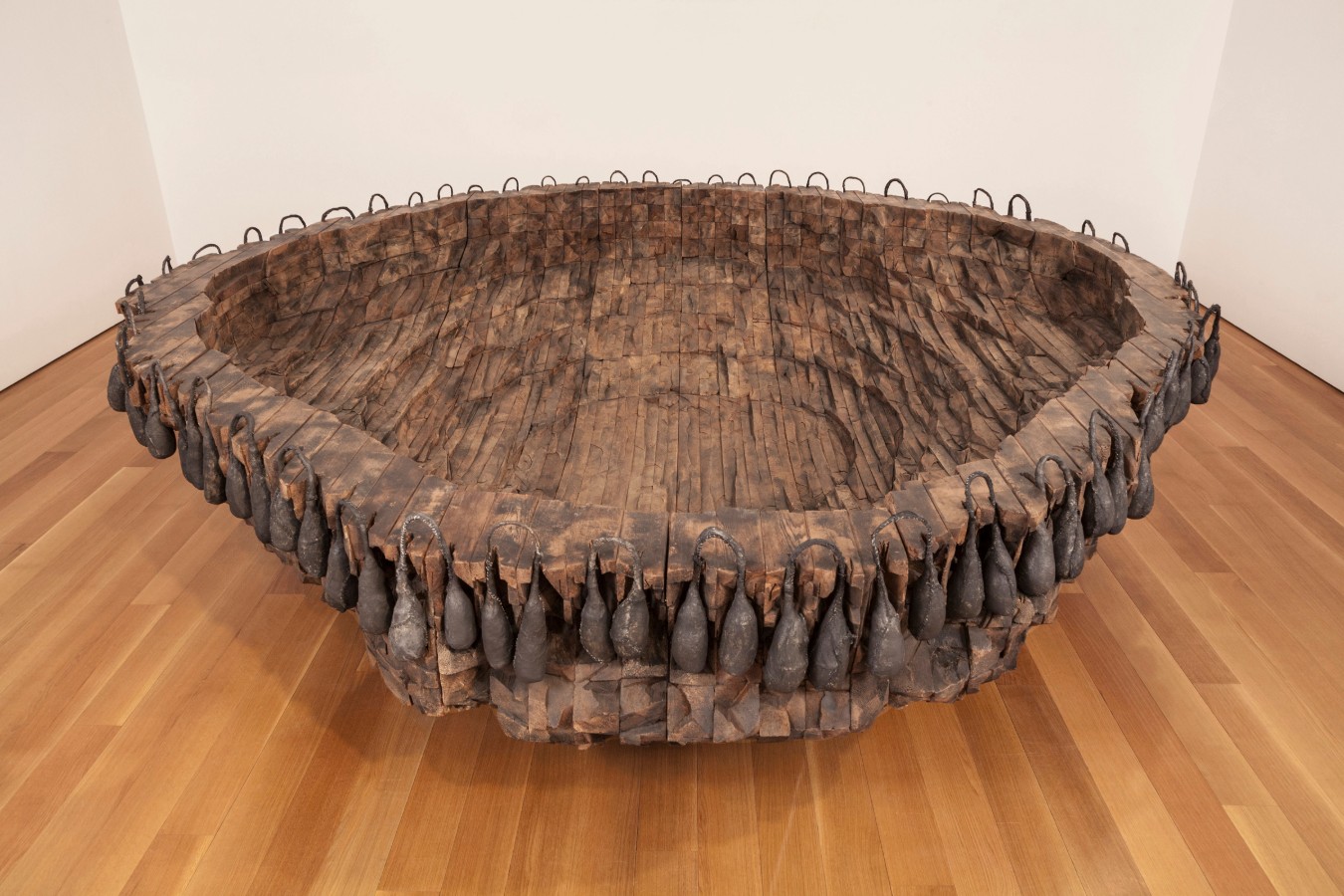
Mark Rosenthal, who curated the exhibit, says that von Rydingsvard’s work, like any good art, beckons us to find “meaning in form.”
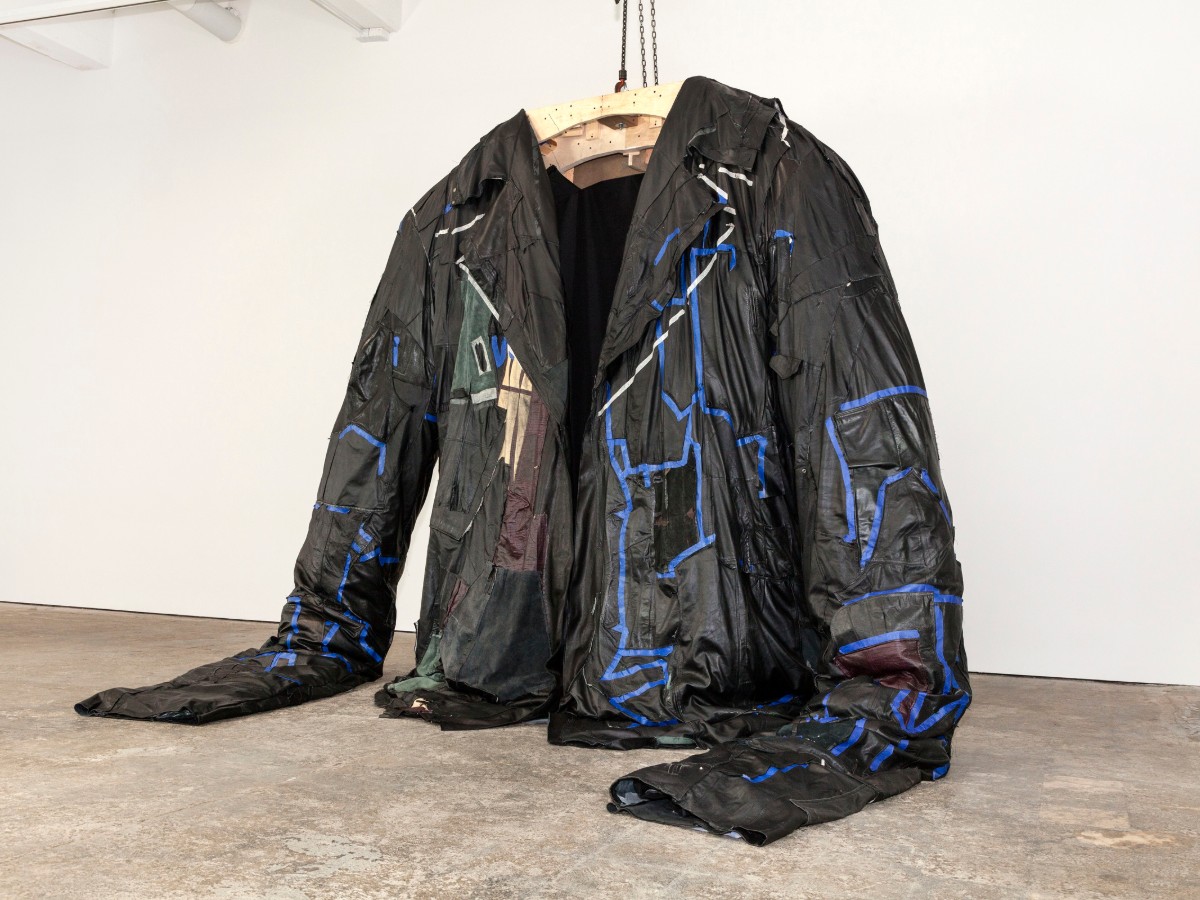
A few years ago, the Fabric Workshop and Museum in Philadelphia, which organized the exhibit, offered von Rydingsvard an opportunity to experiment with new materials, like leather. In PODERWAĆ (2017), for example. von Rydingsvard crafted a leather jacket (on view at NMWA), weighing somewhere between 400 and 450 pounds and requiring close to 900 hours of sewing.
But the intensity of the work is part of what drives her. “It makes you sweat,” she says.
In her own poem, von Rydingsvard writes that she makes art “to survive.” Because there’s a “pleasure” and a “pain” in it—and because she wants to answer unanswerable questions.
“I keep saying, ‘Ursula, this is your last one.’ It never is,” von Rydingsvard says. “I don’t know, I’m probably going to die with the cedar.”
Ursula von Rydingsvard: The Contour of Feeling is on view at the National Museum of Women in the Arts through July 28. Tickets $8-$10.