Rachel Kurzius
Reported use-of-force incidents by D.C. police officers increased by 20 percent from 2017 to 2018, according to a report released this month by the Office of Police Complaints, which also found that the number of officers who used force increased by 18 percent over last year. More than a third of Metropolitan Police Department officers reported using force last year.
“We recommend that MPD takes a real, hard look at the training that goes around use of force,” says Rochelle Howard, the deputy director of the Office of Police Complaints, an independent city agency tasked with monitoring D.C. police. She notes that, while some of the increase since 2015 can be attributed to the change in how D.C. police have collected use-of-force reports, nothing changed in the reporting requirements from 2017 to 2018. “Crime has actually gone down in Washington D.C., so we can only surmise at what we think it is” that has led to the increase in reported use of force, she says. (While 2018 saw an overall decrease in violent crime in the city, the homicide rate was up 39 percent over the previous year.)
Use of force is defined as physical force that ranges from forcibly handcuffing a noncompliant suspect to shooting a gun. MPD’s policies prescribe different levels of response depending on the perceived behavior of the subject. Officers should respond to a cooperative subject, for instance, with non-physical controls like verbal and non-verbal community, whereas passive resistance can be met with “low-level physical force,” like a “firm grip on the subject to gain compliance.” Officers can respond to active resistance with control holds, pepper spray, and other “actions that may induce pain or discomfort,” and to assaultive subjects threatening serious injury or death with deadly force, including strikes to the head with hard objects and the use of a firearm.
The police department collects its information on these incidents from officers, who must complete two separate forms whenever they use force beyond forcible handcuffing. In 2016, MPD began including takedowns among the use-of-force types that officers needed to report. According to OPC, 32 percent of the use-of-force reports provided to the agency by MPD were incomplete, inaccurate, or had other issues.
MPD says that conversations about use of force “must also recognize that officers will, when lawful and appropriate, be in situations where it is necessary to use the minimum amount of force necessary to effectively bring an incident or person under control,” police spokesperson Brianna Jordan tells DCist over email.
“Our officers are trained to de-escalate encounters and to use only the minimum amount of force necessary to bring an incident or person under control,” Jordan said. “It is important to note that force is most likely to be used during an arrest. With 31,680 arrests in 2018, only 4 percent of MPD’s arrests involved the use of force. And the overwhelming majority—87 percent—of those uses of force involved the lowest levels: takedowns or control holds. In 91 percent of force incidents, officers’ use of force either met or was lower than the use of force response prescribed by MPD’s use of force guidelines.”
D.C. police did not comment on the 20 percent increase in use-of-force incidents over the past year.
This is the second annual year that the OPC has released a report about use of force among D.C. officers (the NEAR Act, passed by the D.C. Council in 2016, requires that MPD provide its use-of-force data to the independent agency to audit and analyze the information.) “We believe that transparency ultimately leads to trust,” says Howard.
During 2018, officers discharged their firearms at three people (and six dogs), fatally shooting two people—the lowest number of officer-involved firearm discharges over the past five years, per the OPC. The most common type of force used was a takedown, which was used by officers in 42 percent of the reported incidents, followed by control holds. On average, there were 3.4 use-of-force incidents in D.C. every day, according to the report.
About 70 percent of the 1,322 officers who used force in 2018 did so once or twice, while 20 percent did so three or four times in the year, and 9 percent of officers used force five or more times.
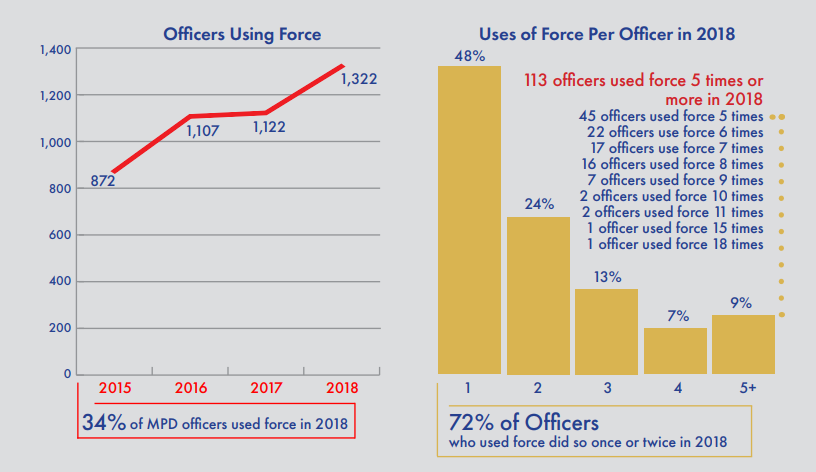
On average, the officers who reported using force were of lower ranks, which makes sense to Howard. “Lower level officers have most contact with community,” she says. The police districts where the most use of force was reported were the Fifth (most of Northeast west of the Anacostia), Sixth (parts of Northeast east of the Anacostia, and some neighborhoods in Southeast), and Seventh (most of Southeast), which remains consistent with last year’s reported findings.
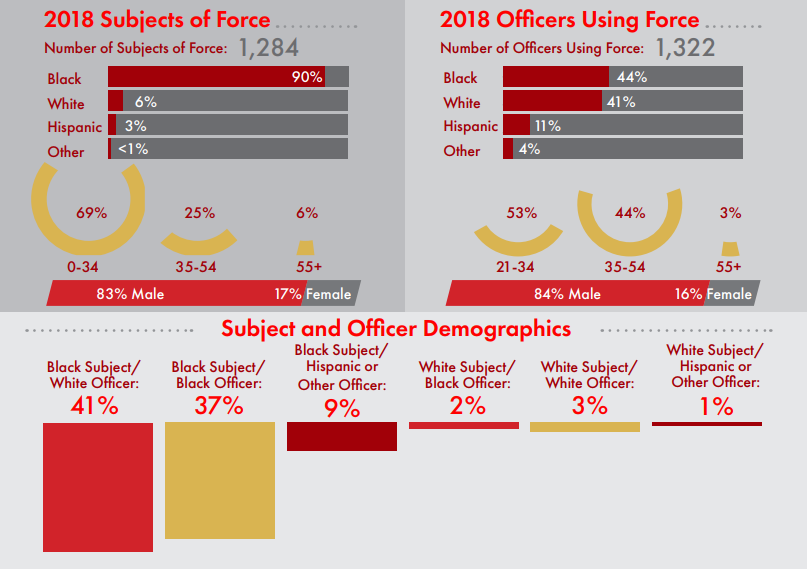
There were 1,284 people who police used force on in 2018, and 90 percent of them were black, while 6 percent were white, and 3 percent were Hispanic.
Officers said that they were assaulted by subjects during 22 percent of these incidents, and that people appeared to be either under the influence or exhibiting signs of mental illness during 15 percent of the incidents.
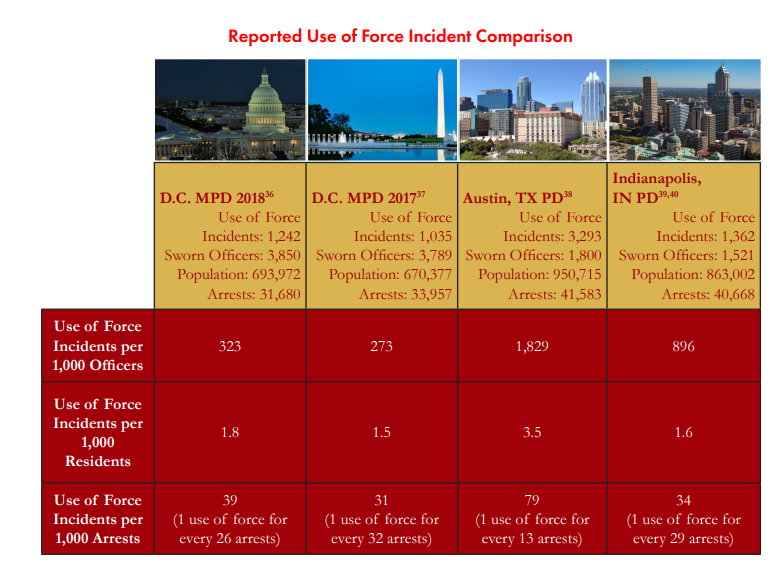
OPC compared D.C. police use-of-force incidents to two cities of similar size and annual arrest numbers. Austin had a significantly higher number of use-of force incidents, and Indianapolis registered similar numbers to the District, when compared to the the total population.