Matt Blitz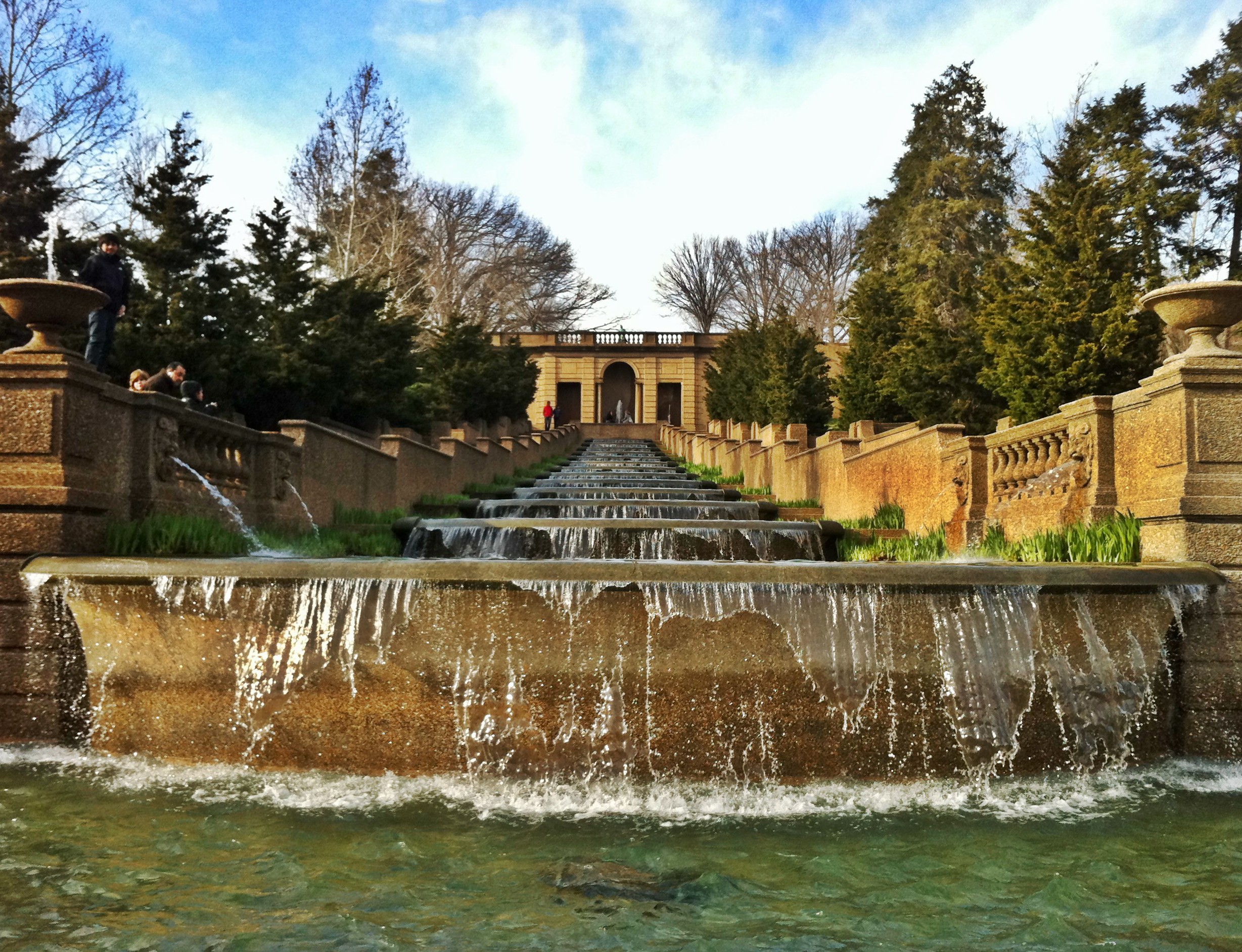
It has been nearly a year since the popular and historic fountain at Meridian Hill Park was last turned on. Now, it’s looking like it will be at least several months before North America’s longest cascading fountain is flowing once again.
As DCist previously reported, contractors with the National Park Service found a leak in the pipe supplying water to the fountain last August. When they went to fix it, they discovered a bigger problem: the pipes were made of cast iron and not ductile iron like documentation had previously indicated. Cast iron is corrosive and degrades significantly over time.
Workers replaced all 90 linear feet of pipe with a modern, durable material, a task that was completed in October. But while turning on the water to test the new pipes, another small pipe break was found, in a tricky, hard-to-reach place by the terrace stairs. This is also the pipe that feeds several drinking fountains, according to National Park Service’s acting public affairs specialist Dana Dierkes. Before workers can go back to testing the system, they first need to repair this other break. They were unable to do so at the time due to falling temperatures and the threat of bursting frozen pipes. Work is expected to start this month.”
“It is one of many fountains managed by the National Park Service in Washington, D.C. Many of these fountains have aging infrastructure and are challenging to maintain. We know this fountain is a beloved landmark,” Dierkes told DCist in an email. “Rock Creek Park staff is hopeful the cascades section of the fountain at Meridian Hill Park will be operational this summer.”
The fountain was built by John Earley and completed in 1932. As part of Meridian Hill—known to locals as Malcolm X Park—it’s a national historic landmark. When it’s on, the fountain is a marvel. Water pours down a 13-basin cascade and into a reflecting pool with several other spouts and jets spitting water for effect.
“It’s a world class fountain,” says Steve Coleman, executive director of Washington Parks & People, co-founder of Friends of Meridian Hill, and a park neighbor for more than three decades. “And it really hurts when it’s off.”
And, recently, the fountain has been off a lot. In June 2016, a broken pump motor caused the fountain to go dry for about two months. When turned back on, it only lasted a weekend. Last year, it was off all spring and summer.
Coleman, whose organization partners with community groups and public agencies to “grow city-wide park-based community health, vitality, and equity,” says that it’s disappointing to see the fountain not working. But he understands the challenges the National Park Service faces with repairing and keeping it flowing. “You are looking at a system that’s getting towards 100 years old,” says Coleman. “It’s really fragile, complex, and maintenance problems keep piling up.”
As with many other parks in the system, Meridian Hill continues to be a victim of deferred maintenance. NPS readily admits that it’s a problem, with more than $11.6 billion in deferred maintenance costs across the country-wide system as of September 2017. Since Meridian Hill is part of the Rock Creek Park system, it’s constantly competing for attention.
“This is not one of the highest priority parks,” says Coleman. “It’s just not in the same group as the major parks downtown that are part of the National Mall system.” There’s also another multi-million dollar construction project at the park slated to start later this year to restore the plaza and make the park more accessible.
All of this contributes to the fountain’s continuous issues. Coleman says that he knows that all of the contractors, Rock Creek Park maintenance staff, and the National Park service are trying their best to get the city’s finest water feature back on. “It hurts them, I think, just as much as it hurts the community that it’s not on,” says Coleman.
This story has been updated with information about why the work couldn’t be completed over the winter.