There’s a praying mantis the size of an adult human in the Pollinator Garden next to the Natural History Museum.
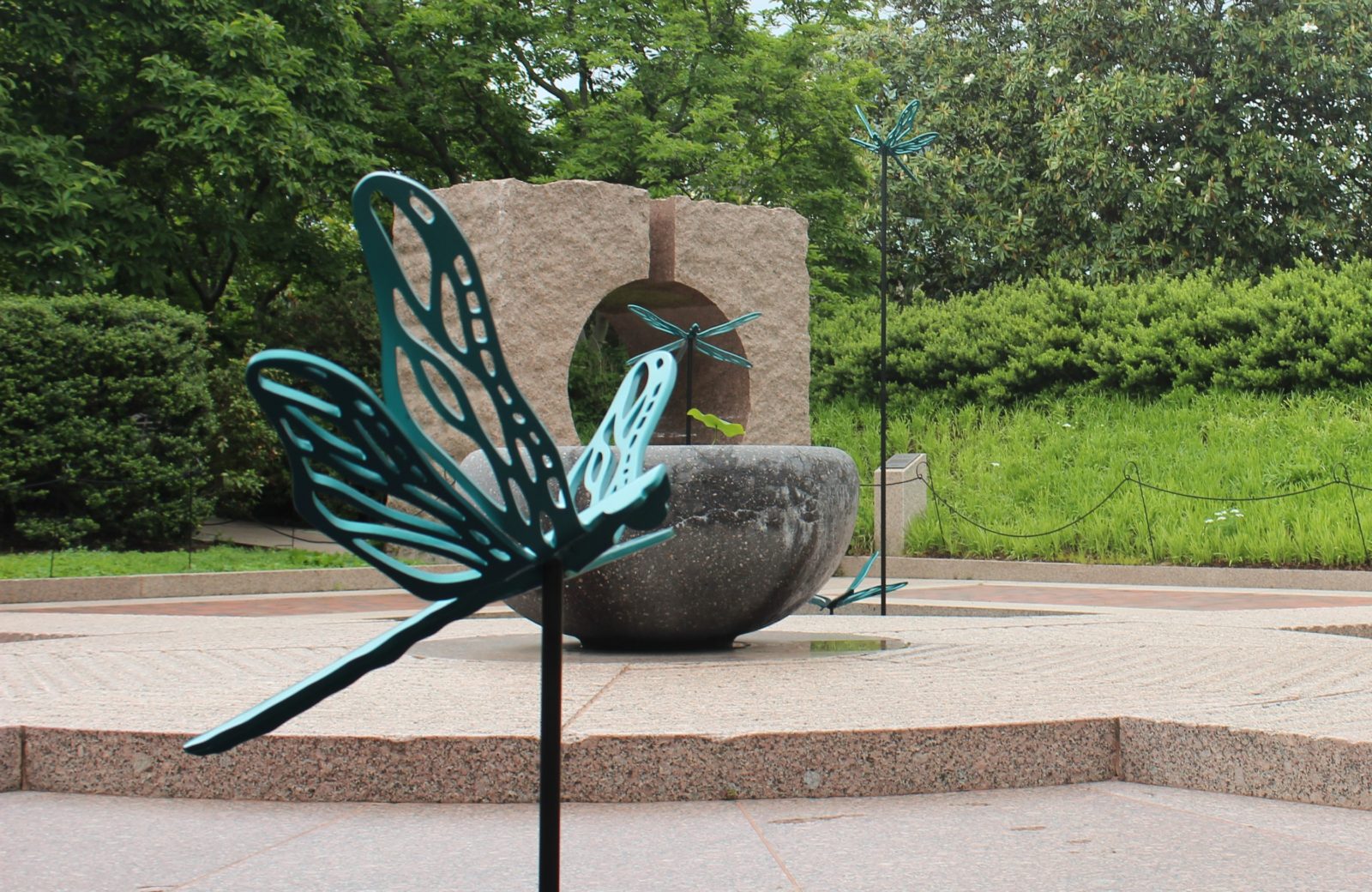
Behind the Smithsonian Castle, a swarm of three-foot-long teal dragonflies hovers above a pond. And over by the Arts and Industries Building, cobalt blue and canary yellow houses jut out of the gardens like a pop-up book.
Don’t panic: They’re all part of “Habitat,” the Smithsonian Gardens’ new exhibition. Fourteen installations explore the theme of protecting habitats, from ocean coral to bird nests, using sculpture, plants, and educational panels.
“Habitats” marks the Smithsonian Gardens’ first campus-wide exhibition in its 47-year history.
“We’re out here without walls,” said Barbara Faust, its director. “Smithsonian Gardens is an accredited museum,” she said, though she believes most people don’t know that.
She hopes this exhibition changes the public’s perception.

Faust’s staff worked with Smithsonian institutions around the National Mall to identify indoor and outdoor spaces for installations and relevant subject matter for each museum. They also collaborated with scientists from the Smithsonian Conservation Biology Institute and the Environmental Research Center.
One of the three exhibits in the Enid A. Haupt Garden, “Sign of the Dragonfly,” introduces visitors to the concept of indicator species. Dragonflies need clean water to thrive, so their presence can provide scientists with information about the health of a pond or stream.
“If you want to know the health of a wetland, ask a dragonfly,” said Maris Scalera, landscape architect for the Smithsonian Gardens.
Dragonflies are also threatened by the trifecta of nature’s enemies: Habitat destruction, pollution and climate change.
A quick walk down the path will bring you to “Foundations of the Seas,” which looks at coral reefs and the underwater ecosystems they support. The reef is built entirely of succulents and is populated by clay fish, which were sculpted by a Smithsonian Gardens horticulturist. A nearby babbling fountain provides a theme-appropriate soundscape.

Giant bug statues dot the Pollinator Garden across the National Mall. They’re made of things bugs like to live in and on, like pine cones, sticks, leaves and other natural detritus. The Smithsonian Gardens calls the structures “Bug B&Bs.”
There are also installations outside the Air and Space Museum, American History Museum, Natural History Museum, Hirshhorn Museum, American Indian Museum and African American History and Culture Museum, as well as inside the S. Dillon Ripley Center.
“Habitat” is on display at the Smithsonian Gardens’ various locations through December 2020.
This story originally appeared on WAMU.