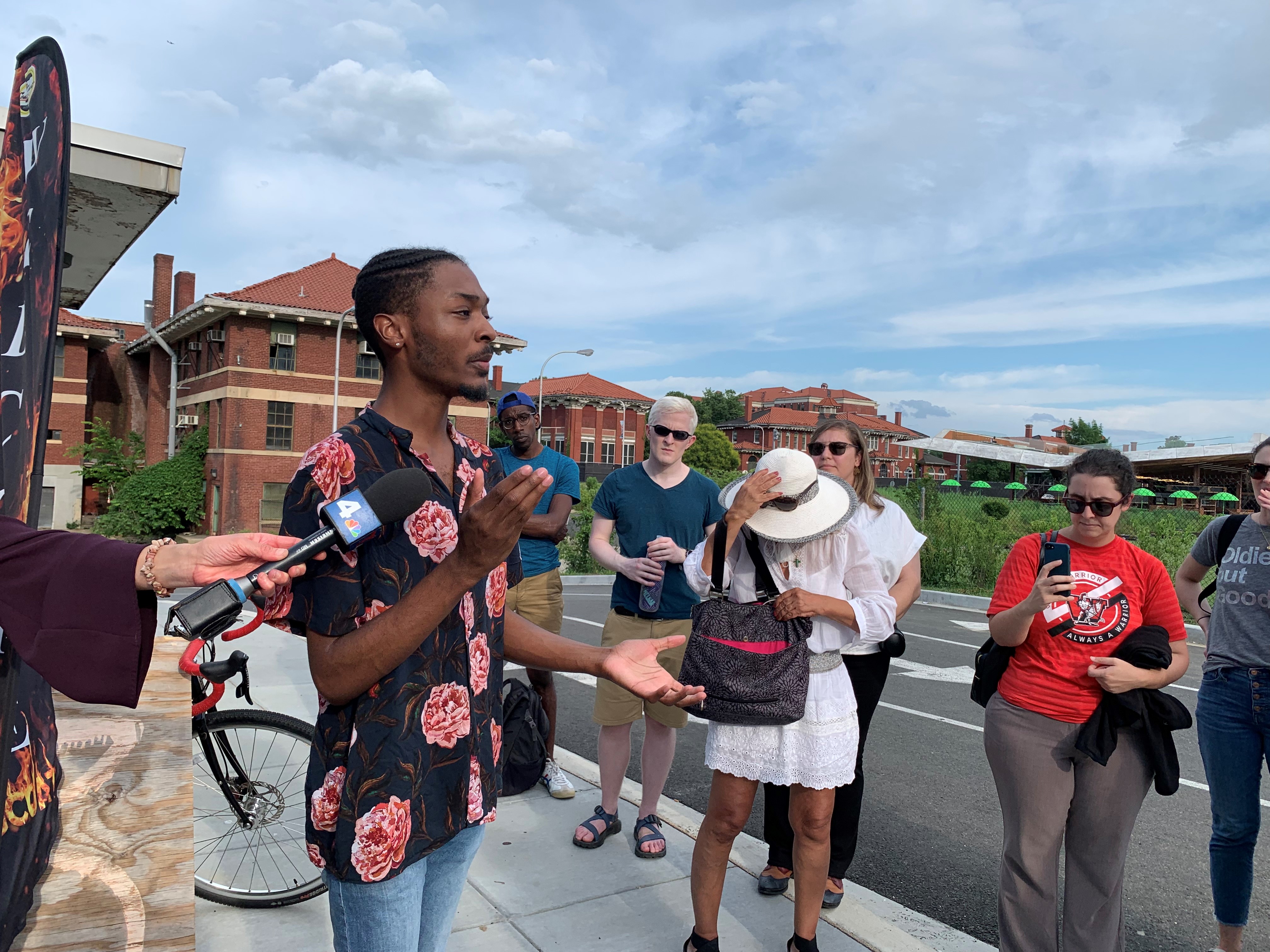
Pedestrians and cyclists gathered for a vigil in Ward 8 on Friday evening to demand safer streets in D.C., though the solemnity was often broken by the sound of cars speeding up Martin Luther King Junior Avenue.
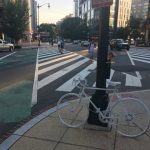
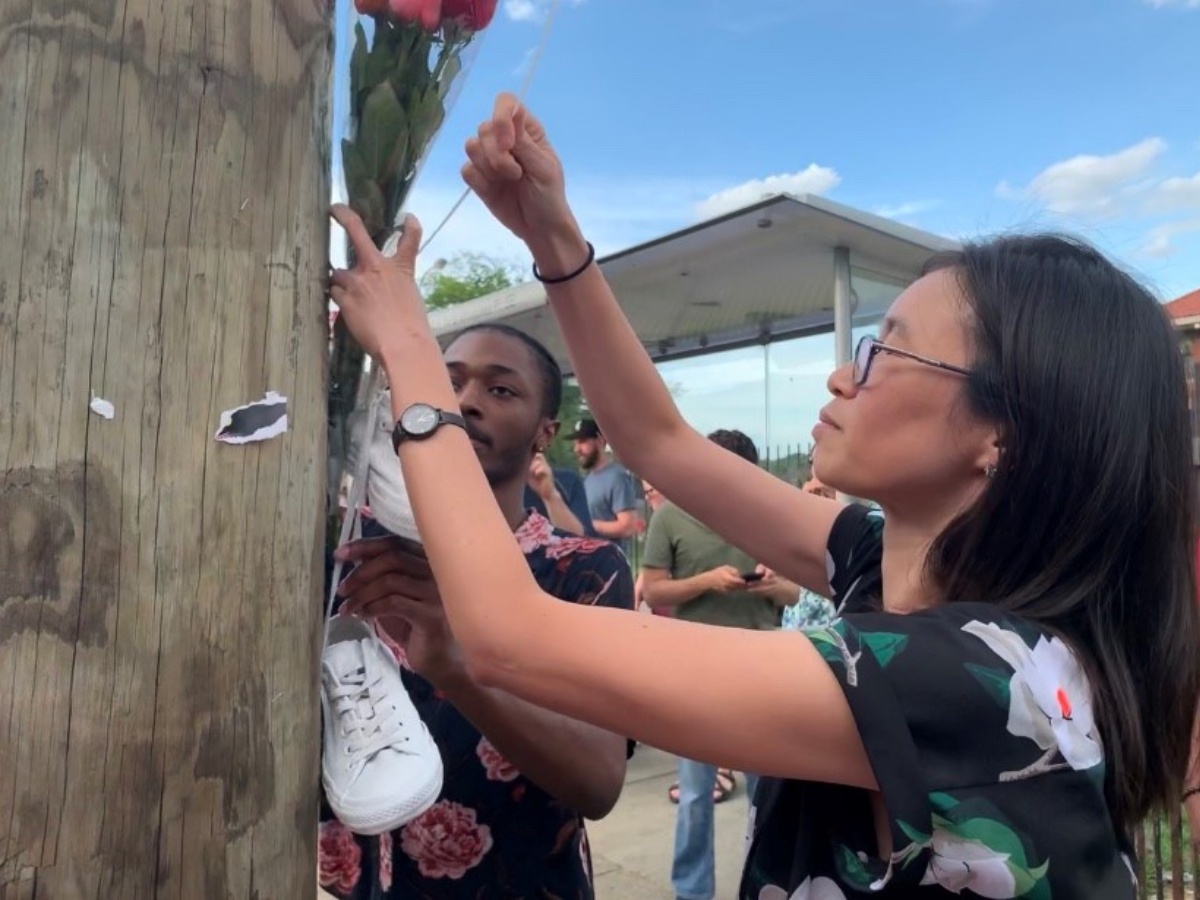
Ronald Thompson Jr. and Christy Kwan tacked up a pair of “ghost shoes”—the pedestrian version of a white bike for cyclists who have been fatally struck by a vehicle—onto a pole in memory of an unidentified woman killed on MLK Jr. Avenue near St. Elizabeths campus on May 17. But even before the memorial began, mourners struggled to get across the street safely.
One man in a wheelchair held a heavy garbage bag in his teeth while he used his hands to wheel himself across the busy street. A white sedan was barreling up the road until a woman flagged him to slow down so the man could cross.
At times, the cars screaming up the avenue drowned out Thompson’s emotional speech.
“We’re behind a hospital that has been here a very long time. People are very vulnerable, they’re here for treatment, and when they walk out onto this street and this entire strip of road, for any number of reasons, they may be unsafe. Whether it be a car speeding down the road, whether it be somebody pulling up and firing shots, they’re not safe,” said Thompson, who began advocating for safer streets after his mother was hit in a non-fatal car collision.. “So we’re here because we’re saying we care about safe people, everywhere and in every way.”
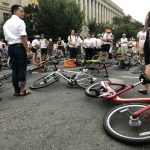
It was the latest in a string of protests around traffic safety in recent months. In April, hundreds lay down in front of the Wilson Building to protest Mayor Muriel Bowser’s response to a spate of traffic deaths plaguing the District. In 2015, the mayor introduced Vision Zero, a plan to eliminate all traffic fatalities by 2024. But deaths have only climbed since then, with 36 people killed in 2018.
The collective tragedy is one that unites all eight wards, even if “safe streets” have a different meaning for various Washingtonians, said Kwan, a Ward 6 resident.
“From the transportation side we think about safe streets in terms of not being struck by a car, but safe streets in other communities may also mean safe streets from gun violence,” she said. “As a woman when I walk around I think about safe streets from harassment, it’s a very intersectional issue and as advocates we can’t view it as a single thing.”
Although the recent rally brought together residents from across the city, Thompson focused on the disproportional number of traffic fatalities in his native Ward 8.
D.C. has seen 12 traffic fatalities since the beginning of the year, according to D.C. Metropolitan Police Department data. Six of those victims were killed in Ward 8, including two in May at the same intersection of South Capitol Street and Firth Sterling Avenue SE.
Thompson sees a link between the number of traffic fatalities and violent crime in his neighborhood. He pointed to the death of 15-year-old Somerset Prep student Maurice Scott, who was shot outside a convenience store down the block from his school over Memorial Day weekend. Police have not identified the shooter, who fled in a sedan down Wheeler Road SE.
“The intersection for me is clear because in almost every single one of these homicides, a vehicle has been involved that’s been the getaway vehicle,” he said. “On these roads speed is easy to obtain because there’s very little to impede a person’s ability to slow down.”
Mysiki Valentine expressed similar exasperation at the lack of resources dedicated to protecting pedestrians in nearby Ward 7. As a high school student, he watched his mother struggle to pay the bills after she was struck by a vehicle making an illegal U-turn. Despite his pleas to Ward 7 Councilmember Vincent Gray and the D.C. Department of Transportation, little has been done to improve safety at the intersection of 34th Street and Benning Road, Valentine said. As recently as April 8, police responded to a homicide at the intersection.
“[It’s] frustrating, as it is frustrating with a lot of other issues in Ward 7 that need to be addressed,” he said. “You can see the negligence.”
In a separate memorial service down the street for Scott, Southeast residents bemoaned the lack of basic infrastructure improvements that could mitigate both traffic fatalities and violent crime.
“We know disproportionate to everybody in the city, our infrastructure is outdated and we need investment,” said Markus Batchelor, the Ward 8 Representative and vice president of the D.C. State Board of Education. “We live in communities where people are more dependent on walking, more dependent on public transportation, and we have a transportation network that isn’t coherent enough and we have a transit network that I think leaves people vulnerable to injury or harm.”
As residents gathered on the block near Malcolm X Avenue SE to honor Scott, Ward 8 resident Aaron Jenkins pointed out two motorcycles and even a D.C. government van that blew threw the pedestrian crosswalk.
“I wonder what it would look like to have resources and things ahead of time in areas we know are prone to certain cycles of violence,” he said. “I wonder what does proactivity look like. I would love to see that the cure is multifaceted, the problems are multifaceted.”
Previously:
Fed Up With Traffic Deaths, Advocates Lie Down On Pennsylvania Avenue
As Changes Come To Intersection Where Pedestrian Was Killed, Community Raises Funds For Burial
‘It’s, Frankly, Personal’: D.C.’s Cycling Community Ramps Up Activism After Longtime Advocate’s Death
2018 Saw A Significant Rise In Traffic Fatalities In D.C. And Fairfax
Bike And Pedestrian Advocates Plan To Protest D.C.’s Failure To Prevent Road Deaths