Rachel Kurzius
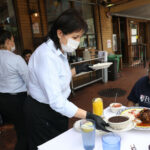
Valerie Torres, who has been in and out of the restaurant industry for the past 25 years, says she was not political before last spring. That’s when a contentious debate about tipped wages began making its way into the public sphere.
“Truth be told, most of us were caught quite unaware,” says Torres, who currently works at Nick’s Riverside Grill in Georgetown and The Game in Adams Morgan.
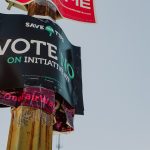
Initiative 77 was a measure on the June 2018 primary ballot that would have gradually eliminated the tipped wage. Currently, tipped workers earn a separate, lower minimum wage than other hourly workers—employers are required to make up the difference if that lower wage plus tips doesn’t equal the full minimum wage, which is currently $14.
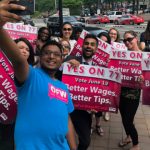
Advocates of the initiative, which was put forth by the Restaurant Opportunities Center D.C., contended that the tipped wage system made employees vulnerable to wage theft and sexual harassment.
But a large group of vocal restaurant and bar workers fought against the passage of Initiative 77. Many formed the DC Bar and Restaurant Workers Alliance, of which Torres serves as vice president. They argued that eliminating the tipped minimum wage would be a disaster for the industry, leading to restaurant closures and loss of jobs.
“For our industry to be under attack in that way was really, for lack of any other way to say it, really not okay with me,” she says. “When we came out in droves to say our piece, they tried to discredit us in every way possible. They called us corporate shills. There were so many attacks on us personally and on us as an industry.”
Torres sees the fight against Initiative 77 as a David versus Goliath-style struggle, with industry workers as the David and the Restaurant Opportunities Center as the nationally-funded Goliath. Proponents of 77 similarly saw it as a brawl between have and have-nots, only they viewed the opposition as the colossus, citing hundreds of thousands of dollars from the restaurant industry in fighting against the initiative.
Ultimately, Initiative 77 was approved by voters at the ballot box, 55 percent to 45 percent, in June 2018. Months later, though, the majority of the D.C. Council took the relatively unusual step of repealing the measure.
Torres says the whole ordeal was “definitely a victory for us to know that, despite what some of their constituents were essentially screaming at these councilmembers, they ultimately were listening to the people who it would mostly affect and impact.” But one thing was especially clear to her: “Through this fight, through this whole debate we were plunged into, it came to light that there was a real need for an organization that really did represent the line-level worker in our industry,” she says. (ROC D.C., which ostensibly holds this role, has not responded to a request for comment.)
That’s why she and other workers are launching a workforce coalition through the DC Bar and Restaurant Workers Alliance. The launch party, slated for this Sunday, is scheduled nearly a year to the day of the marathon D.C. Council hearing about Initiative 77.
“While we were born out of this fight against 77, there are other things we want to focus on to enrich the community as a whole and support the industry worker,” she says. “It’s a tough career path.”
Torres also notes that the fight over 77 did have a silver lining: “There is an issue of wage disparity, there is an issue of bad actors—bad owners and operators who have been guilty of wage theft. There are people who are really just, bad actors, within our industry who are guilty of sexual harassment,” she says. “We realized we needed to be able to advocate for ourselves.”
While the workforce coalition is still in its infancy, some of the ideas for the group include providing services like employment or immigration attorneys or tax assistance at a discount rate, helping with issues with substance abuse in the industry, interpretation services, childcare, and mentorship. Currently, there’s a six-person board that includes president Valerie Graham and founding members Zachary Hoffman, Dawn Williams, Ryan Aston, and Michael Haresign, along with Torres.
There are three tiers of membership “because we wanted to ensure that there will be no way that anyone could accuse us of being manipulated by owners or management,” says Torres.
The first tier is for front-line workers, whether they’re front or back of house. They’ll have a full vote on issues like deciding which positions the group will hold or who can join the board. The second tier is for owners who are still involved with the day-to-day operations of their establishments, who get a half-vote. And the third tier belongs to allies. The annual dues price for founding members is $35.
One of the biggest challenges is the difficulty of scheduling meetings. “It’s really hard for the bar and restaurant workforce to be able to come together, because all of our schedules are all so different.”
Torres sees the group wading into discussions about nightlife regulations, among other citywide policies that would impact the restaurant and bar industry. But even though Initiative 77 is no longer an issue at play in D.C., Torres says the group remains vigilant when it comes to ensuring the tipped minimum wage remains in place. She brings up the Democrat-backed bill to raise the minimum wage to $15 an hour nationwide, which includes a provision to phase out the tipped wage. The House of Representatives passed the legislation in July.
“We’re still fighting it because it’s not going away,” Torres says.