Rachel Kurzius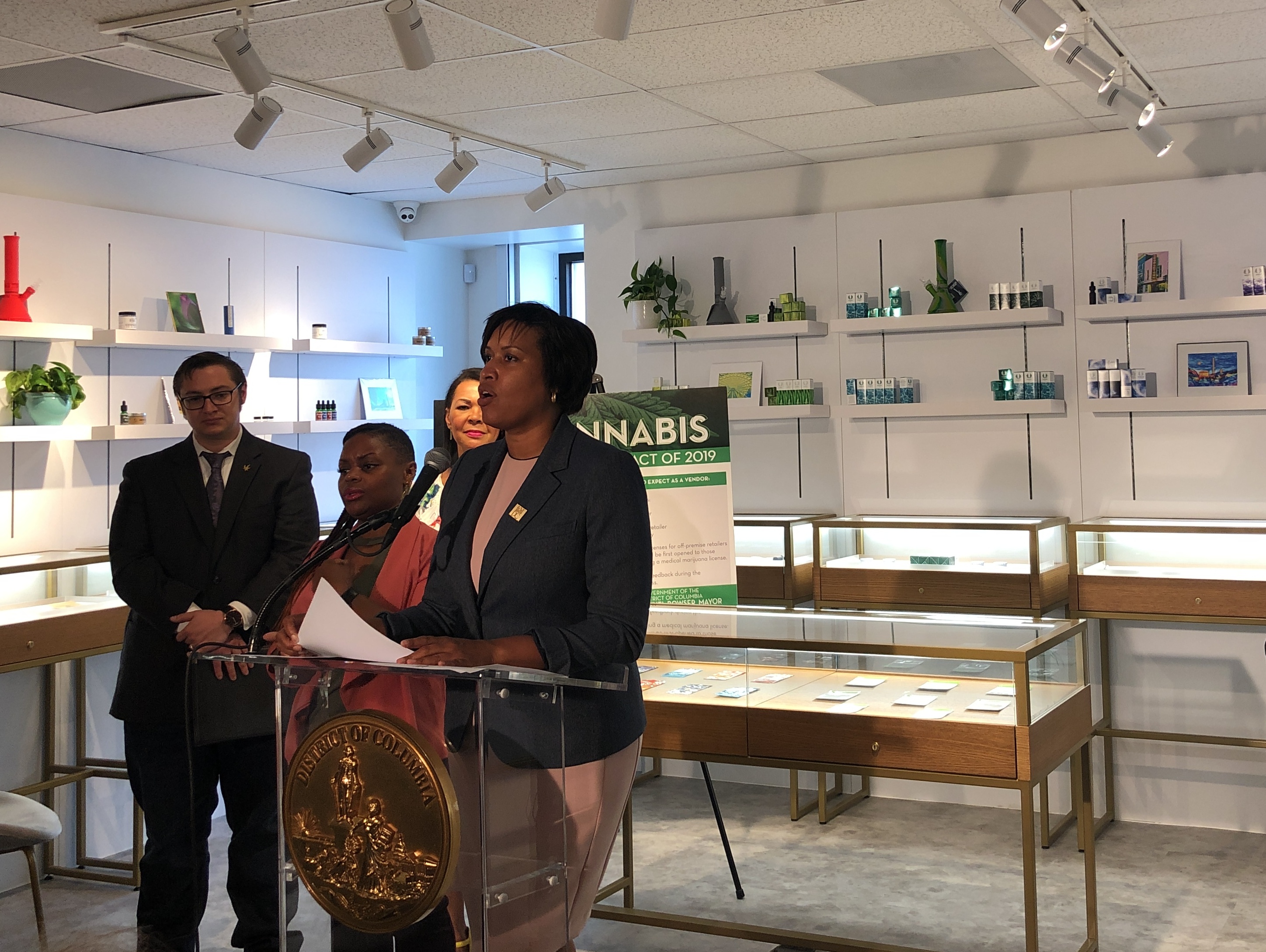
Thousands of city employees can now use marijuana off the clock, whether for medicinal or recreational purposes.
What for some workers is a change in policy and for others is a clarification comes courtesy of a new mayoral order from Mayor Muriel Bowser. The order states that city agencies cannot create their own policies with respect to employee cannabis use and, with some key exceptions, marijuana use can neither prevent a person from getting or keeping a government job. It is still against the rules to use marijuana during work hours.
“It’s really a recognition that, as we make cannabis use policies for the District of Columbia and its residents more equitable and fair and just and safe, we want our human resources policy to be reflective of those values,” says Jay Melder, the assistant city administrator of D.C. The idea is to allow as many workers as possible to exercise their right to possess and use cannabis if they so choose. This new policy comes after District employees dealt with confusion and threats that they would lose their jobs over their use of cannabis as medication.
There are still limits. The difference is that now, rather than allowing any agency to have a blanket policy, restrictions on cannabis use among city employees stem from the way workers are categorized. For example, safety sensitive workers—those whose job duties, if done poorly, could result in harm or death to themselves or others (think Metropolitan Police Department officers or drivers of maintenance vehicles)—are still barred from medicinal or recreational cannabis use and subject to pre-employment and randomized testing. For protection sensitive workers, who are employees who work with vulnerable populations (like teachers or social workers), there’s still a pre-employment drug test, though cannabis use will not be tested, and there’s no random drug test. And security sensitive employees, meaning employees who have access to data or secure information like those working on D.C.’s cyber security or looking at health records, have no pre-employment testing or random drug testing.
All city employees remain subject to suspicion, post-accident, and impairment testing. This policy impacts all of the people who are under the mayor’s hiring authority, which represents about 30,000 of the District’s 37,000 employees. Federally-regulated positions are not affected (after all, cannabis is still considered a scheduled drug under federal law). D.C. agencies have to submit their categorization of their workforce to D.C.’s human resources office for approval.
While D.C. residents overwhelmingly voted in favor of legalizing recreational marijuana in 2014, Congressional meddling has stymied attempts to legalize its sale. D.C. officials are confident that, with Democrats in control of the House of Representatives, D.C. will no longer face those restrictions—so far, they appear right. In that context, Bowser put forth legislation in May to create a tax-and-regulate system for recreational marijuana in D.C. At-large Councilmember David Grosso had already introduced a bill to legalize the sale of recreational cannabis in D.C.
Medical marijuana has been available in the District since 2013 (the implementation of the program was similarly delayed by Congress). The D.C. Department of Health runs the program, which has 6,141 patients registered as of the end of August, along with seven dispensaries and eight cultivation centers.
A D.C. human resources rule first established in 2016 states that most city employees can take part in the city’s medical marijuana program, though the legalization of recreational marijuana “has no impact on the District government’s current enforcement and application of employment related drug testing requirements … [the law] permits District government agencies to maintain and develop policies which prohibit any marijuana use by employees.”
Despite that rule, there has been uncertainty among workers about their ability to treat ailments with medical marijuana, especially after the Department of Public Works recategorized some of its positions as safety sensitive or protection sensitive last summer. Some employees told DCist they were told that they would lose their jobs if they stayed in the medical marijuana program, and they received a memo in May stating they had 30 days to find alternative treatment.
The Department of Corrections “prohibits the use of marijuana by any of its employees,” director Quincy Booth wrote in a letter dated in May, including medicinal cannabis. Grosso told DCist that prospective employees at DOC and the Department of Parks and Recreation received conditional offers from the city, which were rescinded after they said they had medical marijuana cards.
The American Civil Liberties Union of D.C. told DCist at the time that DOC’s stance on medical marijuana raises “serious concerns.” (The ACLU says it is still reviewing this new mayoral order.)
Grosso introduced legislation at the D.C. Council that would bar D.C. agencies from employment discrimination against individuals in the medical marijuana program in May. There will be a hearing for that bill on September 25. The council also passed emergency legislation in June to protect some—but not all—city workers from employment discrimination for being medical marijuana patients.
Grosso says over email that Bowser’s order “represents an improvement over the current situation. However, it does not go far enough and I have concerns over how it will play out practically. The order continues to place a burden on employees using medical marijuana that simply does not exist for other, potentially more harmful, treatments. For example, while the order allows an employee to possibly overcome the presumption of impairment based on a positive THC test (which does not, in fact, assess impairment), she can present evidence that she only takes a CBD treatment with low THC or that the medical use was ‘remote in time’ from reporting to work. This sounds sensible, but how would the employee prove that she had not consumed marijuana in addition to the low THC treatment or at a more recent time?”
One of the DPW employees who received the memo instructing him to find new treatment is Phillip Hedgeman, a longtime motor vehicle operator at the agency who has used medical marijuana since 2016 to treat chronic back pain, though he never medicates before work. He tried other methods of treating his pain, but found that cannabis was the only medicine that was effective and didn’t have debilitating side effects. Because he declined to return to those other treatments, he has been on unpaid administrative leave since May.
Despite this new mayoral order, “I don’t think my status has changed,” Hedgeman says. He signed up to testify before the Council on September 25.
Melder, the assistant city administrator, acknowledges that the mayoral order doesn’t provide a fix for workers like Hedgeman, but says that the problem is the lack of reliable drug testing for marijuana.
Current testing methods cannot determine, for instance, if a person used cannabis that morning or a week prior. That creates liability issues if an incident occurs, and a worker tests positive for cannabis.
“Until science catches up with social policy, we’re going to have to have a bifurcated system,” says Melder. “It’s our responsibility to make sure we have the safest environment possible.”
Previously:
D.C. Council Passes Emergency Bill To Protect Some—But Not All—City Workers Who Use Medical Marijuana
Some City Employees Receive Ultimatum: Find Alternative To Medical Marijuana In 30 Days … Or Else
These City Workers Were Told They’d Lose Their Jobs If They Used Medical Marijuana