Rachel Kurzius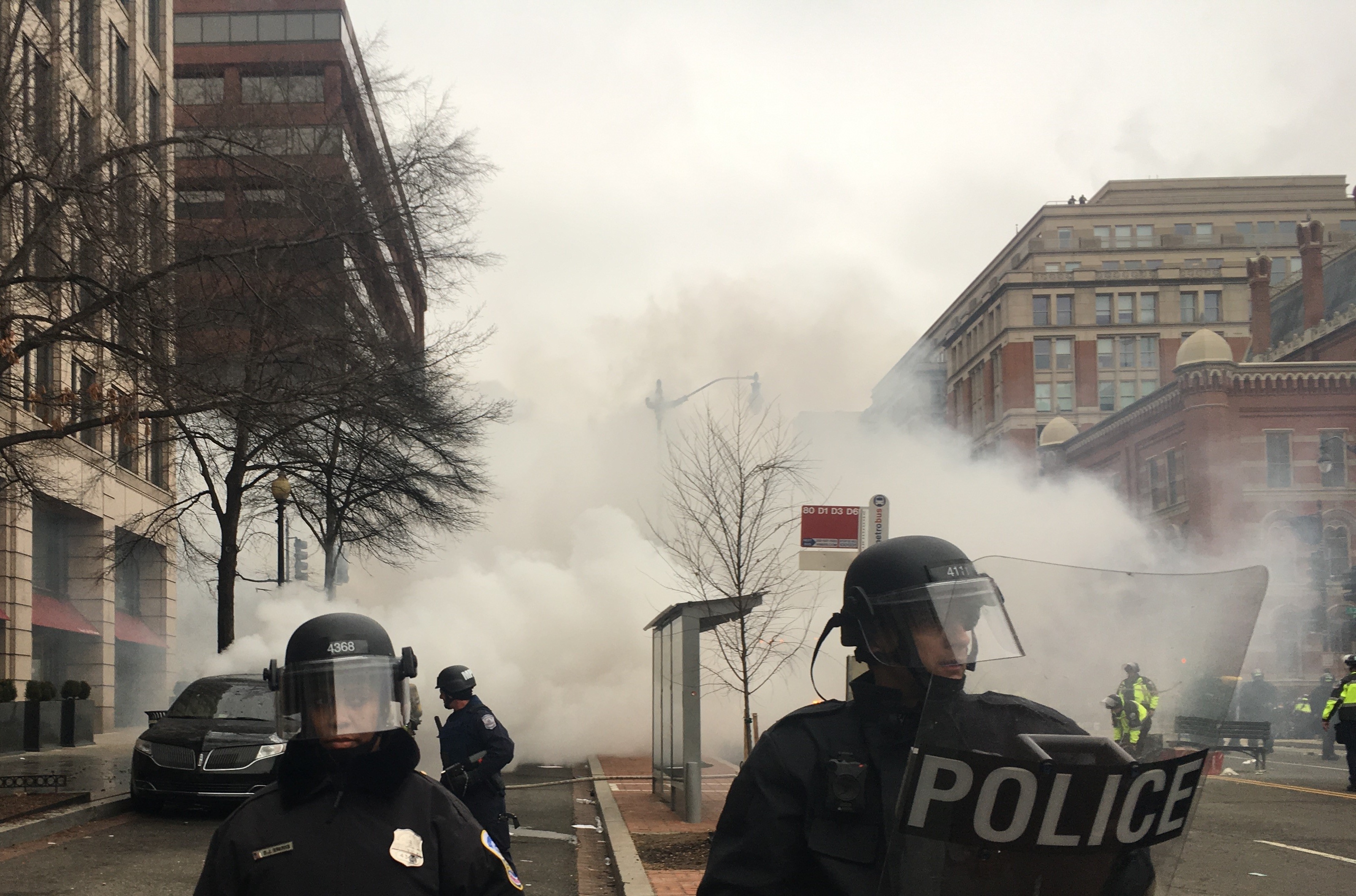
A lawsuit that accuses D.C. police of excessive force and unconstitutional arrests on Inauguration Day can move forward, a federal judge ruled on Friday. However, she granted the government’s motion to dismiss some of the claims.
“I’m pleased the judge is allowing our case to proceed,” said Elizabeth Lagesse, an Inauguration Day protester who is one of the case’s plaintiffs, in a press release. “I think about what happened that day every time I consider participating in a protest. The abusive actions of the police that day conflict with the basic principles of a free society, and this case is about making sure that dissent is respected and protected in the future.”
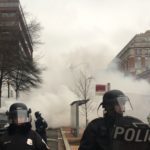
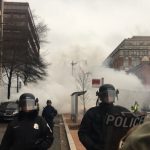
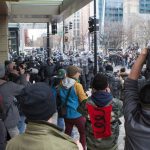
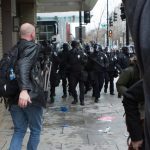
The American Civil Liberties Union of D.C. is suing the city of D.C., the Metropolitan Police Department, Police Chief Peter Newsham, and other officers on behalf of six plaintiffs, including a legal observer, a photojournalist, and a 10-year-old boy. They are among the hundreds of people who were caught up in the law enforcement response to an unpermitted protest on Inauguration Day 2017, when a large crowd of demonstrators largely dressed in black marched from Logan Circle to Franklin Square. Amid window smashing, fires, and other property damage, police used flash bang grenades and pepper spray. They surrounded more than 200 people—including journalists and legal observers—and conducted a mass arrest.
Three of the plaintiffs, along with hundreds of other people, were corralled by police into a confined area for hours. The ACLU lawsuit describes what they observed and experienced, including overcrowding, panic attacks, ongoing pepper spray exposure, open weeping, a lack of available food or drink, and what they called a “piss corner,” where people relieved themselves. Then, they arrestees were loaded into police vans for hours more, per the lawsuit, with zip ties used as handcuffs that were so tight, they created scars and ongoing hand pain for the plaintiffs.
Two of the plaintiffs were subjected to manual rectal probe searches while in custody, the suit says. “I feel like I was raped,” said Shay Horse at the announcement of the lawsuit while describing the rectal probe. He’s a plaintiff who was at the protests on assignment as a photojournalist.
The lawsuit alleged that the MPD violated the First, Fourth, and Fifth amendments as well as D.C.’s First Amendment Assemblies Act, which was passed after a mass arrest in Pershing Park in 2002 resulted in the city paying millions of dollars in class-action litigation. Inauguration Day represented the city’s first mass arrests since the 2002 incident.
U.S. District Court for D.C. Judge Amy Berman Jackson’s decision allows the case to move forward with claims under the Fourth and Fifth amendments, including claims for false arrest, assault and battery, violations of due process, and intentional infliction of emotional distress. But Jackson dismissed the claims under the First Amendment and D.C.’s First Amendment Assemblies Act.
The Metropolitan Police Department stood by its conduct that day. At a press conference at the time, Chief Peter Newsham said he was “very, very pleased” by his officers’ response, and Mayor Muriel Bowser similarly voiced her support for MPD’s actions.
The day after the arrests, the U.S. Attorney’s Office of D.C. charged 230 people with felony rioting, in what some lawyers at the time characterized as a break in policy for both law enforcement and prosecutors. Charges were dropped against some of the journalists who had been covering the protest, but a superseding indictment months later added additional felony charges for others who were arrested that day.
Defendants were facing decades behind bars for what prosecutors deemed a “violent riot,” citing more than $100,000 in property damage. But free speech advocates maintained that police overreacted, and that the USAO’s case was overly broad and could have a stifling effect on First Amendment rights.
The attorney’s office was unable to secure any guilty verdicts after a series of trials, and ultimately dismissed any remaining charges related to the protest by July 2018. Two of the plaintiffs in the ACLU of D.C.’s lawsuit, Elizabeth Lagesse and Milo Gonzalez, were among those facing criminal charges.
MPD Commander Keith Deville said at the first protester trial that convictions in the case “would perhaps limit our civil liability in the matter.”
After the arrests, the Office of Police Complaints called for an independent investigation into Metropolitan Police Department conduct that day. The city agency released a report describing the observations of its monitors, including the indiscriminate use of nonlethal weapons like pepper spray without warning.
When the D.C. Council allotted money for that investigation, the report from the Police Foundation critiqued MPD for a lack of coordination and training, as well as failing to stop disorderly demonstrators and for deploying nonlethal munitions against people who posed no immediate threat.