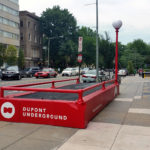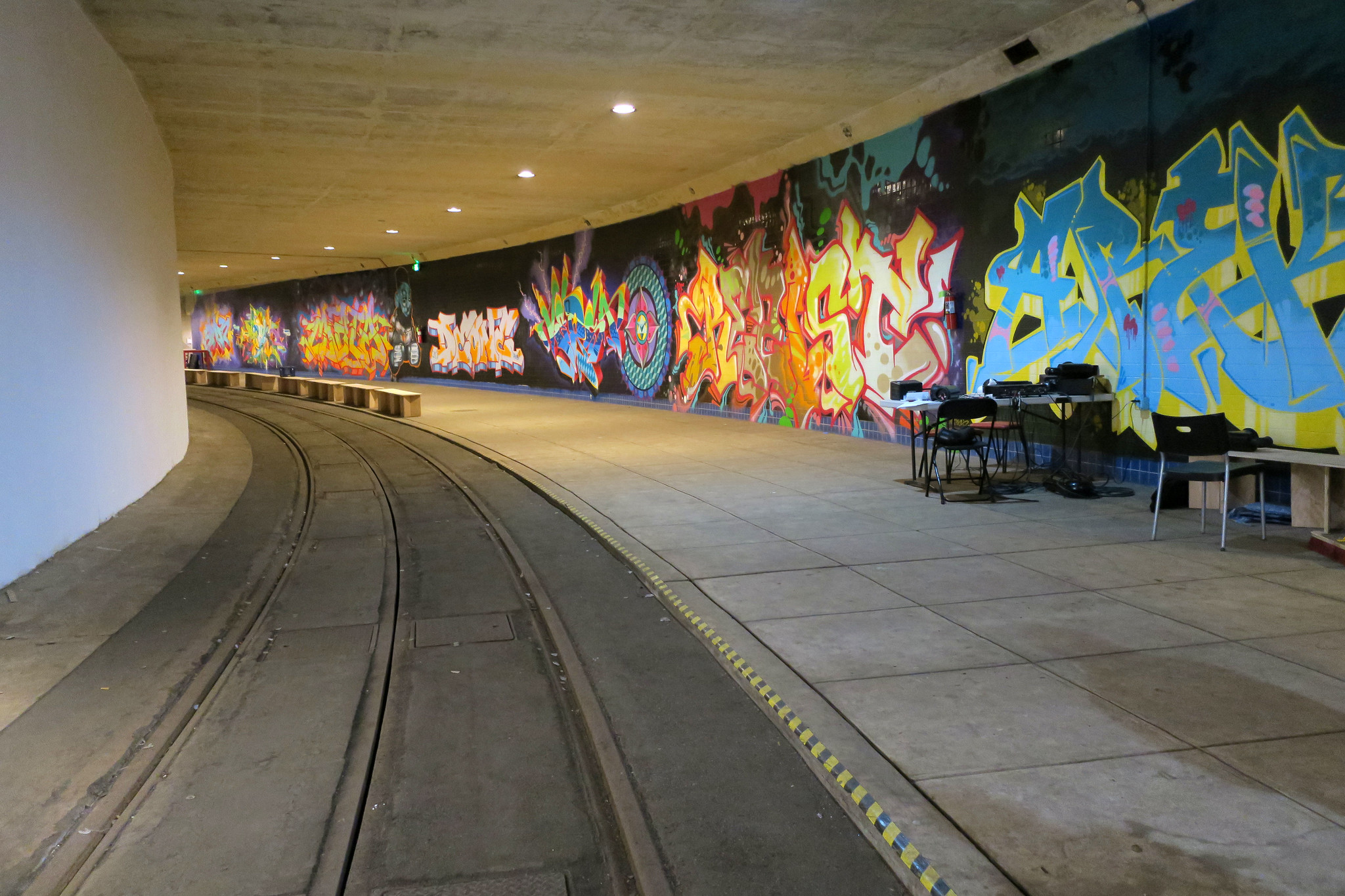
Mayor Muriel Bowser has submitted plans to the D.C. Council that will allow developers to convert a popular subterranean gallery and performance space into a commercial night club.
The proposal, submitted on Friday and shared by journalist Andrew Giambrone on Twitter, comes two weeks after the Dupont Underground went public with fears that the city would not renew its lease.
“I am not surprised,” said Robert Meins, CEO of the nonprofit, who learned of the mayor’s proposal Tuesday when DCist asked him for comment.
Since DCist first reported that the Underground’s lease might not be renewed, Meins says he’s had a meeting with city officials, and that he and his colleagues have received significant support from embassies and arts and philanthropic communities in the District. More than 3,000 people have signed the “Save the Underground” petition, Meins says, and funders have committed more than $200,000—money that is necessary to bring the space up to safety and accessibility codes.
In her resolution to the D.C. Council, Bowser proposes exempting the Underground from the West Dupont Circle Moratorium Zone, a 20-year-old restriction that prohibits night clubs and restricts liquor licenses near the circle. During the 1990s, the moratorium was established in response to concerns from residents about multiple night clubs south of the circle, and proposals the city had received for clubs that include “nude entertainment.”
The Alcoholic Beverage Control Board discussed a three-year extension of the moratorium—with an exception for the west side of the Underground—at a July meeting.
“We recognize that if you are going to have a nightclub in this area, it should be underground and it should be in an area that is not really impacting anyone,” said Daniel Warwick, chairman of Advisory Neighborhood Commission 2B, at the July ABRA meeting. But he doesn’t advocate for a nightclub to replace the arts space. “I personally don’t think a nightclub is the right solution, but it’s not so out of hand that it should be affirmatively not allowed, is where we are coming from.”
Glenn Engelmann, president of the Dupont Circle Citizens Association, also attended the ABRA meeting and spoke in support of exempting the Underground from the moratorium, “in the event the Underground should see fit to develop a nightclub establishment there.”
The ruling is set to become law on March 12, after a public comment period. However, the mayor is urging the council to adopt the proposal sooner.
After this article was published, spokespeople for the Office of the Deputy Mayor for Planning and Economic Development and ABRA told DCist in a joint statement that the mayor made her proposal at the behest of ANC2B and the Dupont Circle Citizens Association. The agencies say they have not received or considered any applications for a nightclub in that space.
Despite the moratorium exception, DMPED says it stands by the statement issued to DCist two weeks ago by Interim Deputy Mayor for Planning and Economic Development John Falcicchio, who said D.C. officials “remain committed to keeping this unique space as an asset of the creative economy.”
According to Meins, at a Nov. 19 meeting attended by three staffers from the deputy mayor’s office, city officials made no mention of the pending night club proposal. They did, however, challenge the Dupont Underground’s assertion that the nonprofit’s lease includes the entirety of the trolley tracks.
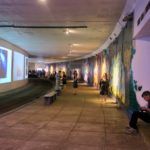
Currently, the Underground has redeveloped only the east side of the tracks. Through Dec. 9, that space is showcasing the third annual World Press Photo DC, a multimedia exhibition honoring excellence in photojournalism. At the rear of the winding corridor, the Alliance for New Music-Theatre recently finished a run of The Havel Project, two plays exploring the legacy of Czech dissident writer Vaclav Havel.
While the Alliance serves as a theater in residence, and spent $12,000 installing lighting and a stage in the underground, a wide variety of local groups, embassies, and artists have also hosted events in the Underground since it opened in 2016. That list includes artist Eric Dickson, choreographer Sarah J. Ewing, Flower Bomb Fest, cellist Wytold, and the TBD Immersive theater collective. The initial 5.5 year lease that the Underground received expires in April 2020, but, given that the heatless space typically closes over the winter, Meins fears that the current exhibit will be the Underground’s last.
“There is only so much gas in the tank,” he said of his nine-month battle with city bureaucrats.
Meins, a Dutch-American development economist, stepped in as CEO in March after previously running the World Press Photo exhibitions. At that point, he says the Underground had only $5,000 in the bank, and had a November deadline for a $150,000 payment. He and his fellow board members, volunteers, and other part-time workers have been raising money and attempting to negotiate a lease extension with the city. In October they were able to get a phone call with the real estate team from the deputy mayor’s office, at which time Meins says officials told him they might begin soliciting bids from developers.
At the Nov. 19 follow-up meeting, Meins says city officials offered to forgive the $150,000 “balloon” rent payment for the past five years, but not renew the lease for the entire space. According to Meins, city officials hadnot read a prospectus that the Underground submitted in October, which proposes that World Press Photo establish a year-round exhibition on the west tracks, a space still cluttered with the remains of a failed 1990s food court.
“They were very vociferous in saying that was not part of our lease, but I said, ‘Yes, yes. It absolutely is.’”
With a permanent partner like World Press Photo on the west side, Meins says, the east side would remain open for rotating exhibition, parties, and performances.
“Our model is for the galleries to be open during the daytime, and to present everything from opera to go-go in the evening,” Meins says. “That’s the only way we can be viable.”
At the July ABRA meeting, Warwick, the ANC chairman, proposed that a commercial nightclub space might produce income for making those necessary renovations. “It will require very creative financing and nightclubs tend to make a lot of money,” he said.
Planned 2020 happenings in the Underground—should the organization be allowed to keep its space—include a multi-media installation and performance by Austrian artist Stefan Tiefengraber and Joby Talbot’s site-specific oratorio Path of Miracles, which would position singers from Washington Choral Arts Society along the Underground’s circular path.
Eva Schoefer, director of the Austrian Cultural Forum, previously told DCist that she and other embassy cultural counselors are impressed with Meins’ leadership and are “ready to invest in the space.”
Support among local arts groups is also strong: Choral Arts was one of more than a dozen District nonprofits that submitted letters urging city officials to retain the arts space.
Before he learned of the night club proposal on Tuesday, Meins said he was scheduling more fundraising meetings and had a letter prepared for the mayor “asking for her help.”
This post has been updated with comment from DMPED and ABRA.
There’s No Paywall Here
DCist is supported by a community of members … readers just like you. So if you love the local news and stories you find here, don’t let it disappear!