 Eliza Tebo
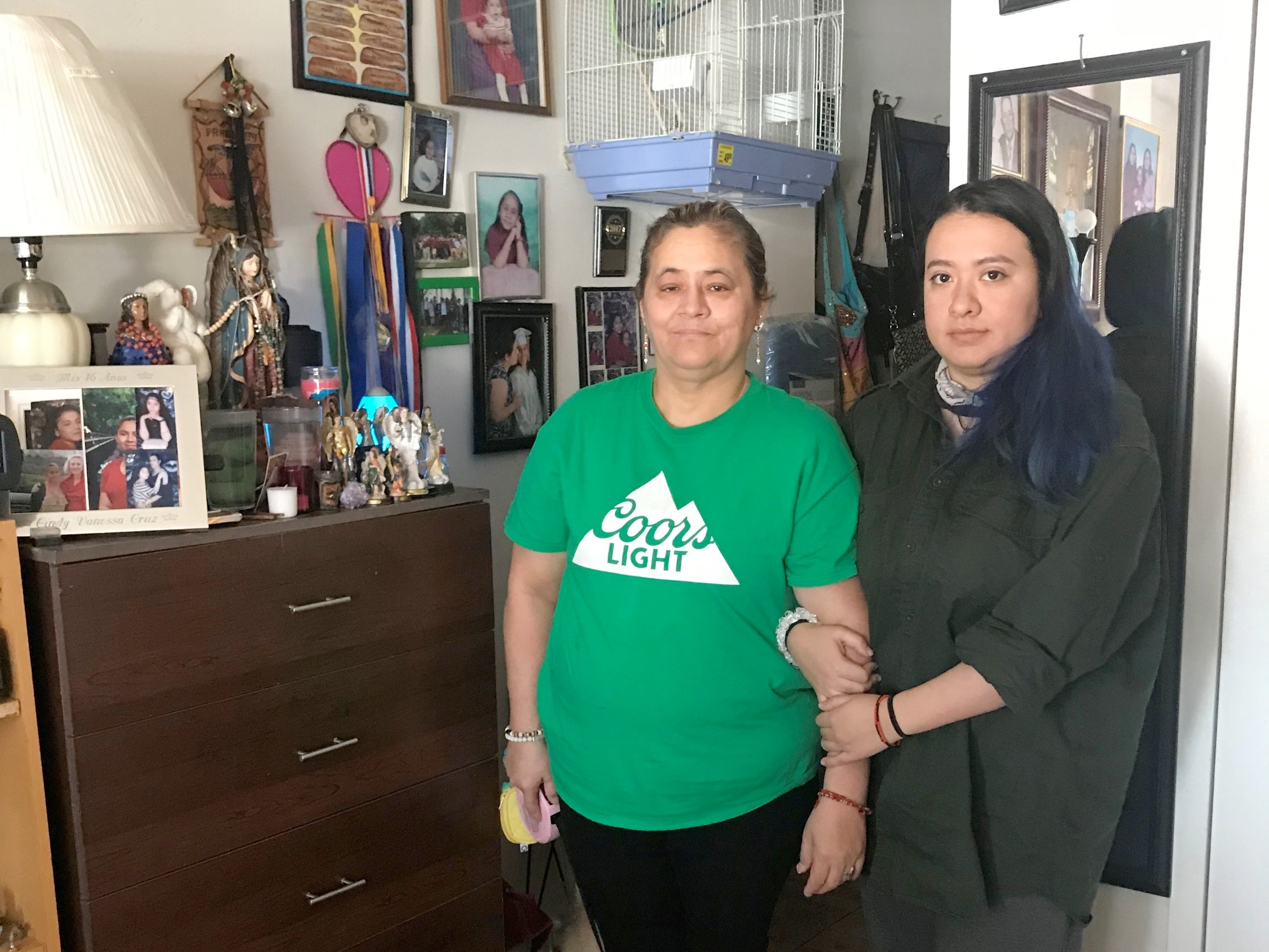
Julia Flores has lived in a rent-controlled apartment in Columbia Heights since the 1990s—a small studio where she raised both her daughters.
“We’ve always had problems in this building, forever,” Flores said in Spanish at her apartment Thursday morning, as local activist and Georgetown student Juan Reyes translated. “The landlord has changed, they’ve sold the building to numerous companies, and nothing changes—the managers just come, they don’t fix anything, and they just collect our rent.”
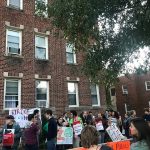
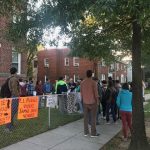
On Friday night, Flores and residents from more than a dozen homes in the 101-unit building, 3435 Holmead Place, gathered to publicly launch a rent strike, withholding their rent until their grievances are addressed.

Some residents of a Columbia Heights apartment building launched a rent strike Friday night.
The Path To A Rent Strike
With the support of organizers from local chapters of the Democratic Socialists of America and its Stomp Out Slumlords project, the D.C. Tenants Union, and Georgetown University’s Kalmanovitz Initiative for Labor and the Working Poor, residents have circulated petitions and communicated with the landlord, Urban Investment Partners Property Management, for the past few months. UIP declined to comment for this story.
Maresa Hernandez, who lives across the hall from Flores and has called Holmead home since birth, has raised concerns with both the central office and building manager.
“We didn’t want it to just be just word and talk; we wanted to see actions,” Hernandez says. “They have responded, but we feel like it hasn’t been enough because there’s still rats and cockroaches.”
On Nov. 5, tenants of Holmead Place sent a letter to UIP management listing their complaints, including mold, lead and the cost of air conditioning. It states:
“We have reported these and other issues to management on multiple occasions, and none of them have been adequately corrected. Management has a responsibility to take reasonable measures within its power to ensure our habitability in our building and to reduce risk of living there. By failing to provide basic measures of habitability, our landlord breached the warranty of habitability which is implied into all residential leases in the District of Columbia.
This letter is intended to serve as a final notice. If these issues are not corrected in the next 30 days, we will begin to pay our rent into an escrow account and withhold it from the landlord pending correction of all housing code violations.”
UIP has made recent efforts in units to make repairs and control pests, Hernandez says, but some residents feel they haven’t yet gone far enough. A notice from the management posted in the building enumerated several areas where management is attempting to make progress.
“UIP values all residents at Holmead Apartments and have pledged to work hard to provide a clean and comfortable living environment for all,” the letter to residents reads.
The company, which purchased the Holmead building eight years ago, operates dozens of residential properties across the city. UIP has been criticized for some of its practices, including its use of voluntary agreements to essentially convert rent-controlled units to market-rate housing by either buying out tenants or allowing current tenants to raise the rent once they depart. Landlords will sometimes incentivize rent increases by promising tenants renovations

Flores raised her two daughters in this studio bedroom, where she fits two beds, a treadmill and a dining area in one room.
‘A National Trend’ Of Rent Strikes
In recent years, residents at several other housing developments in D.C. have engaged in rent strikes, including an ongoing strike at 1454 Irving Street NW and a successful strike in Brightwood, where the owner decided to sell the building weeks after tenants launched a strike.
Rob Wohl, an organizer with Stomp Out Slumlords, has been involved in a handful of local rent strikes. The effort, he says, is a revival of strategies used in D.C. in the 1960s and 1970s, and one that’s grown more common in cities grappling with the impact of gentrification on affordable housing, including Houston, Cleveland, and Los Angeles.
“It’s part of a national trend of more militant tenant activism in response to the deepening of the housing crisis in major cities,” Wohl says.
Wohl points to a 1964 rent strike at 1414 Girard Street NW (less than a mile from 3435 Holmead Place) as a “watershed” local rent strike. Though the striking tenants were evicted after a legal struggle, according to a 1983 study from the University of the District of Columbia, the actions set the stage for local strikes occurring throughout the next decade.
From the study:
“Between 1964-1974, dissatisfied with the lack of progress, tenants turned to direct action and a battle erupted as rent strikes spread across the city. With the assistance of various organizations, tenant groups fought landlords in the courts and before the D.C. Council. And as inflation increased after the mid-1960s, rising rents led to a demand for controls on rents and on cooperative and condominium conversions.
By 1974, tenant victories began to multiply: a local rent control law with expanded tenant protections, a major judicial decision which established the lease as a contract, and the development of city-wide organizing.”
Are Rent Strikes Legal?
In D.C., tenants are permitted to withhold rent if housing-code violations they’ve expressed to their landlord have not been dealt with, and landlords are not allowed to retaliate, says a representative for the D.C. Department of Housing and Community Development. Residents may also file complaints with the DHCD and the D.C. Department of Consumer and Regulatory Affairs.
The “implied warranty of habitability,” a legal precedent followed in many jurisdictions, says tenants can withhold rent when landlords are not complying with local housing codes, a tenet also included in the D.C. Tenant Bill of Rights:
“The landlord must ensure that your unit and all common areas are safe and sanitary as of the first day of your tenancy. This is known as the “warranty of habitability.” The landlord must maintain your apartment and all common areas of the building in compliance with the housing code, including keeping the premises safe and secure and free of rodents and pests, keeping the structure and facilities of the building in good repair, and ensuring adequate heat, lighting, and ventilation.”
Fifty-one property-code compliance complaints have been filed with DCRA against the building since 2004, 31 of which were submitted since UIP took over the building; some have been resolved, others remain open. Neither Flores nor Hernandez have filed complaints with D.C. agencies, and Flores expressed skepticism about being treated fairly as a Spanish-speaking, Latina woman.
Instead, she and Hernandez say they prefer working with other tenant leaders and activists, some of whom are active at developments throughout the city.
In July, a coalition of organizers and residents formed the D.C. Tenants Union to help assemble groups of residents in D.C. who want reform in their buildings. And tenant leaders advocated for stronger local housing laws at a D.C. Committee on Housing & Neighborhood Revitalization hearing last month. The city’s rent-control law is up for renewal in 2020.
Hernandez says she’s more excited than scared about the rent strike: “I’m just really positive and excited about the whole situation.”
This story originally appeared on WAMU.