Martin Austermuhle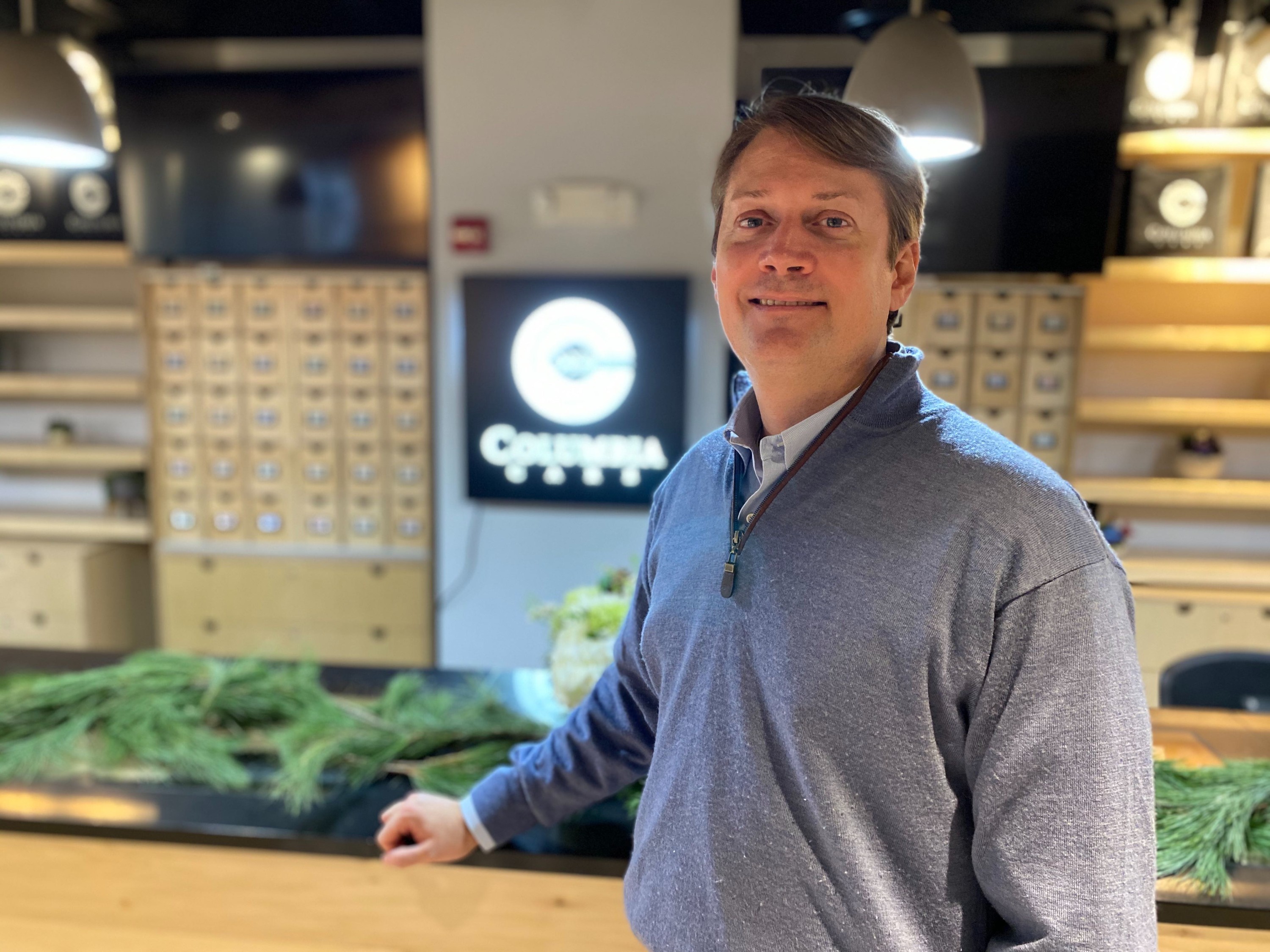
Nicholas Vita’s path from buttoned-up investment banker to CEO of the country’s largest medical marijuana business wasn’t an obvious one.
“Everything that could have gone wrong went wrong,” he says. “My girlfriend dumped me, my parents thought I was crazy, my friends thought I had lost my marbles and everyone I ever worked with told me I’d never get another job.”
Medical marijuana is now legal in 33 states and is a big business, but in 2011, it was just getting started, and most investors were wary of a business model based on a drug still illegal under federal law. “No one had ever built a business like this before, but we wanted to be the first what people now describe as a multi-state operator,” says Vita.
By his own description, Vita had “a pretty normal sort of suburban D.C. experience,” if fairly privileged. He grew up in Bethesda and followed a well-trodden path from private schools (Mater Dei and Georgetown Prep), to an elite university (Columbia), to a job in finance at Goldman Sachs. He followed that with a stint investing in health care companies.
In 2011, a friend at a party asked what he knew about cannabis. Nothing, he replied. “We went up to another friend who knew a lot more than we did, we started asking him about it, and one thing led to another, and it turned out it was a really interesting opportunity,” he says.
That interesting opportunity has since evolved into Columbia Care, one of the country’s biggest producers and sellers of medical marijuana. With 96 dispensaries and cultivation centers in 15 states from California to Delaware—including a newly opened dispensary in Bethesda—New York-based Columbia Care has a market capitalization of almost $700 million and employs over 600 people. Earlier this year, Columbia Care was listed on the Canadian stock exchange. Now, the company is looking to expand into a half-dozen other states and recently spent $140 million to acquire Colorado’s biggest chain of marijuana dispensaries.
“We’re really focused on creating the largest national medical marijuana platform in the U.S.,” says Vita, now in his late 40s, during an interview inside the sleek Bethesda dispensary located a block off of Wisconsin Avenue.
The story of Columbia Care’s rapid expansion under Vita’s leadership isn’t just one of a local boy gone big. It’s also the story of a once-illegal industry growing by leaps and bounds while still under the constraint that marijuana remains illegal federally. But the industry’s development—and the flow of big money—is also testing marijuana’s long status as a part of the country’s counterculture.
Starting Small
When Vita was ready to make the leap into medical marijuana, he decided to stay close to home. The company’s first dispensary and cultivation centers were located in D.C., which recorded its first legal sale in 2013. And he says that dispensary—Capital City Care, originally located on North Capitol Street but now on U Street—served a clientele that included a large number of people who were HIV+ and had been using other powerful and costly medicines to treat their conditions.
“Every family has a member who is impacted by cancer, impacted by arthritis, impacted by very important chronic illnesses,” he says. “You think to yourself, ‘Gosh, I’ve spent all this time with the privilege of going to great schools,’ and you think about all the opportunities you have. And finally, something comes along where you can actually make a huge shift in policy, part of this moment in time where you open up a door for a whole new type of healthcare.”
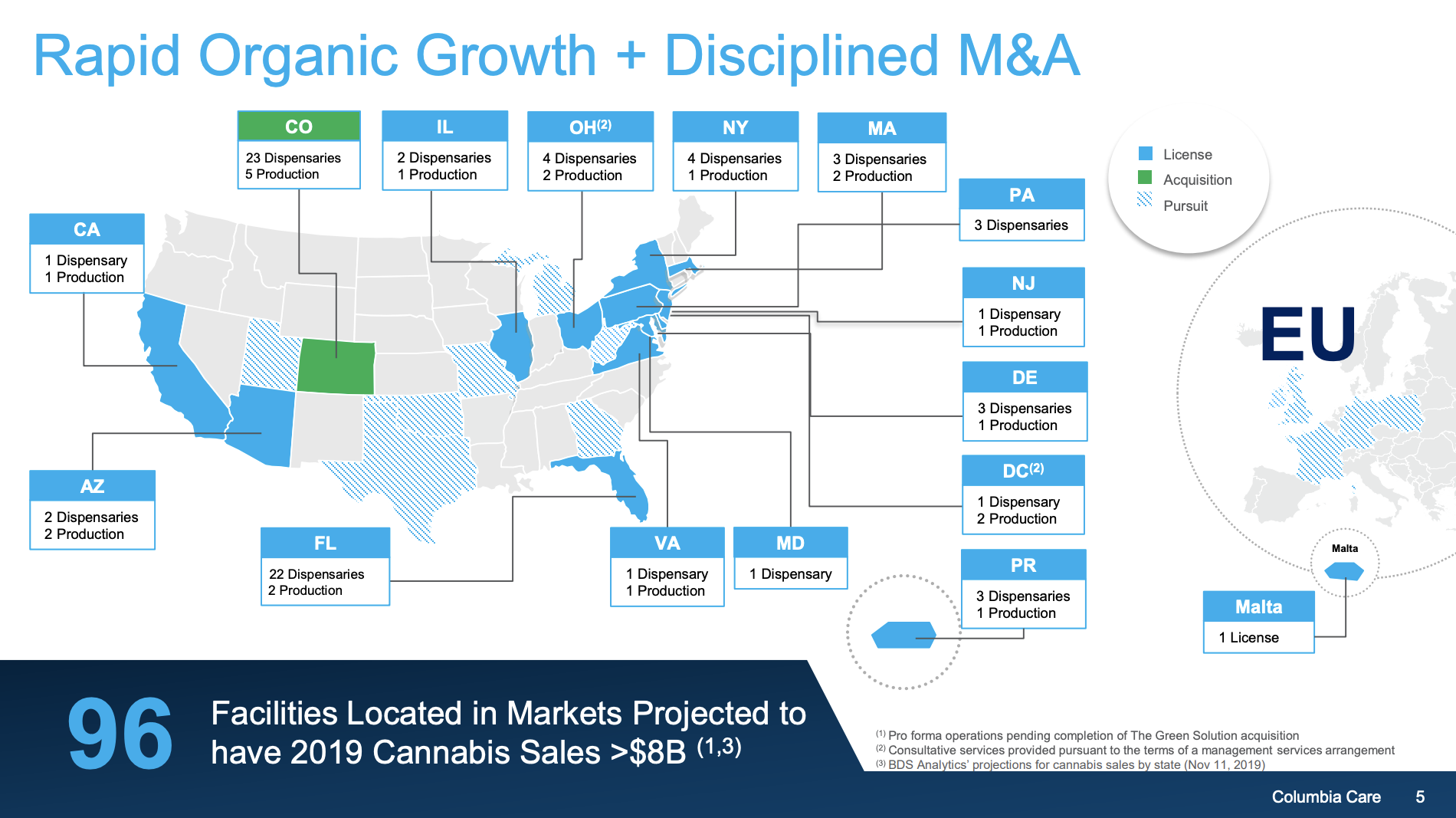
A slide in a November presentation to investors shows where Columbia Care is already active in producing and selling medical marijuana, and where it’s looking to go.
And then there was the additional challenge that since the federal government still considers marijuana to be illegal, many traditional banking services are unavailable to businesses entering state-based programs. (Vita says Chase bank even canceled his personal checking account.) And since the legal marijuana programs are run and regulated by the states, that means any company looking to operate in different states has to start from scratch in every new market they enter.
“It’s a little bit like building a multinational corporation, but within one country,” Vita says. “We have the benefit of people generally speaking the same language, but if you talk to someone from Boston or New York, one’s from Pluto, one’s from Mars, and they can’t stand each other. You have all these cultural, legal and regulatory differences from region to region. Ultimately it’s about being persistent and never giving up.”
The Emergence Of ‘Big Marijuana’
Columbia Care expanded to Arizona, New York, Illinois, Massachusetts and now operates in 15 states, part of the rapid expansion of the legal marijuana industry in recent years. Currently, 33 states have legalized medical marijuana and 11 have legal recreational sales; in 2018, consumer spending on marijuana approached $10 billion, according to BDS Analytics, which does marijuana market research and analysis.
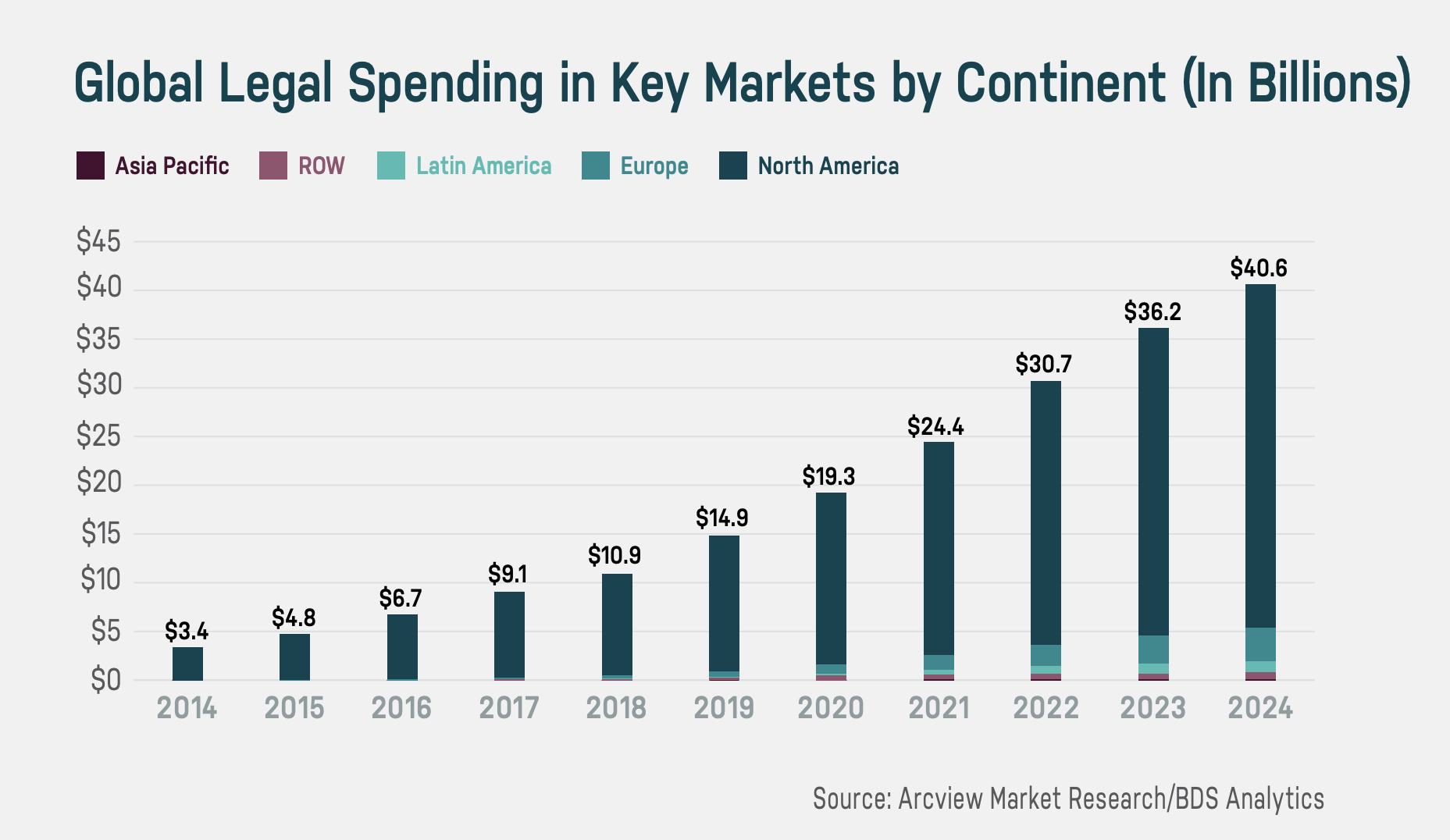
As more states and countries have legalized medical and recreational marijuana, sales have grown — and are expected to continue doing so.
While bigger investors and companies have slowly been getting into legal marijuana in the U.S., Tom Adams of BDS says the real game-changer came when Canada fully legalized marijuana in late 2018. “That really uncorked the investment genie bottle. Suddenly you had publicly-traded companies on the Canadian exchanges who were plant-touching and who investors could legally invest in,” he says.
But the growing interest from traditional investors and financial companies brings positives and negatives. In some cases, it has meant smaller businesses and entrepreneurs—especially minorities—have been locked out of the potentially lucrative medical and recreational markets.
Jason Ortiz, the director of the Minority Cannabis Business Association, sees this as an issue across the industry.
“Historically, the accumulation of wealth has been very white-heavy, and so when you enter a market that requires intense capital, those that are going to be able to do that are going to be white and male and older, and generally straight. That is the case when it comes to finances generally, so the cannabis industry is no different. Where we are seeing differences happening now [is] that people of color are demanding ownership, not just employment.”
In Maryland, minority business owners say they have largely been shut out of cultivation and processing licenses in the state’s medical marijuana program, which serves more than 85,000 patients.
In Columbia Care’s case, the nine-person management team is all white and predominantly male. Like Vita, co-founder Michael Abbott also came from the world of traditional finance. Vita says he’s aware of how societal inequities are in part reflected in the marijuana industry, and that the company consciously tries to address them.
“We leverage our national scale to provide not only financial support but also mentorship and access,” he says. “Our company is as diverse if not more so than the communities we serve.”
But on the other hand, there is an advantage to bigger companies in marijuana, especially in the medical field, says Steph Sherer, director of Americans for Safe Access. Not only can those companies invest in research, development and standardizing their products, but they can enter a new state and open their doors quickly.
“It’s meant that as licenses are given out, those licenses are actually turned into access points for patients. In the past, we saw big gaps when licenses were issued and whether or not the people who had the licenses had the capital to move forward,” she says. “In that way, it’s been a positive.”
‘Protective Moats’
Columbia Care’s new dispensary in Bethesda is located in an unassuming second-floor retail space less than a block off of Wisconsin Avenue. It’s heavy on natural colors and tones, lined with windows to let in sunlight and meant to evoke a natural experience. Walking around the new space only hours before opening it to the public, Vita says he wants to challenge the assumptions of people who have never experienced medical marijuana before, and also set an expectation that will keep them coming back.
“When I would walk to work [in New York], I would pass the Apple store and the AT&T store. I could buy an iPhone at the AT&T store, but everyone waits in line at the Apple store because of the Genius Bar. That is what we have here. And so having people who really understand the products, who understand the importance of when to involve a licensed medical provider rather than just trying to wing it, [that’s] a big part of building credibility and trust,” he says.
He says the company is constantly looking at what’s next—it’s looking to enter the medical market in more than a half-dozen new states and has started exploring expansion opportunities in France. Tom Adams from BDS Analytics says that for now, companies like Columbia Care are seeing favorable terrain for growth. That’s largely because of what he calls three “protective moats:” a lack of direct competition because of licensing rules for legal marijuana programs; national-level retailers steering clear while pot remains illegal federally; and no online competition to upend the industry the way it did for books, newspapers and traditional retail.
“It’s a really unique investment and company-building opportunity because of those protective moats,” Adams says.
Ortiz adds that while big money has started flowing into legal marijuana, many investors have overestimated the opportunities and returns and are thus starting to reconsider and retreat.
“The equity folks, the folks that really understand what they’re doing and are really committed to this plant and this movement, are going to be the ones that survive long term while some of these big financiers will find the next place to pump and dump their money,” he says.
Vita wants to keep growing, but pauses when asked whether he’d ever like Columbia Care to be the Walmart of legal weed. “I hope that we may have the scale of one of those companies, but I would be disappointed if people ever called us a Walmart,” he says. “Sometimes big companies lose their personality, and they lose sight of their focus and mission. If we lose that, we’ll lose the people we serve.”
And, he adds, helping people address their medical conditions is why he’s doing what he does.
“How many times in our lives do we get a chance to go to work every day and say, ‘I’m going to help people?’” he says. “When I was at Goldman, I don’t think in my entire time there anyone ever said, ‘Thanks for coming to work,’ or ‘Thanks for doing what you do.’”
This story originally appeared on WAMU.