Rachel Kurzius
The city’s attempts to develop the McMillan Sand Filtration Site have been a never-ending saga of fits and starts that go back more than a decade, bringing out some of local D.C.’s most heated local commentary with it.
But if there’s one thing that the project’s vocal fans and even more vocal opponents can agree on, it’s that this is among the most protracted, cursed projects in recent D.C. history.
Okay, I’ll bite. What’s McMillan?
The 25-acre site right by Washington Hospital Center sits at the edge of D.C.’s Northwest quadrant, and is bordered by First Street NW, Michigan Avenue NW, North Capitol Street, and Channing Street. It was once part of the much larger McMillan Reservoir and Filtration Plant, a 92-acre plot of land built in the early 20th century as part of the City Beautiful reform movement and the McMillan Plan.
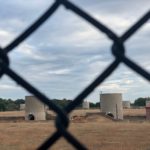
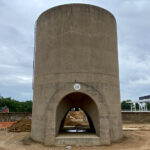
The site became the first large-scale system in D.C. designed to purify the city’s water amid typhoid outbreaks. It used sand to filter the water, a process that happened in huge underground catacombs. Above ground, the sand bins resemble large silos situated alongside brick structures and concrete walls.
The entire 92-acre property was referred to as McMillan Park, according to a 2010 historic preservation report, and American landscape architect Frederick Law Olmstead, Jr. created a design plan, much of which was implemented between 1907 and 1919. The specific 25-acre parcel was industrial in nature, but residents could amble around a landscaped perimeter walk. However, that changed during World War II, when the U.S. Army built a fence around the property and restricted public access over concerns that the water supply could be poisoned. To this day, the area remains fenced off.
The site continued to filter water for D.C. until 1986, when it was decommissioned. The following year, the federal government sold the 25-acre parcel to the city for $9.3 million (though the feds are still in charge of the reservoir itself). The park received D.C. historic landmark status in 1991. Decades after its sale to D.C., the land remains unused. Back in 2012, the city discontinued the practice of allowing tours of the facility, citing safety as a concern.
So who wants to develop the property, and what do they want to do with it?
Ever since the city acquired the land in 1987, it has been hoping to do something with the McMillan site. Long one of the biggest undeveloped tracts in D.C., planners have largely eyed it for mixed-use development and designated it as such in 1990. (But that wasn’t the only suggestion. Per advocates, plans for the property have included a Kmart and a prison, and according to a 2006 Washington Post story, a bunch of groups wanted to use the land for a monument, including an organization hoping to memorialize dogs killed in wars.)
It took more than a decade to get the ball rolling on developing the property (you can read what happened in that intervening time in this HillRag series on McMillan). D.C. determined that construction to make the land ready for public use would be too expensive without the help of a private development partner, per court documents.
By 2007, the land was in the portfolio of the Deputy Mayor for Planning and Economic Development, the agency that remains in charge of the property to this day. Following a competitive bidding process to determine a master plan for the site, the city chose Vision McMillan Partners—a group formed by construction companies EYA, Trammell Crow, and Jair Lynch—that same year for the task of imagining what was to come on those acres.
After that, Vision McMillan Partners became the developer on the project. But the city didn’t put out a new bid for the developer. Instead, it just de-facto turned to Vision McMillan Partners—a decision that D.C.’s auditor called flawed in 2015, suggesting that the project should be put out to bid once more to properly follow protocol.
But rather than follow the auditor’s suggestion, D.C. Council Chairman Phil Mendelson introduced emergency legislation to waive the city’s competitive bidding requirement altogether for the project in 2016. As you’ll shortly see, this choice riled up some opponents.
The current vision for the 2.1 million-square-foot project includes 146 townhouses, more than 500 apartments, retail, a Harris Teeter, a park, and a community center, and 2016 estimates put the cost at around $720 million.
The proposal’s design integrates some of the historic structures, like the 20 silos currently on site, but other old buildings are slated to be demolished. DMPED also says the project will mean 3,000 construction jobs, 3,200 permanent jobs, and more than $1.2 billion in tax revenues for the city.
Back in 2016, as Vision McMillan was soliciting a general contractor, it envisioned having the first buildings completed by 2018.
2018, you say? But the first buildings haven’t even begun construction. What happened?
In short, the city’s plans for McMillan have faced a series of court challenges.
There are two main groups issuing these challenges: Friends of McMillan Park and the Save McMillan Action Coalition, both of which have actively opposed the city’s plans for redevelopment.
If you talk to a member of Friends of McMillan Park, they’ll likely tell you that they don’t necessarily object to any development on the site. Instead, they’ve got issues with the process: They feel like the city’s plans don’t properly preserve the history of the site; would have an undue density and traffic impact on the neighborhood; and have not properly taken into account the Comprehensive Plan, D.C.’s document that outlines its plan for future growth. (Amendments to the plan in 2021 called for additional housing, making it harder to use the document to block new residential construction — though the document will be updated more thoroughly in 2025). They’ve been working with lawyers since 2014, and started appealing decisions from the zoning commission and the mayor’s agent that cleared the way for the project to move forward.
Similarly, Chris Otten of the Save McMillan Action Coalition is a self-described “civic agent” well known for delaying local development projects through lawsuits. He told DCist at a 2016 party in the underground vault, wherein revelers protested the site’s development, that he wanted to see the city preserve McMillan as-is and turn it into a destination spot. Otten has filed restraining orders to prevent demolition at the site, and contends that the development could lead to traffic woes and other issues.
There are also those who oppose these opponents, and say groups like Friends of McMillan Park are delaying needed housing and amenities in the neighborhood.
As opponents of McMillan filed appeal after appeal in the D.C. Court of Appeals, they scored multiple wins that kept the development in limbo, mostly on questions of procedure.
But I swear I remember a big groundbreaking. Is that my imagination?
Great memory! The groundbreaking ceremony was no dream when it was held in December 2016. Mayor Muriel Bowser, Ward 5 Councilmember Kenyan McDuffie, and others lifted their shovels to begin what they’ve called “one of the most transformative projects” in D.C. However, the ongoing court cases meant that the groundbreaking was ceremonial and only marked the start of historic preservation work, given that the city did not have the legal ability to begin demolition.
In a twist that literally occurred one day after the groundbreaking ceremony, the D.C. Court of Appeals vacated the orders from the Zoning Commission and Mayor’s Agent for Historic Preservation. The decision said that the Zoning Commission didn’t address the project’s impact on the neighborhood. It wasn’t a complete victory for Friends of McMillan Park, because the decision said that high-density development on the property could be justified—but the city just hadn’t made the case properly yet. The city pledged to get its nose to the grindstone to address those issues causing the setback.
By September 2017, the Zoning Commission yet again gave the project the green light, as the development made it once more through the various agencies requiring approval. In July 2019, it appeared that the D.C. Court of Appeals had finally cleared the way for the project. A decision said that the Zoning Commission’s analysis this go-around was “reasonable, supported by substantial evidence, and adequately explained.” Opponents appealed that, too.
At the end of the summer, DMPED scored demolition permits for the property. But that victory led to even more legal challenges. On January 16, 2020, the D.C. Court of Appeals issued an injunction that prevented any demolition or other work on the McMillan site. A D.C. Superior Court judge said those demolition permits were granted without the developer ever proving that it has the funds to finish the project, contra a court order, leading to a new series of appeals.
What broke the logjam?
In the summer of 2021, the D.C. Council chimed in yet again on McMillan. Mendelson introduced an amendment to the Budget Support Act that called for the project to “proceed expeditiously and without further delay through all phases of demolition and construction of the foundation of the community center.” While a few councilmembers expressed concern that the measure meant the council was trying to unduly influence court cases underway, the measure passed.
Citing that law, a three-judge panel finally lifted a stay on demolition activity in late September 2021. The city and the developers wasted no time: demolition activities got underway the very next day.
Even as judges allowed demolition to proceed, the underlying case against the permits was not dismissed on the spot. But when the court heard oral arguments on the case in late October, judges appeared skeptical that opponents still had a case, given the council’s bill. Days later, the D.C. Court of Appeals dismissed the case altogether. Their reasoning? “The Council has directed that, whether or not the specified permits were properly issued under the law as it then existed, these permits are lawful by the Council’s decree, and demolition and development as authorized by these permits can move forward.”
What has all this cost?
It’s tough to fully quantify, but here are some stats worth keeping in mind. In 2020, DMPED officials said in court filings that the cost of litigation has boosted the cost of the project by $100 million over the past five years, according to WBJ, and the agency’s attorneys believe the city is losing about $6,500 each day as the project remains in limbo. (It’s worth taking those numbers with a grain of salt, given that lawyers were trying to show how much financial hardship the delays have created.)
As of October 2021, Friends of McMillan Park has raised more than $29,000 on GoFundMe over the past three years towards its legal fund.
There’s no way this is over, is there?
So it seems you’ve been paying attention! The lawsuit dismissed in late October isn’t the only legal action underway. There’s also a federal court case alleging that D.C. violated the historic preservation covenants associated with McMillan.
And expect to see more action at D.C. courts, too. At the October D.C. Court of Appeals hearing, lawyers kept bringing up the subdivision of the site — while the judges maintained that issue wasn’t germane to that case, it could certainly come up in the future.
Another argument to keep your eyes on: opponents are now claiming that demolition of the site will release asbestos. They don’t have any proof, but say that the city hasn’t released any proof to the contrary. City officials maintain that those claims are bunk: agencies have tested McMillan for asbestos multiple times and never found anything, Mendelson said in October.
Friends of McMillan Park has also tried to get Republicans in Congress to step in, a tactic that depends on the ability of federal lawmakers to intervene in local D.C. affairs — generally a major frustration of statehood advocates.
And opponents have stepped up their protests since demolition started, including at homes of councilmembers. In late October, three activists chained themselves to equipment at the site, temporarily preventing demolition.