Rachel Kurzius
Members of Congress will soon vote on whether D.C. should become the 51st state for the first time since 1993.
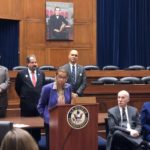
D.C. Delegate Eleanor Holmes Norton, Mayor Muriel Bowser, and Council Chairman Phil Mendelson were flanked by House Oversight and Reform Chairwoman Carolyn Maloney on Thursday afternoon to announce that the oversight committee is scheduling a markup and vote for HR 51 on February 11. The bill is expected to be voted through committee and make it onto the House floor.
Since joining the House of Representatives in 1991 as D.C.’s largely non-voting representative, Norton has introduced statehood legislation every legislative term. But in January 2019, Norton introduced this version of the bill with support from Speaker of the House Nancy Pelosi and a record number of co-sponsors for statehood legislation. Currently, the bill has 224 co-sponsors in the House, all Democrats except for Jeff Van Drew, the representative from New Jersey who has since switched parties to become a Republican. It takes 218 votes for a bill to pass the House.
“I am so sure that the House will pass HR 51, I am already working in the Senate with senators and national organizations,” said Norton.
A Senate version of the bill was introduced in February 2019. It currently has 35 co-sponsors, including all four of the sitting senators still in the presidential race. None of the co-sponsors are Republicans, which is a death knell in the GOP-held upper chamber. Senate Majority Leader Mitch McConnell, a Kentucky Republican, called D.C. statehood “full-bore socialism” in June, adding that “as long as I’m the majority leader of the Senate, none of that stuff is going anywhere.”
While D.C. has a larger population than both Vermont and Wyoming, its more than 702,000 residents lack full representation on Capitol Hill. Many statehood advocates frame it as a matter of equality: D.C.’s residents pay federal taxes and serve in the armed forces, yet have no final vote on where those taxes go or whether the country goes to war. Additionally, the status quo means that the District deals with Congressional meddling (take the lack of recreational marijuana dispensaries as an example) and additional bureaucratic hurdles.
If HR 51 were enacted, D.C.’s eight wards would become a state called Douglass Commonwealth, with two senators and one House member to represent its population. The Capitol, the National Mall, and other sites would remain under the federal government’s jurisdiction. Courts would revert to local control, though the bill doesn’t explain how that process would work.
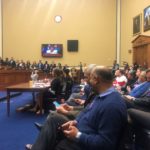
When the bill was introduced, then-Oversight Committee Chair Elijah Cummings, a Democrat from Maryland, pledged his committee would hold a hearing and markup of the bill in 2019. Before he passed away, the oversight committee held a hearing on statehood in September, with Norton chairing it and lines snaking around the building for entrance into the hearing room. This was the first time the House held a hearing on statehood since 1993 (though the Senate held one in 2014). After Cummings died in October, Maloney, a New York Democrat, assumed leadership of the oversight committee. She said on Thursday that she is committed to working with Norton until HR 51 passes.
The majority of local statehood advocates are careful not to present the issue as a partisan one, despite the domination of Democrats among D.C.’s voting population. Beverly Perry, a senior advisor to Bowser who is heading up the mayor’s statehood efforts, said in 2017 that “I don’t take it for granted that our two senators would be Democrats.”
But Republicans by and large aren’t buying it. With few exceptions, they oppose to the measure, often citing the intent of the founding fathers or, more recently, corruption scandals involving former Ward 2 Councilmember Jack Evans as justification. However, former Ohio governor John Kasich put it plainly during his presidential run last term in an interview with the Washington Post, calling D.C. statehood “just more votes in the Democratic Party.”
Bowser took on that argument during her testimony before the House Oversight Committee in September. “It is true that we are more brown and more liberal than some of you, but denying statehood would be unfair no matter who was affected,” she said. “It should not matter what our politics are or what yours are.”
Some national progressive advocates are in favor of framing D.C. statehood as a liberal prerogative and a way to make the Senate more representative of urban centers. “Two decades of framing this as a moral issue and not as a partisan one has not paid any meaningful dividends,” David Faris, author of It’s Time to Fight Dirty: How Democrats Can Build a Lasting Majority in American Politics, told Washington Monthly.
While D.C. residents overwhelmingly voted in favor of statehood in 2016, a Gallup poll released over the summer shows that 64 percent of Americans overall don’t think D.C. should be a state.
When the House last voted on D.C. statehood in 1993, it was defeated 277 to 153.
This story has been updated with quotes from Thursday afternoon’s announcement.
There’s No Paywall Here
DCist is supported by a community of members … readers just like you. So if you love the local news and stories you find here, don’t let it disappear!