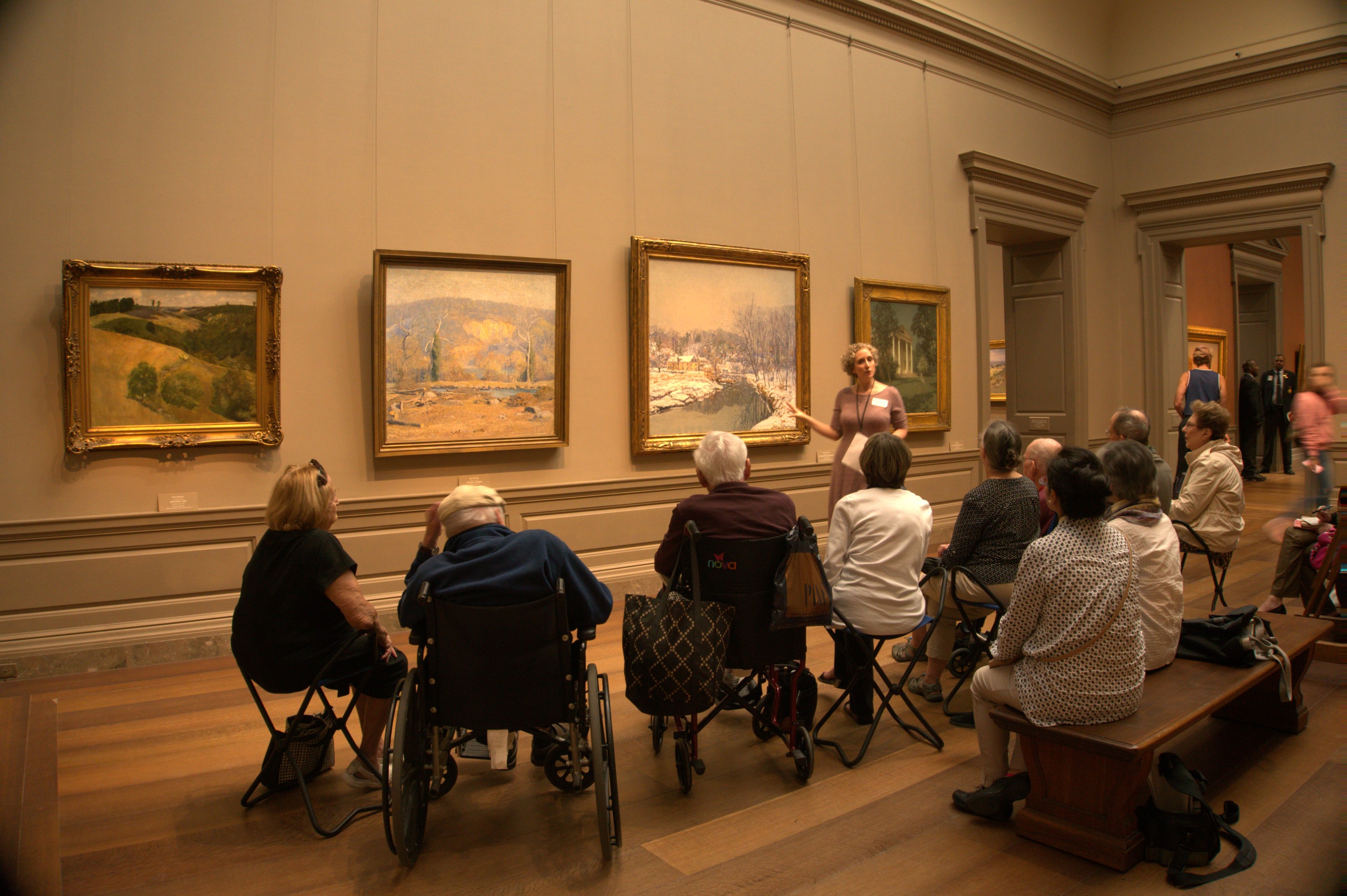
On an unseasonably warm Monday in February, a dozen people with memory loss and their caregivers entered the National Gallery of Art and were transported to the tundra. There was snow; there was ice. There needed to be a hot-chocolate stand, one person said—or a wine bar.
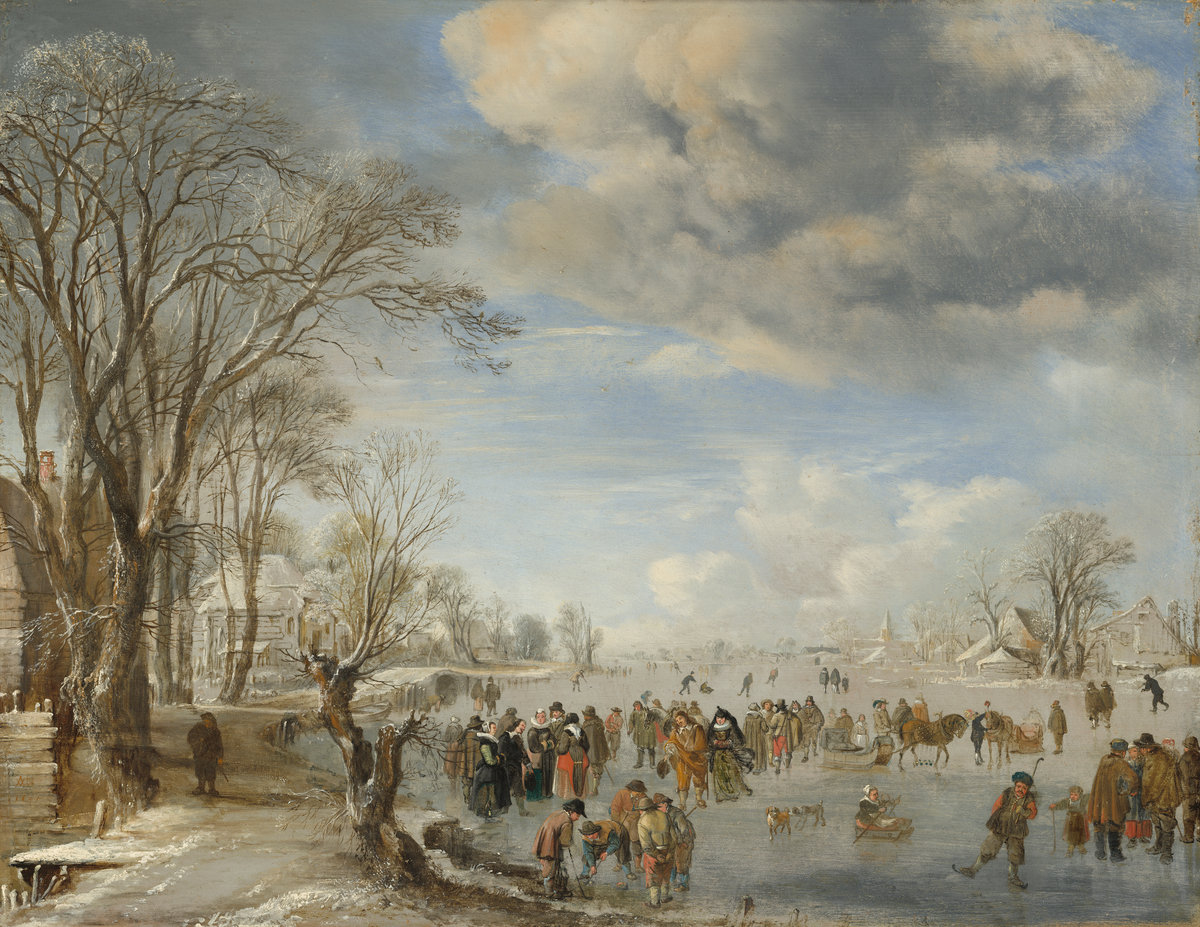
The men and women, many graying, sat in three rows of folded chairs in front of Aert van der Neer’s “Winter in Holland: Skating Scene,” a 1645 oil painting. For 30 minutes, museum educator Meagan Estep asked the group questions about the piece and how it made them feel.
One woman noticed a prancing horse; another pointed out that some of the figures standing on van der Neer’s frozen body of water were wearing boots, not ice skates. When Estep asked participants what they thought the weather was like, a chorus of voices rang out: “cold.” “Before global warming,” one woman retorted, eliciting chuckles from her peers.
An attendee who had spent time in Ontario lent her perspective on the chilly scene; a former Boy Scout recalled the time he fell into a frozen lake. The group had a spirited discussion about that special anticipation before a snow storm, and the puff of air they’d create by exhaling in the cold.
They laughed often. And then they moved on to the next painting.
The tour is the latest edition of “Just Us at the National Gallery of Art,” an opportunity for people with memory loss—and their caregivers—to explore beautiful art. During twice-monthly, 90-minute sessions, museum facilitators lead small groups through two to three paintings, with ample time to meditate on and then discuss the works. Since its inception, the NGA reports that nearly 2,000 patrons have attended 178 tours, though many are repeat visitors.
“We wanted to create a space where folks can connect with art, with the museum, with us, and with each other,” says Lorena Bradford, the museum’s head of accessible programs. “Art is such an opportunity: It’s a universal language. There’s a lot of power in inviting folks who aren’t traditionally part of the museum audience and saying, ‘We want you here. We want to learn from you, as well.’”
Bradford developed the program—which is free but requires advance registration—in 2017 with the assistance of Carolyn Halpin-Healy, the New York-based executive director of Arts & Minds. The not-for-profit organization aims to improve quality of life for people with Alzheimer’s and other dementias, and for their care partners, through contact with art—and, specifically, meaningful engagement in museums. Halpin-Healy trained staffers at the National Gallery of Art on designing a program that caters to the forgetfulness that patients of dementia might experience, as well as the problems with attention, language, visual and spatial perception, motor function, and learning.
“Museums are social spaces,” Halpin-Healy says. “There’s a tremendous capacity for supporting human dignity just by walking in the door, and taking part in the wider world of art and ideas.”
The goal is for sessions to be “completely open, completely exploratory,” Bradford says. Spending 30 to 45 minutes with each piece allows sufficient time for people with memory loss to absorb the art and articulate their feelings; almost all share their thoughts or ask a question during the experience. “There was always a gentleman who looked like he was half asleep, but when somebody would ask what he thought about [the art]—well, he had been paying attention,” recalls Bill Fanning, who’s attended numerous times with his wife. “Like a lot of things, it’s like looking through the fog—after a little while, you see things you didn’t see before.”
At the end of the program, attendees are sent home with prints of the art they studied, a memento that many say they display in their homes and keep for years.
The need for a program like “Just Us” is growing: Around 5.8 million Americans are living with Alzheimer’s disease, which is the most common type of dementia, according to the Alzheimer’s Association. By 2050, that number is projected to jump to nearly 14 million. There’s no cure for dementia, and more than 16 million Americans are unpaid caregivers for people with the disease.
It’s difficult to overstate the value of “being in an environment where everybody is in the same boat,” Fanning says. “You may be sitting on different seats in the boat, higher or lower, but you’re in the same boat.” No one is “special.”
Research suggests there are ample benefits to programs like “Just Us,” including improved well-being, stress relief, and reduced feelings of social isolation. Facilitators never ask participants to try to remember something, but often, the experience triggers memories.
“Art and music have a capacity to unlock parts of the brain that might be affected by diseases like dementia and Alzheimer’s,” Bradford says. Museums are places of knowledge, expertise, and aesthetic enjoyment, Halpin-Healy adds, and the hope is that participants leave on a high note. Even if they can’t remember what improved their mood, science suggests it will remain elevated, “and that comes from a sincere and deep social sharing of art,” Halpin-Healy says.
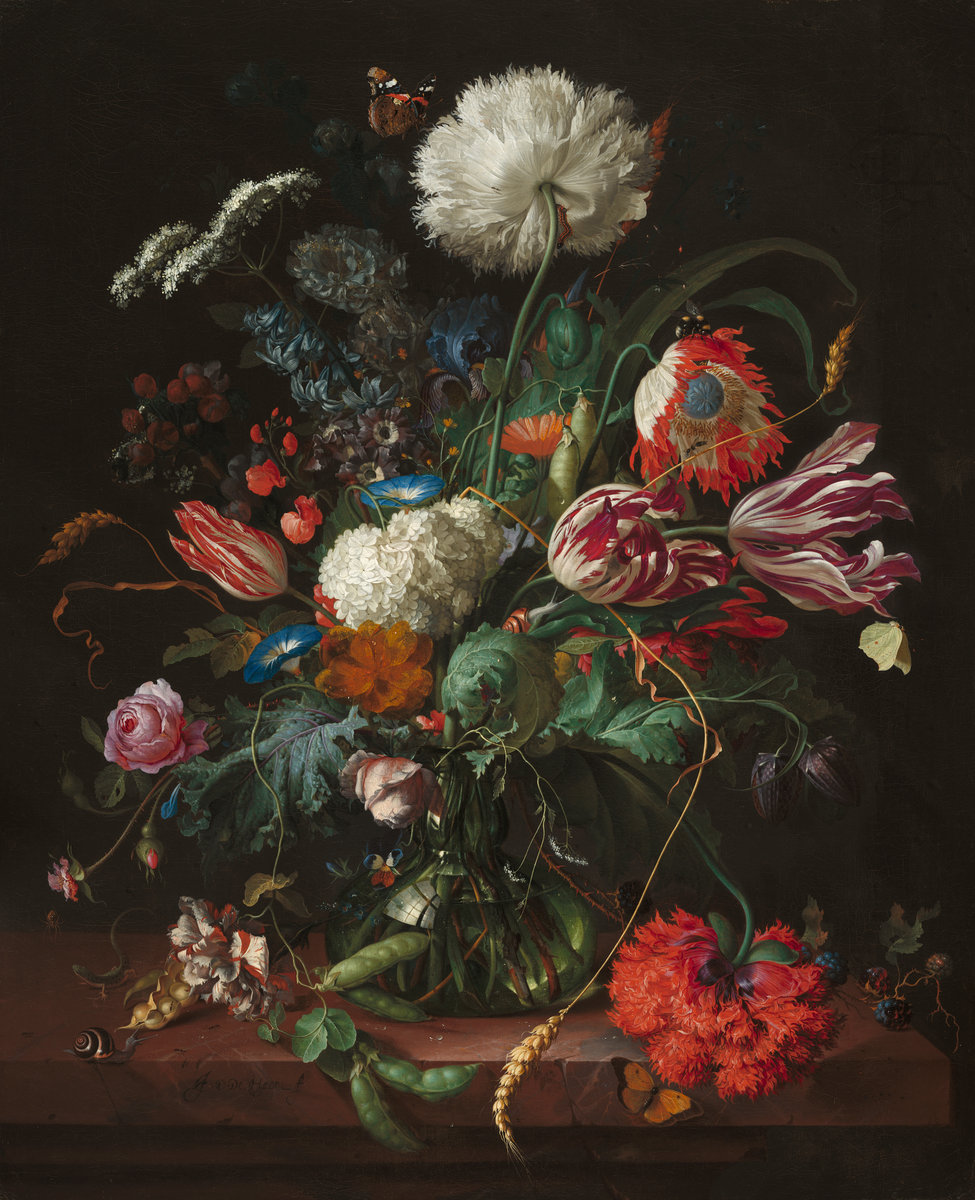
There’s a different theme each time, which helps make the program more cohesive for participants. The early February session focused on nature in Dutch art, and after analyzing van der Neer’s painting, the group moved on to Jan Davidsz de Heem’s “Vase of Flowers.” It’s an explosion of many types of flowers and plants that would not be in season at the same time. “It’s like life—messy and disheveled,” one woman remarked during a debate about the painting’s symbolism.
Fifteen minutes before parting ways, each couple received a felt board and Ziploc bag stuffed with materials: green felt leaves; red, blue, and yellow flower buds; thin brown string that made a convincing trunk or stem. After creating a bouquet, they shared their work. “Flower Song,” one couple titled their project. “Vase No. 1.” “Posies.” “Copy Cat.” “It’s Our Painting and We Can Do What We Want.”
Elizabeth Gill, whose husband was diagnosed with dementia about 10 years ago, wasn’t at the February session but has attended often. She marvels at the museum’s ability to create a program that’s interesting for people both with and without cognitive impairment. “It is such a gift to all the participants, and it’s so needed,” she says. “It’s a break from your daily routine, it’s a group of people who understand what you’re going through, there’s no shame, there’s no embarrassment, and there’s time for those with dementia to express themselves and get drawn out.”
“Just Us” is intended to benefit caregivers like Gill as much as the attendees with memory loss. “When they’re in the art museum and having a conversation about a work of art, it neutralizes a lot of the conversations that might happen at home when a husband or wife hasn’t signed up to take care of their loved one who has this scary diagnosis,” Bradford says. “That’s why we call it ‘Just Us.’ It’s not medication reminders; it’s not doctor appointments; it’s not the diagnosis at all. It’s about the work of art and whatever it evokes for us.”
Nancy Roderer, whose husband was diagnosed with dementia in 2012, says the best advice she ever got about coping with the disease was to live in the moment. “Just Us” facilitates that, she points out—people with dementia and their caregivers don’t know what the next moment will be like, let alone the next month or year. The program provides a rare, valued opportunity to think about art and nothing else.
Roderer’s husband is now in special care and can’t travel to the museum, but both she and Gill attend a spin-off program Bradford created for caregivers whose spouses are no longer able to attend. “It’s a treat, and in the life of a caregiver, you treasure treats,” she says. “It’s something I can do for myself—go and think about art for an hour. It’s quite a lovely thing.”
As Fanning adds: “It’s really good for the soul, and good for the brain, and good for everything else.”
There’s No Paywall Here
DCist is supported by a community of members … readers just like you. So if you love the local news and stories you find here, don’t let it disappear!