Elliot C. Williams
As D.C. February gets further underway with no sign of truly cold weather in sight, the city’s plants (and its people) appear to be feeling a little confused.
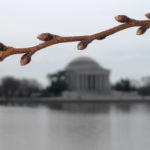
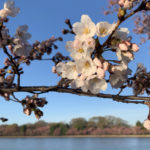
Washingtonians have spotted some early cherry blossoms blooming over the past few weeks, causing concern about the iconic Yoshino cherry trees that line the Tidal Basin and the National Mall. The city was gifted the trees from Japan in 1912, and an entire Cherry Blossom Festival has sprouted up around them, scheduled to begin this year on March 20.
But some are wondering how the mild winter and the already-blooming trees will affect the peak bloom date, when 70 percent of the Yoshino Cherry blossoms along the Tidal Basin and the National Mall are open. When the flowers peak too early, creating a “false spring” effect, a sudden cold snap in March can cause serious damage to the blossoms, as was the case in 2017.
I drove by the National Mall today and saw some of the cherry trees blossoming. It is February!! @capitalweather is this cherry blossom season going to be a wreck?
— Tamara Keith (@tamarakeithNPR) February 14, 2020
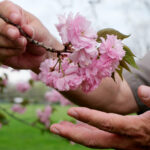
But don’t freak out just yet: “The Yoshino trees—which make up about 70 percent of the population and are what we track for peak bloom each year—have not yet begun the bloom cycle,” says National Park Service spokesperson Mike Litterst. The blossoms people are seeing (primarily on the Washington Monument grounds) are the Higan Cherry Trees, or the autumn flowering trees. Higans produce buds and white flowers off and on during a warm autumn (or particularly mild winter) and then fully flower in the spring.
Similar early blooms have caught vigilant D.C. residents off guard in recent years, so this is nothing new. But while there’s not reason for alarm just yet, Litterst says that this mild winter weather could still have an effect on the Yoshino trees.
“Given how mild the winter has been so far, it would come as no surprise if the trees blossom earlier than the April 3 historic average peak bloom date,” says Litterst.
The earliest peak bloom came in 1990, when the trees had fully blossomed by March 15. It’s still too soon to determine just how early this year’s peak bloom will be, but forecasts have #BloomWatchers looking at a late March date.
Right now, Washington is having the sixth warmest winter on record to date. With an average temperature of 50.4 degrees, per the National Weather Service, Washington weather has been most similar to Atlanta’s typical climate. Because of global warming, such warm winters are becoming more commonplace.
In some parts of the Southeast, spring has come as early as four weeks ahead of schedule—the earliest spring in 39 years—according to the USA National Phenology Network, which tracks the status of spring throughout the country.
Theresa Crimmins, the network’s director, says that the models haven’t been as severe in the Mid-Atlantic just yet, but research shows the early flowering of cherry blossoms in the Tidal Basin is an indicator of climate change more broadly.
In case that makes you as depressed as it makes me: here’s a guide to taking a pretty blossom picture.