Matt Blitz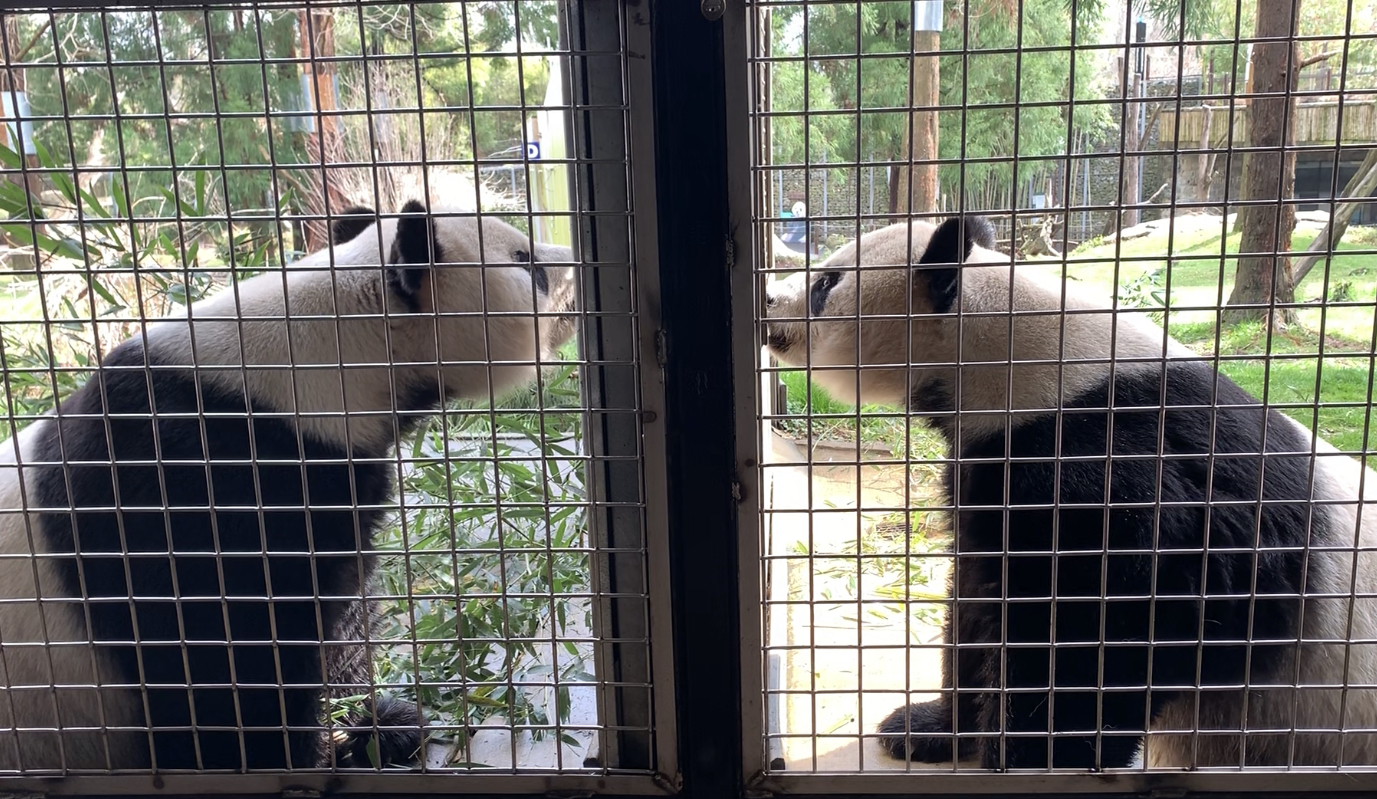
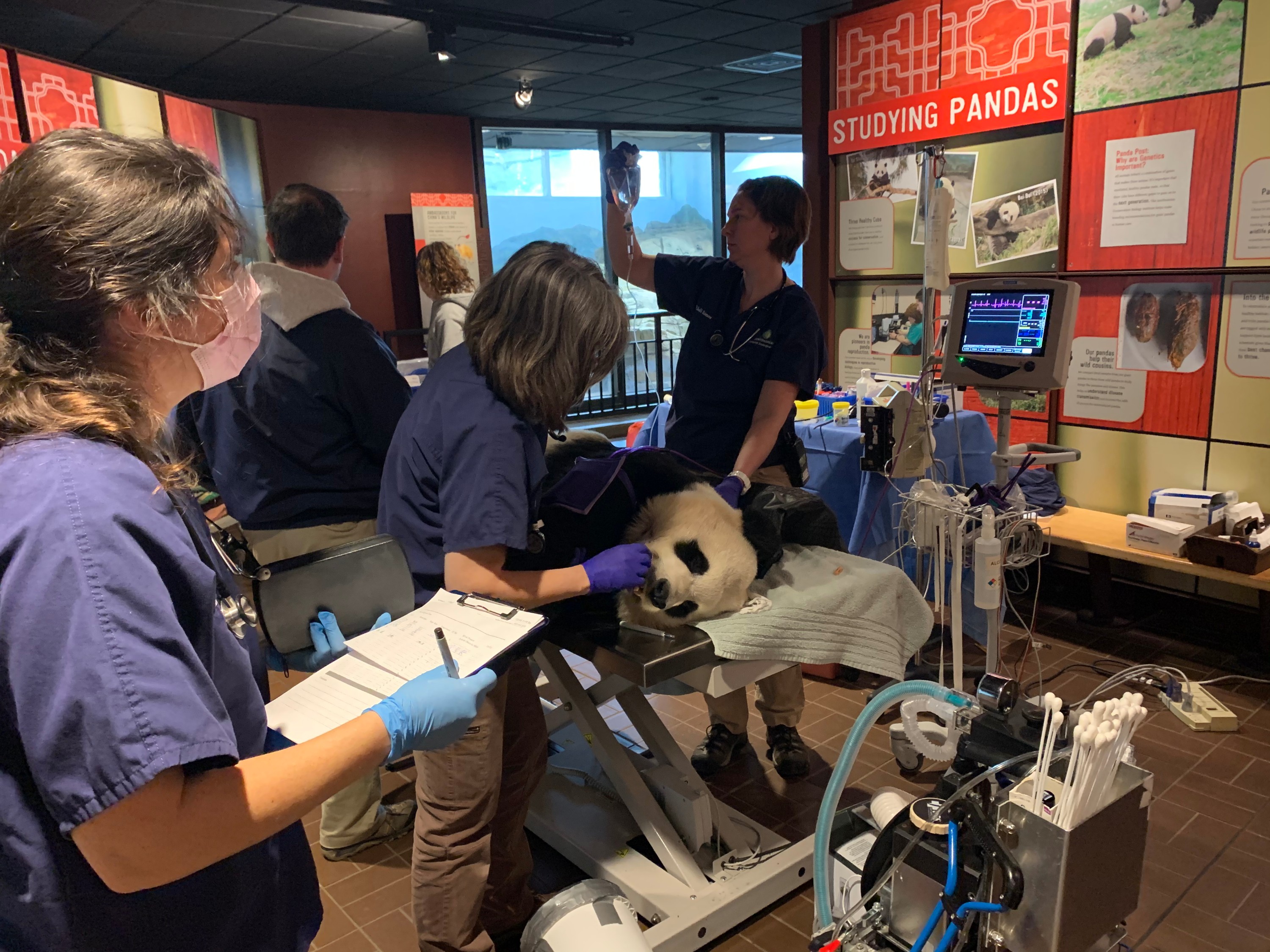
Time doesn’t stop for a pandemic, and neither do the reproductive cycles of pandas. On Sunday morning, the team at the Smithsonian’s National Zoo artificially inseminated their 21-year-old panda, Mei Xiang.
Female giant pandas are only able to become pregnant for 24 to 72 hours each year, so the National Zoo had little choice than to proceed using the frozen semen of their 22-year-old male panda Tian Tian.
“We have a large role in saving the giant pandas,” the National Zoo’s Asia Trail and Giant Panda curator Michael Brown-Palsgrove tells DCist. “So, we felt like, after consulting with our Chinese colleagues, that taking this step right now was so critical… despite the challenges.”
Amid the COVID-19 outbreak, significant precautions were taken by the National Zoo during the artificial insemination procedure to limit person-to-person contact. Equipment and medical supplies were laid out in advance and the number of staff present was cut.
The team also decided to use a frozen sample from Tian Tian that had been collected in 2015. Brown-Palsgrove says collecting a fresh sample would have required anesthetizing both pandas, which would mean additional staff. (Frozen samples have proven to work in the past.)
Right as the National Zoo and the Smithsonians shut down to the public amid a series of state of emergency declarations, Mei Xiang started to get a bit restless. She began walking backward with her tail up, “scent-marking,” and playing in water. She was also vocalizing with “bleats and chirps,” all signs of impending ovulation.
On the other side of the “howdy window,” Tian Tian took notice and started vocalizing back. “There are hormones in the air,” said Brown-Palsgrove.
Mei Xiang began positively responding to Tian Tian’s attention over the weekend, another sign she was ready to breed. Through further analysis, the zoo discovered that she was getting close to ovulating and her extremely short pregnancy window was about to open.
Pandas generally ovulate in the spring, from about February to May. The timing of Mei Xiang’s current ovulation falls almost exactly a year from her last ovulation. At 21, the giant panda is nearing the end of her reproductive life cycle, though some female pandas have cubs into their 20s.
Bei Bei, Mei Xiang’s last cub, left D.C. in November (along with a ton of snacks) for his new home in China, as part of the National Zoo’s panda lease agreement. Mei Xiang’s first surviving cub, Tai Shan, left in 2010 and her second, Bao Bao, departed for their ancestral home in 2017.
It will take a few months for the National Zoo to know if the artificial insemination worked. While Mei Xiang hasn’t had a successful pregnancy since 2015 (pseudopregnancies are fairly common in giant pandas), the team hopes to give people something to look forward to.
“With what’s going on in D.C. and the rest of the world right now,” says Brown-Palsgrove, “we would be so happy to share the birth of a panda.”