Colleen Grablick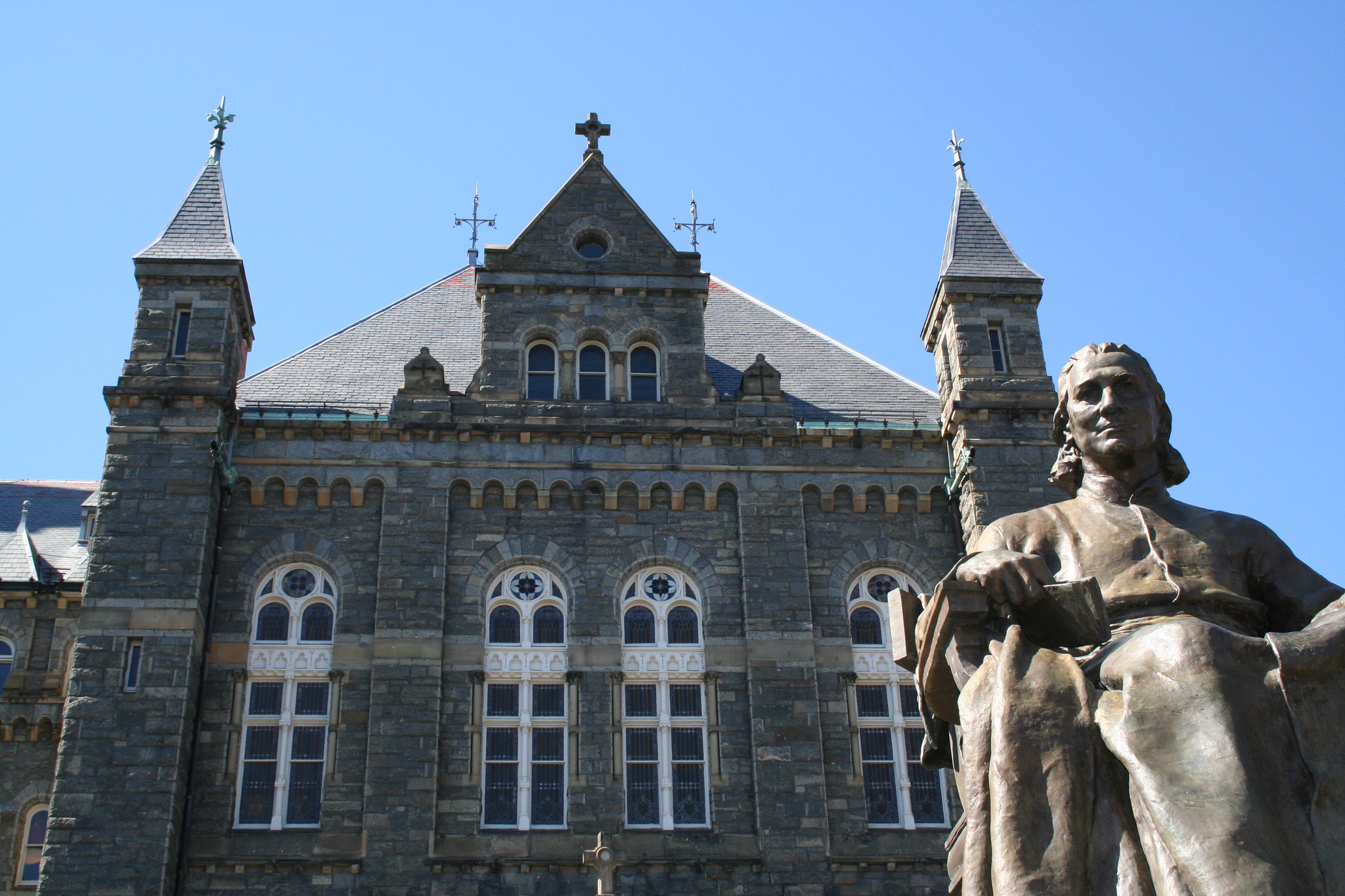
Last Friday, Georgetown junior Nicolo Ferretti boarded an almost empty bus to New York City.
Ferretti, Georgetown’s student body president, had just packed up his on-campus dorm room, and moved his items into the student association office on campus, after the university announced it would be cancelling all in-person classes for the remainder of the semester and asked students to move out by Sunday, March 22.
He was one of five passengers on the bus to New York City from D.C.—everyone was wearing a mask. When Ferretti arrived at Penn Station, ready to catch an Amtrak back to his hometown in Red Hook, New York, the normally buzzing hub in the middle of the city was eerily quiet. “It really did feel like the apocalypse,” he says.
Ferretti is one of thousands of college students across the District whose educations have been disrupted amid the coronavirus pandemic. Forced to make journeys back to their hometowns due to campus closures, or struggling to find places to live if home isn’t an option, students’ lives changed in a matter of days.
All of D.C.’s universities have all transitioned into online-only classes for the remainder of the semester, and are asking that students move out of on-campus housing.
These situational burdens vary student by student, with hometowns, fields of study, and differing financial situations creating obstacles for area undergraduates. While some students face shaky wifi connection or technically-challenged professors, others are confronting new schedules and a completely different curriculum.
Casey Chambers, a sophomore international studies major at American University, has spent the past week sheltering-in-place in his hometown Moraga, California after moving out of his campus dorm-room. Due to the time-zone difference, Chambers attends a class at 5:10 in the morning through the online platform Zoom.
“I try to keep a regimented schedule,” Chambers says. “Being on the West Coast but having classes on East Coast time, I have to wake up around 5 a.m. and I’m in class until 11 a.m. But it’s still not as bad for some people I know who are living in the Philippines or Japan, and they’re going to class at awful hours, like 3 a.m.”
For students whose majors aren’t conducive to online learning, the sudden closure has disrupted nearly every aspect of their educational experience.
American University senior and education major Tessa Bratton was in the middle of her student-teaching position at Key Elementary School in D.C. when both her university and the D.C. Public School system shut down. Currently living with her boyfriend in Arlington after leaving her on-campus dorm, Bratton is logging into Zoom to talk to students who have computer access and completing supplemental materials provided by the university to fulfill her graduation requirements. But Bratton says that she’s anxious about beginning her career as a teacher without the full student-teaching experience.
“I think for me what’s scary is all of the unknowns,” Bratton says. “All of my plans are now gone, and no one really has any answers right now. [When the school closed] I started thinking about my major, that I won’t see my students again in person, or I might not get those experiences I really need for my career. It’s kind of selfish thinking about those things when other people’s situations are worse, but I think it’s also valid to be sad about the things you’re missing out on.”
The disruption of the staples of college living, like living in a dorm, the luxury of attending a class in-person, and the loss of a community of peers has made the new reality of existing in the coronavirus pandemic stressful for some students, who are struggling to navigate their academics with mounting anxiety about the state of the world.
Isabel Suarez, a junior at the University of Vermont, moved into to her childhood home in Northwest D.C. after her spring break, instead of returning to her off-campus apartment in Vermont. As a social work major, Suarez says that she feels unproductive attending classes via Zoom, when her course-work is typically rooted in field-experience and hands-on interactions with people in need.
“I feel this incredible burden of wanting to be a student towards making change and healing people who have been harmed, but right now it just feels like the whole world has been harmed so much in one swift motion,” Suarez says.
She says that focusing on class work during a global pandemic, when every bit of normalcy has been removed from daily life, poses a huge burden that is hard to manage on top of academics.
“My brain feels close to bursting,” Suarez says. “School feels besides the point right now. I wake up and read the news for two hours straight because there’s so much going on, and so much upheaval. It feels like you’re trying to focus on 10,000 things at once. Stress and frustration have been the big emotions these past ten days.”
Some universities in the area are allowing students to take classes as pass-fail to accommodate for stress of moving and transition online, but for some seniors, regardless of what steps the universities take to ease students’ anxieties during this tumultuous time, there’s little to be done that can ever bring back the final months of their college careers. Guthrie Edson, a senior business school student at George Washington University, was devastated when GW announced it would be cancelling its annual commencement ceremony on the National Mall. Yesterday, university officials postponed the commencement officially until May 2021.
“I still really can’t find words for it,” Edson says about leaving his dorm on the Foggy Bottom campus, and returning to his childhood home in Falls Church. “I had a lot of really big plans for the next two months, and commencement was a really big part of it. I don’t want to call it grief, but I did lose something. I lost two months of things that were going to be really big memories and there’s nothing that can make up for that.”
Edson has found focusing on classes difficult, and instead has found comfort in working remotely for his internship with a mental health nonprofit Active Minds, which is targeted towards advocating for young people and students across the country.
“I feel like I am kind of doing my peers a service by doing this work during this time, targeted towards students,” says Edson. “That has been an an escape for me, because I get to work with group that really is for students.”
As student body president, Ferretti says for the past two weeks he’s been holding online meetings with university officials and other student leaders, in attempts to institute new policies and services for students during the time of upheaval. A group of Georgetown students launched Student Advocates for COVID-19 Response, a coalition advocating for student’s needs and creating a platform for students to communicate with their student government and university officials.
Ferretti says the GroupMe, the online messaging group, for the coalition now boasts over 900 students, and leaders are continuously updating the student government’s social media with petitions and letters advocating for student’s needs as they transition out of in-person learning and on-campus living.
“The GroupMe has been huge in terms of advocating for students,” Ferretti says. “This is incredibly chaotic: everything from the financial burden of having to move out, to the financial burden of having to set yourself up with a work area at home, to the psychological burden of having to re-do your projects in a way that you can submit them online. It’s hard, so we’re making sure that administrators understand these needs of students.”
With so much uncertainty, students are relying on their friends and campus communities, whether through social media or virtual meetings, to provide momentary relief from newfound loneliness, and isolation.
In addition to listing students’ concerns, Georgetown’s Student Association has posted light-hearted resources on social media for students as they quarantine in a new space, like a “Quarantunes” playlist with up-beat pops from artists like Lizzo and Doja Cat. Campus organizations have been hosting online hangouts, meetings, and happy hours, and school’s meme Facebook group has been more active than ever, according to Ferretti.
“One of the positive outcomes of this crisis is how much students have been able to come together and support each other—it’s been beautiful,” Ferretti says. “It’s a renaissance period for the meme group, it’s a golden age … The best humor comes at the worst times, maybe.”
Both Edson and Suarez say that they’ve been making daily efforts to enjoy fresh air and stay connected with their peers from campus. Edson has started taking walks in the parks around his home, helping his family cook dinner, and writing letters to his friends.
“What’s really anchored me is talking to my friends, and trying to maintain laughter and comedy in this time,” Suarez says. “We are all going through this very horrific, uncertain, but human experience together. I’ve seen so much solidarity among the youth right now, so I’m really just trying to hold on to threads of hope.”
Now back in D.C. during peak bloom, Suarez has taken the time to appreciate the beauty of the cherry blossom trees on her street, despite only viewing them through her in window.
“I’m so lucky that I have a place in my childhood home to fall back on,” Suarez says. “I’ve just been trying to be grateful that the trees still bloom.”