Almost overnight, coronavirus forced D.C.’s breweries to flip the switch on how they do business.
When local governments ordered bars and restaurants to limit their operations to take-out last week, the decrees shocked small businesses across the region, triggering widespread layoffs. At brewpubs and taprooms, skeleton crews are now turning company vans and Honda Civics into delivery vehicles. Some of them are also waiting for back-orders of crowlers that may not arrive until late April.
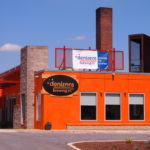
“It’s been a crazy two weeks, it feels like two years,” says Emily Bruno, a cofounder of Denizens Brewing Company in Silver Spring, Maryland. “We’re doing okay right now as long as we’re able to operate with the changes in place.”
Like other breweries in the area, Denizens is doing what it can to adjust to all the disruptions caused by the spread of coronavirus. The brewing company has been monitoring the novel virus for the last two months and had the foresight to set up a beer-delivery service on March 13, Bruno says.
“We essentially, in 24 hours, put together a new business model,” she explains. The company pretty much had to: After Maryland Governor Larry Hogan recently ordered establishments to close to on-site patrons, demand for draft beers evaporated.
To keep taps and revenue streams flowing, Denizens pivoted to selling packaged products and temporarily shut down its Riverdale Park taproom. The brewery is using Uber Eats to deliver food while its sales staff and events manager run deliveries with the company van. When they have an abundance of orders to fill, Bruno takes her own Honda Civic to drop off beer in what she calls “a totally contactless way.” Customers can hold their IDs up to her window when she arrives at their homes.
“Everybody is a jack of all trades,” Bruno points out. “Whatever position they were hired for, that’s not what we’re doing now. My general manager is calling orders, people have pivoted, and we’re taking it day by day.”
Bruno is still crunching numbers to see whether Denizens may eventually have to take out loans. For now, the deliveries are buoying a core team of 10 people, though she still had to furlough 30 workers.
At Supreme Core Cider, a Northeast brewery located near the National Arboretum, cofounder Will Sullivan has kept his three cider-making employees and 14 front-of-the-house staff busy by turning to deliveries and take-away orders. He’s already looking at expanding hours, including by opening earlier on weekdays to capitalize on the emerging trend of virtual happy hours.
“Right now, revenues are down for everyone,” Sullivan says. “We’re trying to shift around our resources, we’re in that period of adjustment. We’ve got a staff we want to keep together and occupied and employed.”
Supreme Core isn’t alone in making changes to survive. At Hellbender Brewing in Northeast’s Lamond Riggs neighborhood, owner and brewmaster Ben Evans has abandoned kegs and pint glasses. He’s one of the many brewers who’ve stocked up on 32 oz. crowlers—cans considered less virus-prone than traditional growlers.
Evans was lucky enough to buy a crowler-sealing machine last July and replenish another half-pallet of crowlers about a month ago. When he sought more of them last Monday, his supplier told him they’re on back order until mid- to late April.
“The crowlers are quickly becoming the hand sanitizer and toilet paper for brewers,” says Evans. “We sanitize the crowlers, drip-dry, and then fill them and seam them up. They’re not only more sanitary than a growler, they’re less of hassle.”
Still, Evans says he’s somewhat worried about the brewery’s supply chains. Hellbender stocked up on hops to get through a slower period and just received 10,000 lbs. of grain. That shipment is about two-thirds the amount of what the business normally buys.
Other breweries in the area have relaxed or paused production for fear they might overproduce draft beers that would go bad in a month or two. Although Ivy City-based Atlas Brew Works has an ample supply of hops, CEO Justin Cox is wary about other elements of the brewing process.
“We don’t want to overproduce, but another big ingredient is yeast,” Cox says. “It’s living—and how do we keep it healthy?”
As brewers wait out the slump, some are considering lagers over ales. That’s because lagers can take up to six weeks in a fermenter, versus as little as two weeks for ales, usually making them more difficult to justify producing for small operators.
Red Bear Brewing Company in NoMa might end up brewing a lager since it has the tank space and time, says cofounder Bryan Van Den Oever. Meanwhile, his customers have been ordering jello shots and cocktails to go, like the “Hurricane Bryan,” a rum-based Moscow mule infused with Asian pea flower.
“When you order it here it looks blue, and because of the citrus it turns purple like magic,” Van Den Oever notes. “But now [that] it’s in the [to-go] cup, you don’t see the magic.”
Over in Shaw, Midwest-expat bar Ivy and Coney is selling sealed containers of beer: full kegs of them. The keg sales were primarily a joke, says co-owner Josh Saltzman. He warns that unless someone has a kegerator—a refrigerator made specifically for kegs—the kegs are probably not worth it; however, should anyone place an order, please abstain from using the keg for a crowd.
“This is a social-distancing keg, this isn’t about throwing a party,” Saltzman says. “This is about supporting our staff. If you want to hang onto this for when this nightmare is over, go ahead.”
Saltzman spoke with DCist from Tanzania, where his wife works on malaria prevention. He now faces the effects of a growing virus back in D.C., where he’s had to lay off his entire staff of 15, including 10 part-time employees. To adapt to the new reality, Ivy and Coney started delivering food and drinks via Grubhub—something now allowed under District law—only to stop days later. In the meantime, the bar’s owners are offering pickup through its website and working out a plan to hire some of its workers back as part-time delivery staff.
“Every day I wait for my business partners to wake up, we have a quick phone call or we text and [are] like, ‘Okay, what’s the game plan for today?’” Saltzman says. “Literally every day has been different. We’re changing up the offerings for delivery, hearing best practices, hearing what the government has to say.”
Ivy and Coney’s to-go orders have taken on a kind of ingenuity perhaps seen only during strange times. According to Saltzman, one customer ordered a pizza and a bottle of Old Overholt rye, which the customer promised to share with his wife. “We had somebody [else] who got a Detroit pizza, two cans of Strohs, and two shots of Malört that we have in a sealed container in a very fancy plastic ramekin,” the co-owner adds.
Even if the coronavirus crisis drags out for months, the bar is sitting on 35 bottles of Jeppson’s Malört. This should be enough to deliver a taste of Chicago for a while. “Malört we’re good on,” Saltzman says. “We’ve got enough to get us through one or 2.5 apocalypses.”
This post has been updated with new information about Ivy and Coney’s takeout offerings.