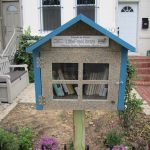
As the coronavirus began to spread in D.C. and getting groceries became a challenging chore for many, Chhaya Rao decided that her little free library might serve better as a little free pantry.
“I wanted to create a space for people who don’t feel comfortable going to the grocery store,” said Rao, a former English teacher who now works in educational assessment.
She posted a sign on her library, which is painted the same indigo as her AU Park house: “Please prioritze neighbors with greater need and vulnerability,” it reads in part, and promises, “We’ll get through this together.”
Rao is far from alone in her instinct to use little free libraries as a form of help and community connection during a difficult period of social distancing. So many people have been doing it, in fact, that the Wisconsin-based Little Free Library non-profit has posted a national map of all the LFLs offering groceries and supplies. (There have also been people who used their libraries this way even before the pandemic).
But as the coronavirus spreads in communities across the country, the organization—and individual little free library owners themselves—have had to grapple with the possibility that their instinct to help could be harming people instead. The little libraries, touched over and over again by passersby taking or leaving items, are potential vectors of disease.
The organization’s website advises: “ .. it’s safe to use Little Free Libraries as long as you are not witnessing an outbreak in your community … if your community is a hotspot for coronavirus activity, you should temporarily suspend service at your library.”
The website also informs that some of the libraries’ stewards—its name for their owners and caretakers—have decided to shut theirs down during the pandemic. If stewards opt to keep libraries open, the non-profit suggests ways to sanitize them.
Individual little free libraries are built on private land and planted on the property of their owners, who decide for themselves whether to keep them open or shut them down as the pandemic spreads.
But some people say the decision should be obvious. Because the virus may live on hard surfaces for up to three days, those little libraries pose a risk, they argue. As one reader wrote on Popville: “Might be a good idea to encourage people to avoid the little free libraries. I know everyone is about to be bored out of their mind and stir crazy but safe is better than sorry!”
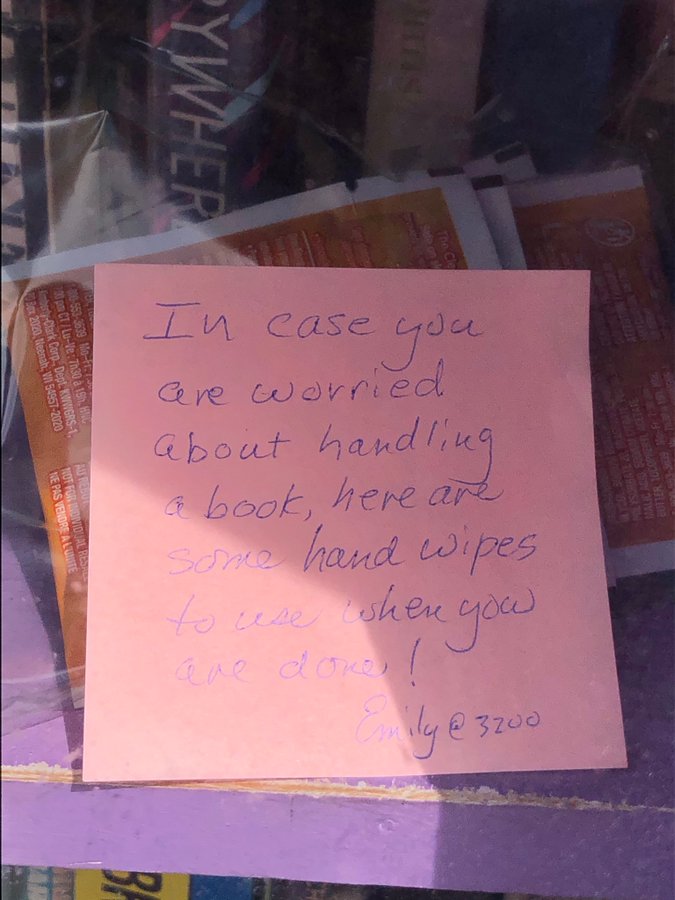
That same post included a photo of a little free library in Mt. Pleasant where someone had left a few sanitizing wipes along with a note that reads: “In case you are nervous about handling a book, here are some hand wipes to use when you are done.”
Rao considered that her little free library could spread the novel coronavirus. But she decided that her neighbors were using it carefully, and seemed to be heeding the precautions she listed on the sign she posted on her library, including: “Please avoid touching the pantry door unless leaving or taking items” and “Please avoid touching the items more than absolutely necessary.”
Rao says she plans to keep her pantry open as long as the pandemic lasts.
Wendy Hammond decided to shut hers over the weekend.
In Hammond’s little pantry, in front of her house by the Potomac Avenue Metro Station, there have never been any books. She placed it in her front yard in November to provide food, hygiene products and paper goods to whomever might need them in her rapidly gentrifying neighborhood.
As the coronavirus spread, unemployment spiked, and people began to fear bumping into others in grocery stores, her “Blessing Box,” as she calls it, began to empty more quickly — every day as opposed to every other day.
“Yes, it’s empty. It fills up and it gets emptied right away . . . By 8 p.m. tonight this stuff is going to be gone,” she said last week, looking over the pantry as she spoke with a reporter on the phone.
Mindful of how the coronavirus spreads, she wore gloves to stock it. And every day she dipped a clean rag into a bowl of hot water and Clorox and wiped the whole pantry down.
“Are people worried about touching it? No one has brought that up,” Hammond said.
But just days after initially speaking with a reporter, Hammond suddenly changed her mind, shutting her little pantry down and texting that she was worried about it spreading the virus.
Amanda Farnan does not own a little free library, but she passes them all the time on her runs around her Shaw neighborhood. Brainstorming ways to help her neighbors as the coronavirus spreads illness, anxiety, and fear, she made the little libraries part of her plan.
For more than three weeks Farnan has been stocking two little free libraries with food and other necessities, from granola bars to baby wipes, that others may have trouble finding or buying during the coronavirus pandemic.
“There’s so much we can’t control right now,” said Farnan, who works for an internet start-up. “These little free libraries are a way to keep a piece of what’s normal.”
Farnan has also thought about the two little libraries she stocks as potential virus-spreaders, so she’s taking her own precautions, wearing gloves and leaving only what she can wipe down— wrapped granola bars and packages of chips, for example.
She said she tries to restock the libraries she’s adopted every two days or so, dropping off items on her morning runs. One day recently she noticed that someone had left sanitizing wipes in one of them. She thought the whole container would soon be gone, but was surprised to find that, over the course of a week, people seem to be taking “just one or two at a time”—only what they needed to to use the little library safely.
Farnan’s efforts inspired a friend, Cara Hill, to start stocking a U Street area little free library that stands in front of a school she often walks past.
“When I can get out to the stores, I pick up some extra things,” said Hill, an ultrasound technologist at Children’s National Hospital. “I’ve been trying to do it at least once a week.”
Hill said she realizes that some people might shy away from little free libraries for fear that they could contract the coronavirus by picking up a book, pack of pretzels, or roll of toilet paper. But working in a hospital, she said she knows how to keep the little library as clean as she can, and always brings hand sanitizer or wipes on her re-stocking runs.
She also points out that there seems to be a real demand for everything she places on the library’s shelves.
“As long as the owners [of the little free libraries] are taking precautions and the people who are taking and giving to the libraries are taking precautions, then I think it’s okay,” she said.