Elliot C. Williams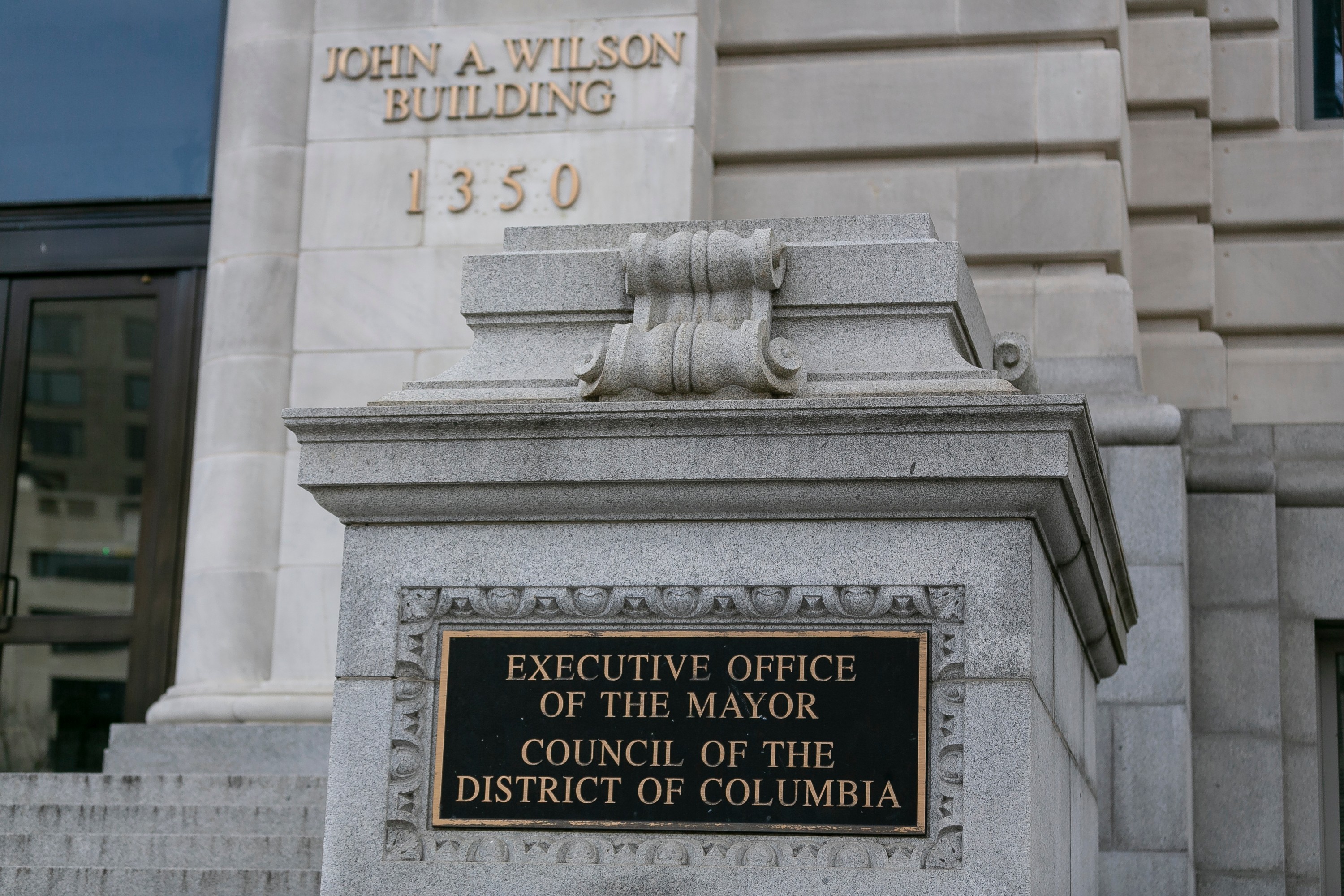
D.C. Mayor Muriel Bowser on Thursday presented highly anticipated recommendations from a task force she commissioned to figure out how best to reopen the city amid the coronavirus crisis. Barring any major peaks in the number of COVID-19 cases, the District could kick off a phased reopening as early as May 29, Bowser said.
In preparation for such a reopening, the mayor said D.C. will bulk up its testing efforts next week. She said she would make a final decision May 26 about whether to keep the May 29 date for the first phase of the reopening.
According to the ReOpen D.C. advisory group’s 80-page report (which we’ve summarized here), a phase-one reopening would allow certain businesses to resume operations, including barbershops and hair salons, both by appointment only. Restaurants could provide service for outdoor seating, while non-essential businesses, such as bookstores and florists, could offer curbside delivery. The latter allowance would expand on a city pilot program that launched this week.
The group’s co-chairs—former National Security Advisor Susan Rice and former U.S. Secretary of Homeland Security Michael Chertoff—outlined the factors the District would consider in deciding whether to trigger the reopening plan, which has four phases. They include trends in the number of new COVID-19 cases, testing capacity, contact tracing, and the local healthcare system’s capacity for patients.
“These gating criteria are a gauge to determine the right time to proceed, and to recognize whether we need to dial back if it turns out that things take a turn for the worse,” Chertoff said. “Stage four is ultimately what we all hope for and long for, which is a vaccine that makes this problem totally recede.”
In phase one, in-person worship services could begin again with no more than 10 people at a time. Parks, fields, tennis courts, and golf courses would also reopen, but playgrounds, pools, gyms, museums, and summer camps would remain closed.
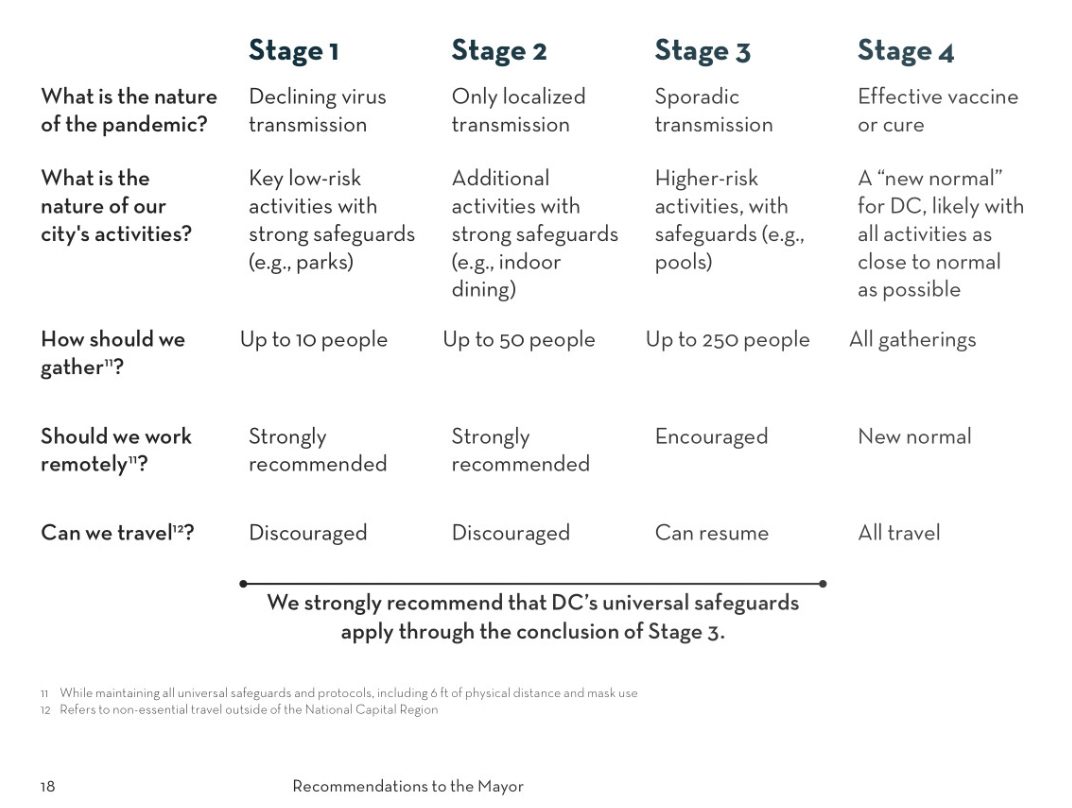
The task force recommends restricting “mass gatherings” to a maximum 10 people in phase one, 50 people in phase two, and 250 people in phase three. It also says people should remain six feet apart in public—a primary guideline for social distancing—until a COVID-19 vaccine becomes widely available. Telework is encouraged through phase three.
The plan goes on to outline what transitioning between the four phases would look like for education, business, public transit, recreation, and government services. It calls for restricted capacity and other safeguards at every stage, leading to a “new normal” in phase four.
“It’s not an on-and-off switch,” Bowser said at a press conference Thursday. “We will not be able to go back to life as we enjoyed it in February. But we are incrementally adding activities back in our lives, which we all miss and are all eager to get back to.”
The task force says it devised its recommendations based on more than 17,000 responses to a public survey, dozens of focus groups, interviews with community leaders, and virtual “town hall” meetings. More than 80 percent of the survey respondents expressed concern over the ability of “vulnerable communities” to reopen.
The plan comes as the District reported 237 new coronavirus cases Thursday, the highest number of new single-day cases since May 8. LaQuandra Nesbitt, the director of the D.C. health department, said this uptick stemmed from a testing-results backlog at a lab.
The city also saw an 11-day-decline in what officials refer to as “community spread.” The recommended phase-one reopening requires a 14-day decline in community spread, according to D.C. Health.
That metric tracks the “amount of virus circulating around the city” and reflects symptom-onset dates, but doesn’t include cases in congregate settings, such as homeless shelters, said Nesbitt. The curve of coronavirus cases that officials are watching is a function of a five-day rolling basis. The 14-day-decline countdown would reset on any day when the city’s number of cases surpasses two standard deviations from the predicted average.